
Now Reading: Binaural Beats and Neuroplasticity: Can Sound Influence the Brain’s Ability to Adapt?
-
01
Binaural Beats and Neuroplasticity: Can Sound Influence the Brain’s Ability to Adapt?
Binaural Beats and Neuroplasticity: Can Sound Influence the Brain’s Ability to Adapt?
The human brain is not static.
It constantly changes in response to experience, behavior, learning, attention, stress, and environment.
This ability to adapt is known as neuroplasticity.
In recent years, interest in neuroplasticity has expanded far beyond neuroscience labs.
People now explore everything from meditation and sleep optimization to focus training and brainwave audio in hopes of supporting healthier cognitive habits.
One topic that frequently appears in these discussions is the relationship between binaural beats and neuroplasticity.
Can sound actually influence the brain’s ability to adapt?
The answer is more nuanced than many internet claims suggest.
Binaural beats are not magical shortcuts that instantly “rewire” the brain.
However, sound environments may still play a supportive role in attention, focus routines, relaxation, and mental states that influence learning and adaptation over time.
🧠 What Is Neuroplasticity?
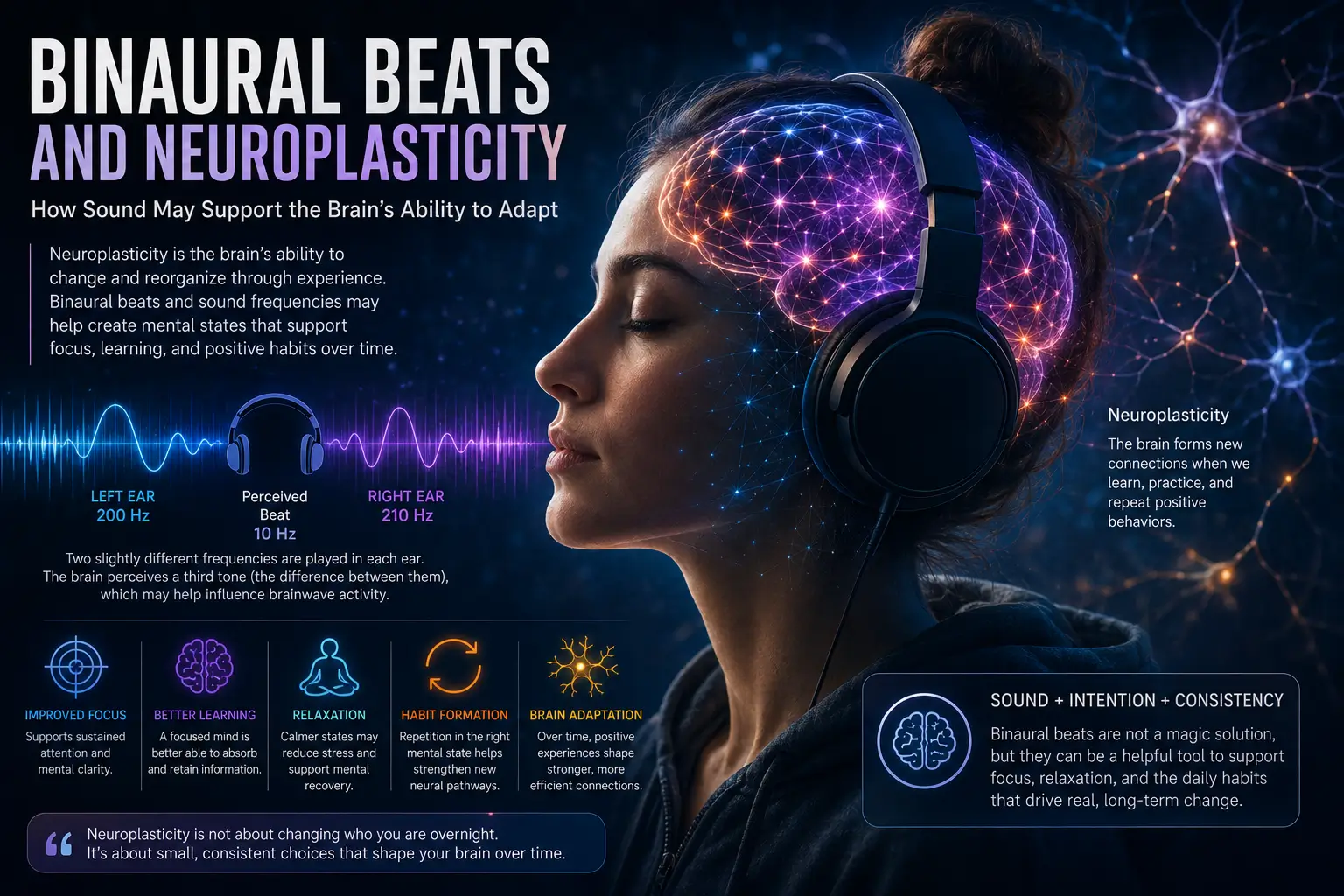
Neuroplasticity refers to the brain’s ability to change and reorganize itself through experience.
This process is involved in:
- learning new skills,
- forming habits,
- memory development,
- attention patterns,
- behavioral adaptation,
- and recovery from repeated experiences.
The brain constantly strengthens, weakens, and reorganizes neural connections depending on how it is used.
This means repeated behaviors and environments can gradually shape cognitive patterns over time.
Related article: The Science of Neuroplasticity.
🎧 What Are Binaural Beats?
Binaural beats are an auditory phenomenon created when two slightly different frequencies are played separately into each ear.
For example:
- the left ear hears 200 Hz,
- the right ear hears 210 Hz.
The brain processes the difference between them as a rhythmic pulse.
This effect is commonly associated with brainwave entrainment, where rhythmic sound patterns may influence mental states under certain conditions.
Related guide: Brainwave Entrainment Explained.
🌊 Why People Connect Binaural Beats With Neuroplasticity
The connection usually comes from one central idea:
The brain changes through repeated experiences and environments.
If sound environments influence attention, focus, relaxation, or mental habits, some people believe they may indirectly support conditions associated with learning and adaptation.
This does not mean binaural beats directly “rewrite” the brain.
However, they may potentially support mental states that make focused repetition and intentional habits easier to maintain.
And repetition plays a major role in neuroplasticity.
📚 Learning Depends on Repetition
One of the most important aspects of neuroplasticity is consistency.
The brain strengthens patterns that are repeated regularly.
This applies to:
- learning skills,
- building habits,
- attention routines,
- mental focus,
- and even emotional responses.
Many people misunderstand neuroplasticity as an instant transformation process.
In reality, meaningful adaptation usually happens gradually through repeated exposure and practice.
🎯 Focus and Attention Matter for Brain Adaptation
Attention strongly influences learning.
Scattered attention often weakens deep learning and memory formation.
This is one reason some people experiment with structured audio environments during:
- studying,
- deep work,
- meditation,
- creative work,
- or concentration sessions.
For certain individuals, consistent sound environments may help reduce distraction and create more intentional focus routines.
Related article: Best Binaural Beats for Focus and Concentration.
🧘 Relaxation and Mental Recovery
Stress and overstimulation can affect cognitive performance.
When the brain remains constantly distracted or overloaded, sustained concentration becomes more difficult.
Some listeners use binaural beats as part of relaxation or mental recovery routines.
This may include:
- calm focus sessions,
- mindfulness practices,
- deep breathing,
- or pre-sleep routines.
Relaxation itself does not automatically create neuroplastic change.
However, healthier mental states may support better learning conditions over time.
🧠 Brainwave States and Cognitive Function
Different brainwave frequency ranges are commonly associated with different mental states.
🔵 Beta Waves
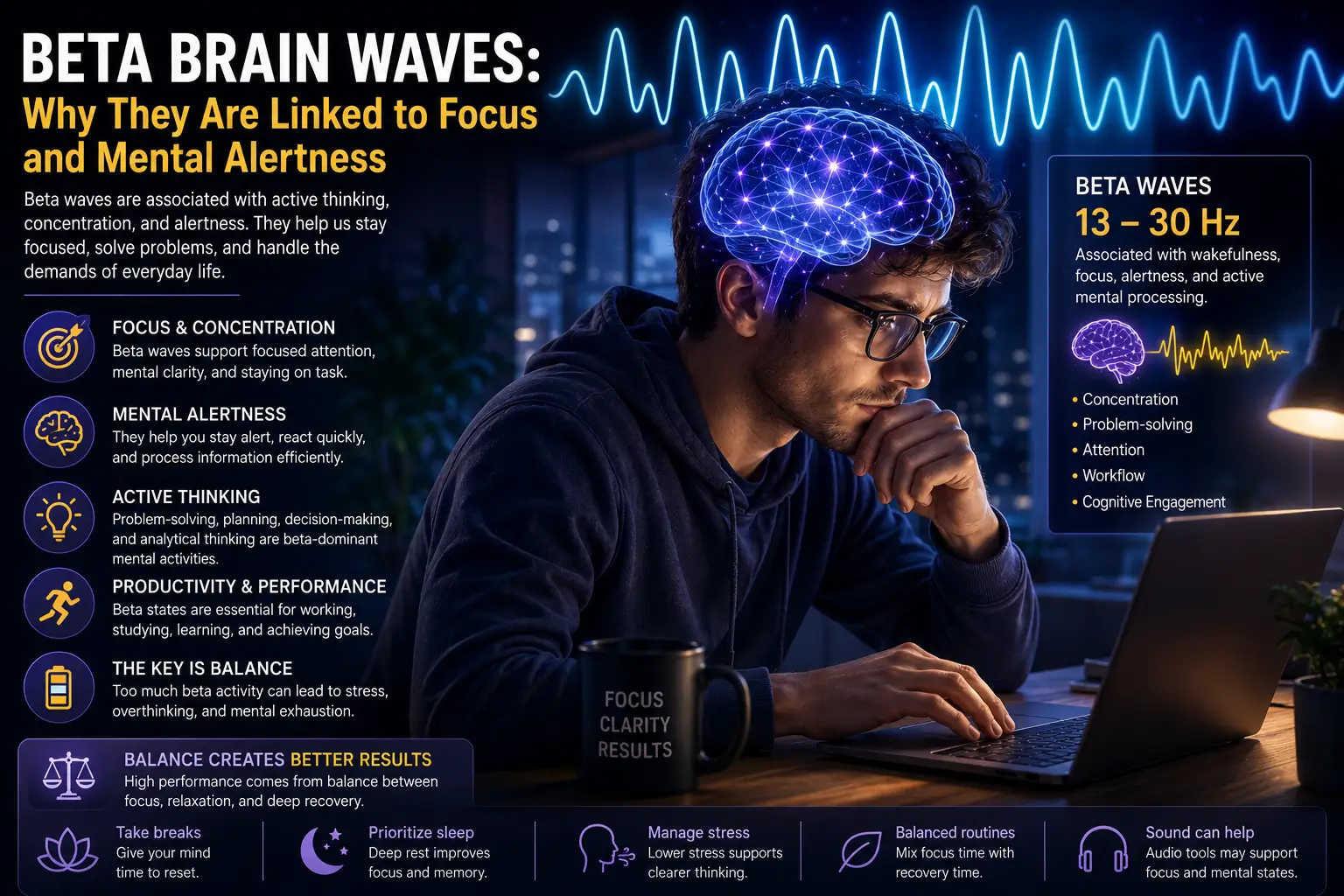
Often linked with active concentration and alert thinking.
Related guide: Beta Waves and Motivation.
🟢 Alpha Waves
Frequently associated with calm focus and reduced mental tension.
Related article: Alpha Brain Waves and Calm Focus.
🟣 Theta Waves
Often discussed in relation to meditation, creativity, and slower mental states.
Related guide: Theta Waves and Sleep.
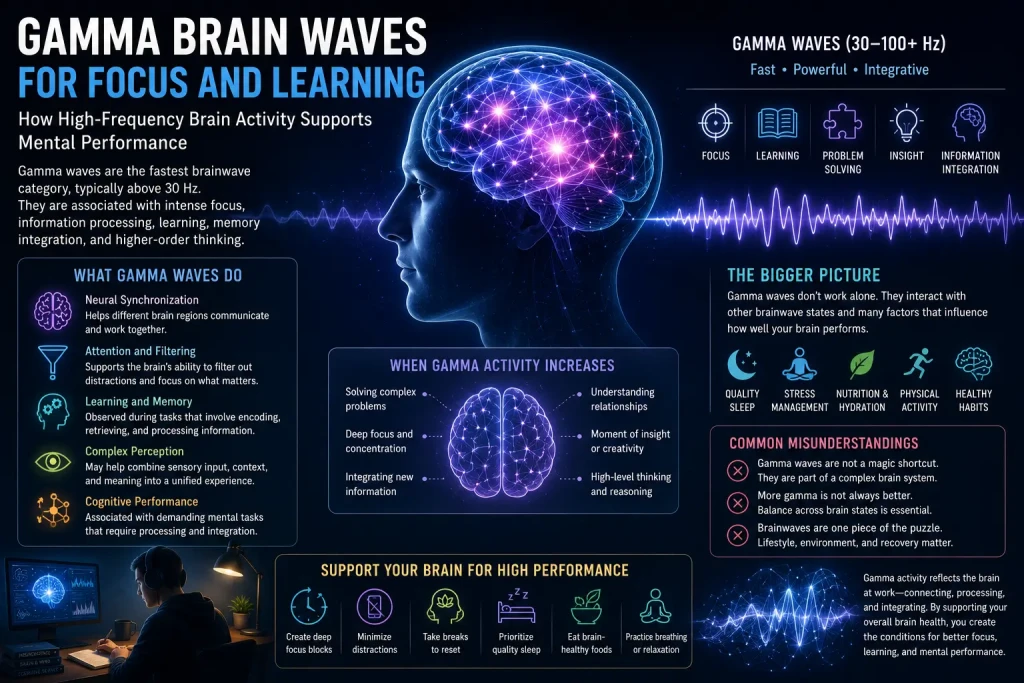
🟡 Gamma Waves
Commonly associated with complex cognitive processing and awareness.
Related article: Gamma Brain Waves and Cognitive Performance.
📖 What Research Actually Says
Research into binaural beats and brain function is still evolving.
Some studies suggest rhythmic audio stimulation may influence:
- relaxation,
- mood,
- attention,
- or stress reduction in certain situations.
However, scientific evidence remains mixed.
Results vary significantly between individuals.
Responsible discussions about neuroplasticity should avoid exaggerated claims such as:
- “instantly rewire your brain,”
- “unlock hidden genius abilities,”
- or “permanently transform your mind overnight.”
The brain adapts through repeated patterns and experiences over time — not instant miracles.
🎵 Audio Environments and Mental Habits
One practical benefit of structured audio environments is consistency.
The brain often responds strongly to repeated context and routines.
Some people use sound as a psychological cue for:
- deep work,
- creative sessions,
- study blocks,
- or meditation practice.
Over time, repeated association between a sound environment and focused work may itself become mentally reinforcing.
Some individuals also explore neuroacoustic audio environments designed to support focus, relaxation, and mental recovery routines.
These are generally most useful when combined with healthy habits and realistic expectations.
📵 Neuroplasticity Depends on Lifestyle Too
No audio technology can replace:
- sleep quality,
- movement,
- stress management,
- nutrition,
- consistent learning,
- or intentional focus habits.
Neuroplastic adaptation depends on broader behavioral patterns over time.
Healthy environments matter.
Repeated attention patterns matter.
Consistency matters.
🚫 Common Misunderstandings
❌ “Neuroplasticity Means Instant Brain Rewiring”
Real adaptation usually happens gradually.
The brain changes through repetition and experience.
❌ “One Frequency Permanently Changes the Brain”
The brain is far more complex than simplistic internet marketing claims suggest.
❌ “Audio Alone Creates Cognitive Transformation”
Environment, behavior, sleep, focus, and repetition all play major roles in mental adaptation.
🧠 Final Thoughts
Neuroplasticity reflects the brain’s remarkable ability to adapt through experience, attention, and repeated behavior.
Binaural beats are not magical shortcuts that instantly transform the mind.
However, structured sound environments may still help support focus, relaxation, consistency, and intentional mental routines for some individuals.
And over time, repeated mental environments and habits can influence how the brain learns and adapts.
The most realistic perspective is balanced:
lasting cognitive change usually comes from consistent habits, focused attention, healthy recovery, and long-term behavioral patterns — not instant miracles.
Related Articles
Related Posts
Stay Informed With the Latest & Most Important News
Previous Post
Next Post