
Now Reading: Brainwave States and Mental Performance: Focus, Creativity, and Attention
-
01
Brainwave States and Mental Performance: Focus, Creativity, and Attention
Brainwave States and Mental Performance: Focus, Creativity, and Attention
The human brain is constantly active.
Every thought, emotion, memory, and decision involves electrical activity moving through networks of neurons.
These electrical patterns are often grouped into what researchers call:
- brainwave states.
Different brainwave ranges are commonly associated with different mental conditions involving:
- attention,
- relaxation,
- focus,
- creativity,
- and sleep.
Interest in brainwaves has expanded rapidly online because many people are searching for ways to improve:
- productivity,
- concentration,
- mental clarity,
- and emotional balance.
But how much of the internet hype surrounding “brain optimization” is actually supported by neuroscience?
The answer is more nuanced than many dramatic claims suggest.
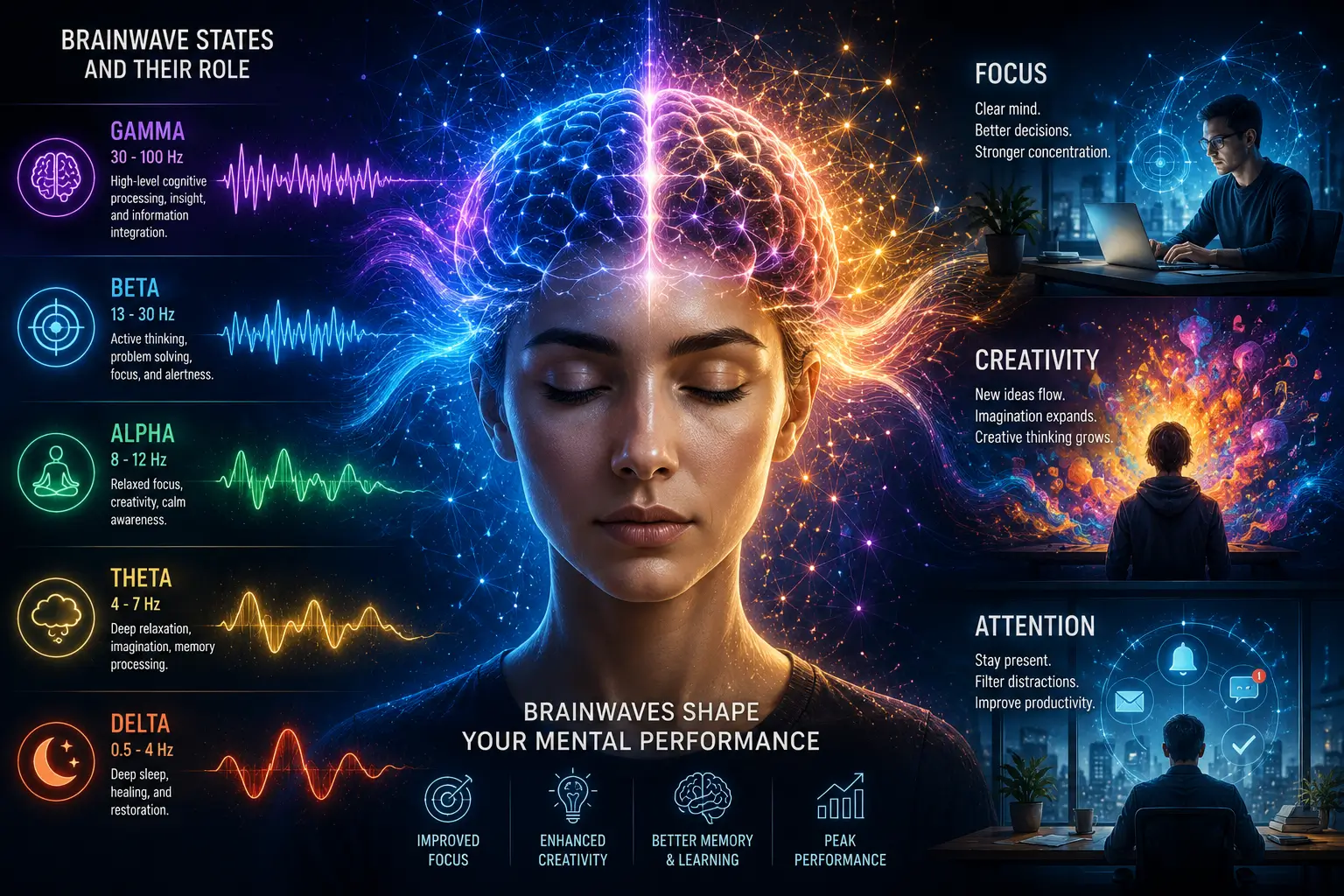
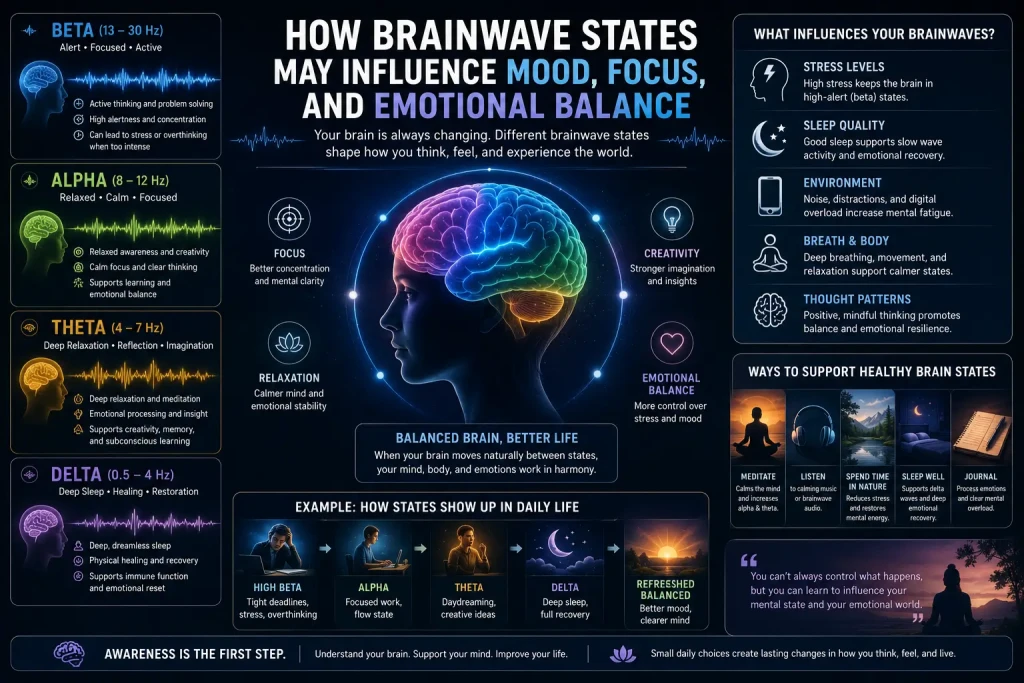
⚡ What Are Brainwave States?
Brainwaves are rhythmic electrical patterns measured in the brain using EEG technology.
Researchers commonly group brain activity into several frequency ranges, including:
- Delta,
- Theta,
- Alpha,
- Beta,
- and Gamma.
Each range is associated with different types of mental activity.
The brain naturally shifts between these states throughout the day depending on:
- attention,
- emotional state,
- sleep,
- stress,
- and sensory environment.
🌊 Alpha Waves and Relaxed Focus
Alpha brainwave activity is often associated with:
- calm awareness,
- relaxed attention,
- creativity,
- and mental flow states.
Many people experience stronger alpha activity during:
- meditation,
- quiet concentration,
- journaling,
- mindfulness,
- or calm creative work.
You may also enjoy our article on alpha waves and focus to explore how relaxed concentration environments are commonly discussed in neuroscience.
🔥 Beta Waves and Active Thinking
Beta activity is commonly linked to:
- alertness,
- active concentration,
- problem-solving,
- and external attention.
During work, conversation, studying, or decision-making, beta activity often becomes more dominant.
However, excessive mental stimulation and stress may also create prolonged high-alert states that contribute to:
- mental fatigue,
- distraction,
- and overstimulation.
💡 Gamma Waves and Cognitive Integration
Gamma brainwave activity is one of the most discussed topics in neuroscience-related internet content.
Gamma activity is often associated with:
- information integration,
- attention processing,
- memory coordination,
- and high-level cognitive activity.
However, many exaggerated “genius frequency” claims online go beyond current scientific evidence.
You can also explore our article on gamma brain waves explained for a deeper look at how gamma activity is discussed in modern neuroscience.
🌙 Theta and Delta States
Theta activity is commonly linked to:
- deep relaxation,
- imagination,
- meditation,
- and transitional mental states.
Delta activity is most associated with:
- deep sleep,
- recovery,
- and low-frequency restorative states.
These slower brainwave ranges are often discussed in sleep and relaxation-focused audio environments.
You may also enjoy:
theta waves and creativity and binaural beats for sleep to explore how slower-frequency environments are commonly used in relaxation routines.
🔬 What Science Actually Says
Research involving brainwave activity continues evolving.
Scientists study how neural oscillations may relate to:
- attention,
- emotional regulation,
- sensory processing,
- sleep,
- and cognitive coordination.
However, many internet claims involving:
- instant intelligence,
- “brain rewiring,”
- or guaranteed cognitive enhancement
greatly exaggerate current scientific understanding.
Further reading:
https://www.frontiersin.org/articles/10.3389/fnhum.2019.00425/full
https://www.ncbi.nlm.nih.gov/pmc/articles/PMC10198548/
The healthiest perspective is viewing brainwave discussions as part of broader neuroscience and mental-state research rather than magical shortcuts.
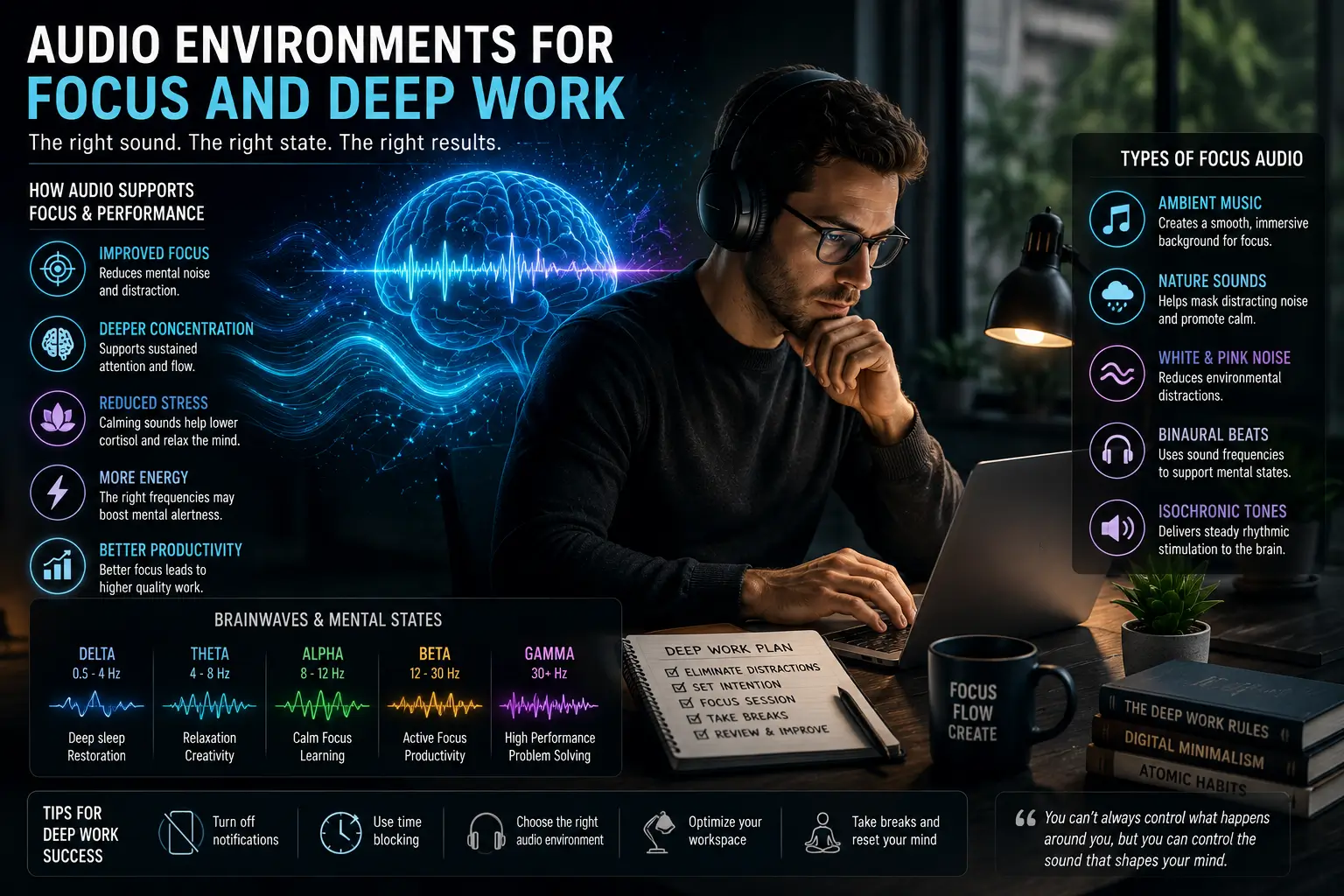
🎧 Audio, Environment, and Mental States
Some people use:
- ambient music,
- meditation audio,
- binaural beats,
- white noise,
- or rhythmic sound environments
to support:
- focus,
- relaxation,
- creativity,
- or mindfulness routines.
Certain structured audio environments may help reduce:
- distraction,
- sensory overload,
- and fragmented attention.
Some listeners also experiment with neuroacoustic audio systems designed to support calmer focus and mental clarity routines.
☁️ Why Mental Environment Matters
Mental performance is influenced by much more than a single frequency or productivity trick.
Factors that often affect cognitive function include:
- sleep quality,
- stress,
- emotional health,
- focus habits,
- sensory environment,
- and physical well-being.
This is one reason sustainable mental performance usually depends on broader lifestyle patterns rather than isolated “brain hacks.”
⚠️ Common Myths About Brainwaves
Myth:
“One frequency unlocks success.”
Reality:
Human cognition and emotional regulation are highly complex.
Myth:
“Brainwave audio permanently upgrades intelligence.”
Reality:
Current scientific evidence does not support extreme transformation claims.
Myth:
“Everyone responds identically to sound environments.”
Reality:
People react differently to music, audio stimulation, and sensory conditions.
🌍 Why Brainwave Topics Remain Popular
Interest in brainwave states continues growing because many people are searching for:
- better focus,
- emotional balance,
- reduced stress,
- improved sleep,
- and calmer mental environments.
In a world filled with constant digital stimulation, structured sensory environments may simply help people feel more mentally organized and emotionally grounded.
Final Thoughts
Brainwave states represent a fascinating intersection between:
- neuroscience,
- psychology,
- attention,
- emotion,
- and sensory experience.
Research suggests different neural patterns may relate to different mental conditions under certain circumstances.
At the same time, exaggerated “mind upgrade” claims should be approached carefully.
The most balanced perspective is viewing brainwave discussions as part of broader conversations involving focus, relaxation, creativity, and mental well-being.
Related Articles
Related Posts
Stay Informed With the Latest & Most Important News
Previous Post
Next Post