
Now Reading: Brain Waves Explained: The Complete Guide to Alpha, Beta, Theta, Delta, and Gamma States
-
01
Brain Waves Explained: The Complete Guide to Alpha, Beta, Theta, Delta, and Gamma States
Brain Waves Explained: The Complete Guide to Alpha, Beta, Theta, Delta, and Gamma States
The human brain is never truly silent. Every thought, emotion, memory, and action is accompanied by electrical activity generated by billions of neurons communicating with one another. These electrical patterns create rhythmic oscillations known as brain waves.
Modern neuroscience has shown that different brain wave frequencies are associated with different mental states. Some patterns are linked to deep sleep, while others support focus, creativity, learning, meditation, or peak cognitive performance.
Understanding brain waves provides valuable insight into how the brain functions and why certain mental states feel dramatically different from one another.
This guide explores the five major brain wave categories—Delta, Theta, Alpha, Beta, and Gamma—and explains how they influence daily life, productivity, relaxation, learning, and mental performance.
🧠 What Are Brain Waves?
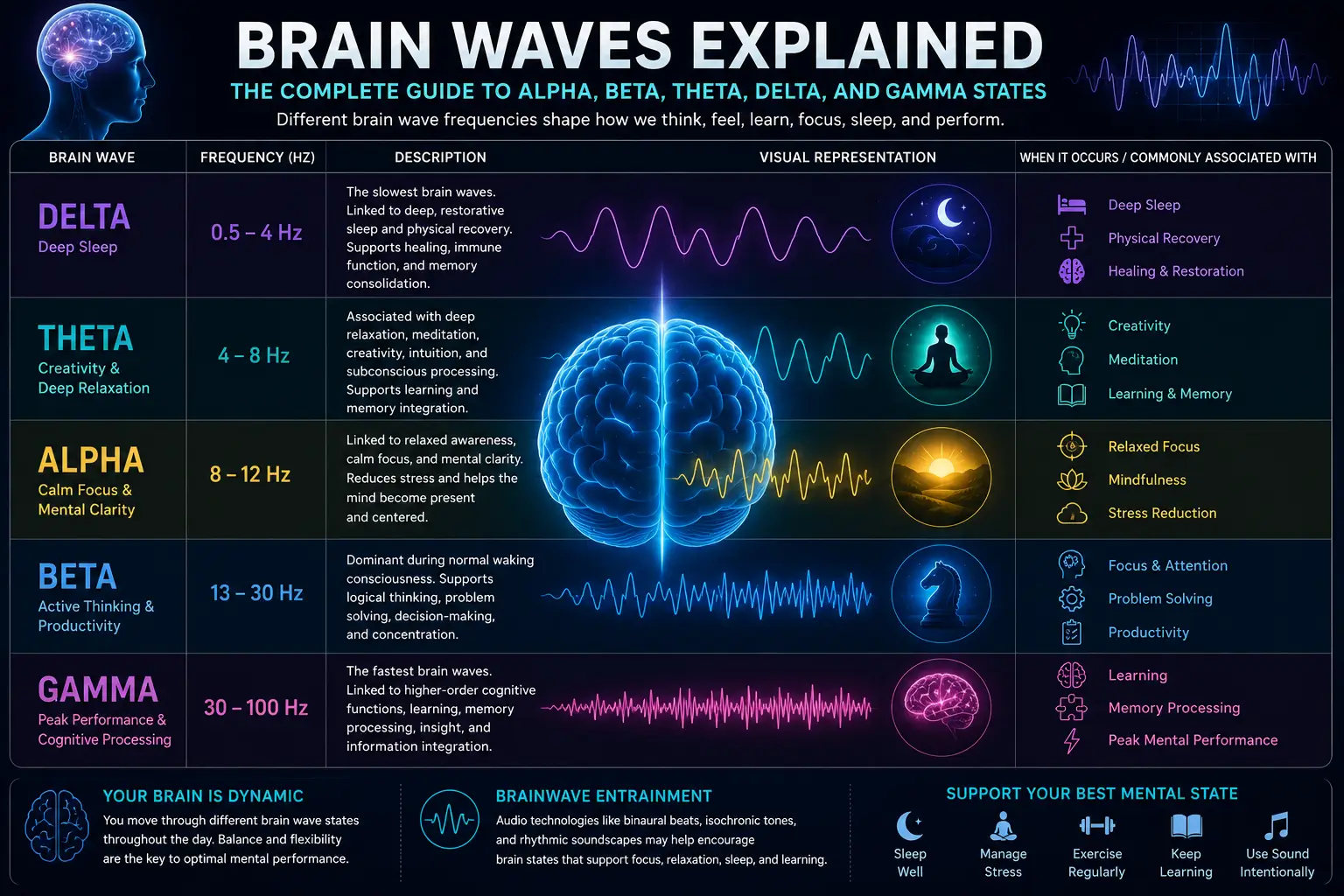
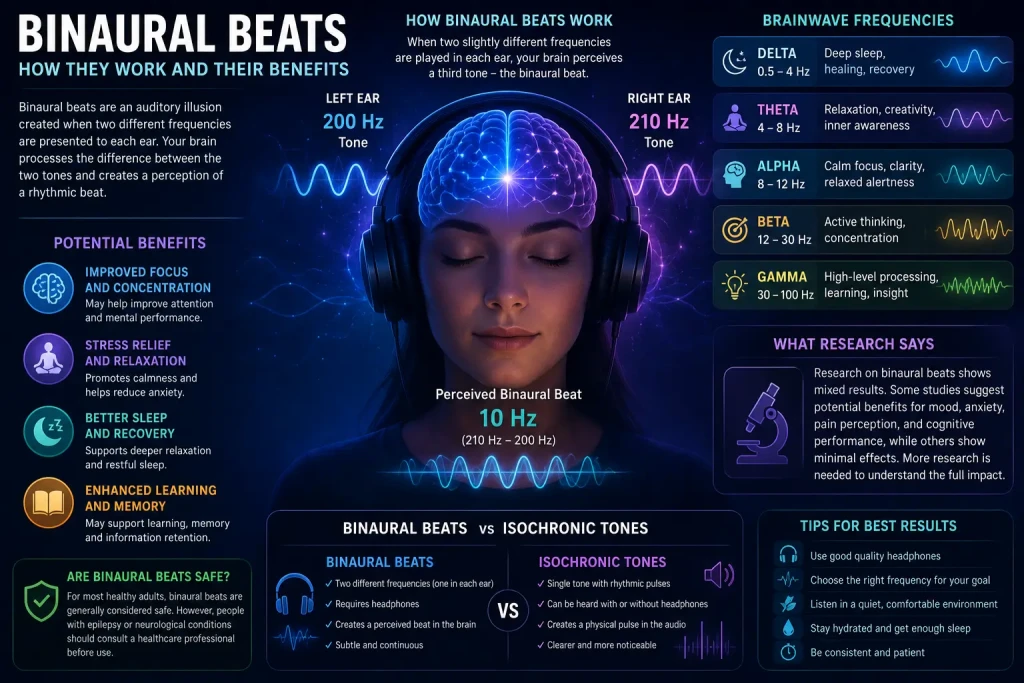
Brain waves are rhythmic electrical impulses produced when neurons communicate through electrochemical signals. These oscillations are measured using electroencephalography (EEG) and are classified according to their frequency, measured in Hertz (Hz).
Different frequencies tend to dominate during different mental and physical states.
- Delta Waves (0.5–4 Hz)
- Theta Waves (4–8 Hz)
- Alpha Waves (8–12 Hz)
- Beta Waves (13–30 Hz)
- Gamma Waves (30–100 Hz)
Although one frequency may dominate at a given moment, the brain typically produces multiple wave patterns simultaneously.
🌙 Delta Waves: Deep Sleep and Recovery
Delta waves are the slowest brain waves and are most commonly associated with deep, restorative sleep.
During delta-dominant states, the body focuses on physical recovery, tissue repair, immune system support, and hormonal regulation.
Researchers believe delta activity plays an important role in memory consolidation and overall brain health.
Delta waves are commonly observed during:
- Deep sleep
- Physical recovery
- Healing processes
- Growth hormone release
Related reading: Binaural Beats for Sleep
🌌 Theta Waves: Creativity, Intuition, and Deep Relaxation
Theta waves are frequently linked to daydreaming, imagination, creativity, and meditative states.
Many people naturally enter theta states during moments of deep relaxation, just before falling asleep, or immediately after waking.
Theta activity is often associated with:
- Creative thinking
- Visualization
- Meditation
- Emotional processing
- Internal reflection
Some researchers believe theta states may help facilitate learning and memory integration.
Related reading: Theta Binaural Beats
☀️ Alpha Waves: Calm Focus and Mental Clarity
Alpha waves occupy a unique position between relaxation and alertness. They often appear when a person is calm, focused, and mentally present.
Alpha activity tends to increase when external distractions decrease.
Alpha-dominant states are commonly associated with:
- Relaxed concentration
- Mental clarity
- Stress reduction
- Flow preparation
- Meditative awareness
Many people naturally experience increased alpha activity during mindfulness practices and quiet reflection.
Related reading: Alpha Waves
⚡ Beta Waves: Active Thinking and Productivity
Beta waves are commonly observed during normal waking consciousness.
When solving problems, making decisions, analyzing information, or concentrating on tasks, beta activity often becomes dominant.
Beta waves support:
- Focused attention
- Logical reasoning
- Decision-making
- Task execution
- Goal-directed behavior
While healthy beta activity is important for productivity, excessively high beta activity may sometimes be associated with stress and mental overload.
🚀 Gamma Waves: Peak Cognitive Processing
Gamma waves represent the fastest commonly measured brain wave frequencies.
Researchers have linked gamma activity to higher-order cognitive functions, including information integration, learning, memory formation, and complex problem-solving.
Studies suggest that gamma synchronization may help different regions of the brain communicate more efficiently.
Gamma waves are often associated with:
- Learning
- Memory processing
- Information integration
- Insight generation
- Peak mental performance
Related reading: Gamma Waves
🔄 Brain Waves and Everyday Mental States
Most people move through multiple brain wave states throughout the day.
| Mental State | Dominant Brain Waves |
|---|---|
| Deep Sleep | Delta |
| Dreaming | Theta |
| Meditation | Alpha / Theta |
| Relaxed Focus | Alpha |
| Problem Solving | Beta |
| Peak Learning | Gamma |
These transitions occur naturally and help the brain adapt to changing demands throughout the day.
🎯 Brainwave Entrainment: Can Sound Influence Brain States?
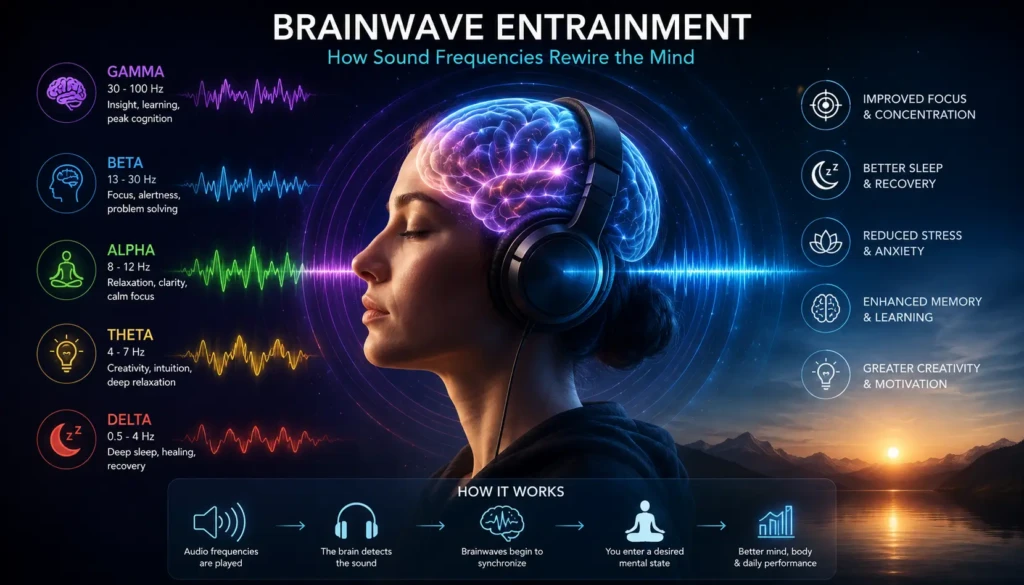
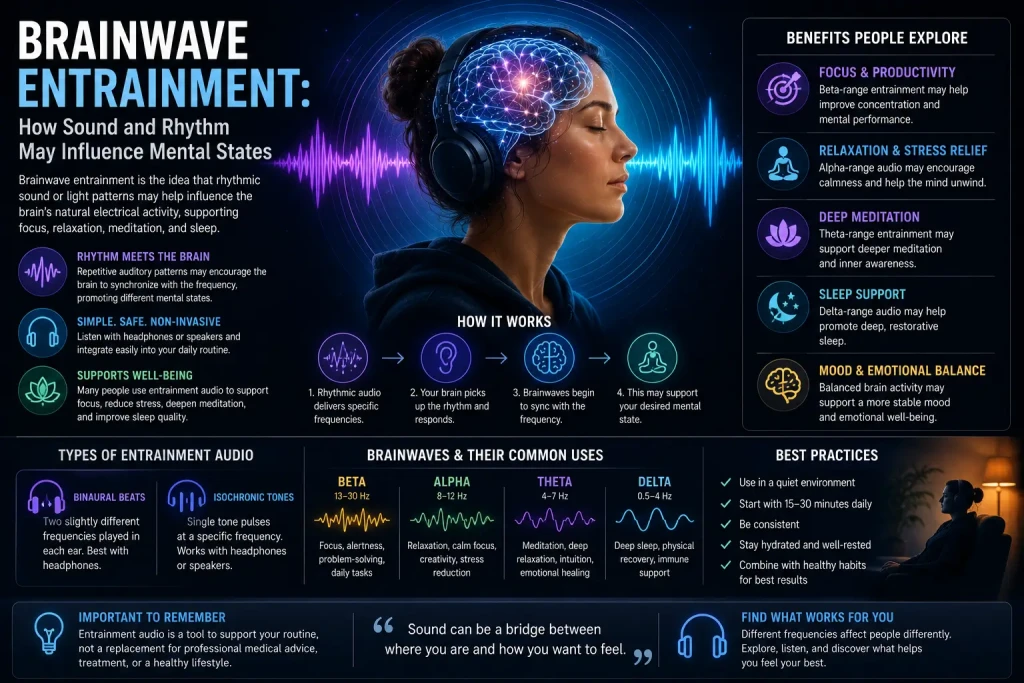
Brainwave entrainment refers to techniques designed to encourage specific patterns of neural activity through rhythmic stimulation.
Common approaches include:
- Binaural Beats
- Isochronic Tones
- Rhythmic Audio Stimulation
- Neuroacoustic Soundscapes
The goal is not to force the brain into a particular state but to provide rhythmic sensory input that may support desired mental conditions such as relaxation, focus, meditation, or sleep.
Related reading: Ultimate Guide to Brainwave Entrainment
🧬 Brain Waves, Neuroplasticity, and Learning
Brain waves do not operate independently from the brain’s ability to change and adapt.
Neuroplasticity allows neural networks to strengthen through experience, practice, and learning. Certain brain states may create favorable conditions for acquiring information, consolidating memories, and maintaining attention.
This relationship helps explain why sleep, focus, repetition, and recovery all play important roles in long-term cognitive performance.
Related reading: Neuroplasticity: How the Brain Adapts, Learns, and Rewires Itself
🔬 Common Myths About Brain Waves
Myth #1: One Brain Wave Is Better Than All Others
Each brain wave serves a specific purpose. Healthy cognitive function depends on flexibility, not a single dominant frequency.
Myth #2: Brainwave Audio Instantly Changes Intelligence
There is currently no evidence that listening to audio alone dramatically increases intelligence. Brainwave-related audio should be viewed as a potential support tool rather than a shortcut.
Myth #3: Gamma Waves Are Always Superior
While gamma activity is linked to advanced cognitive processes, the brain requires a balance of multiple frequencies to function optimally.
Final Thoughts
Brain waves provide a fascinating window into how the human mind operates. From deep sleep and recovery to focused work, meditation, learning, and peak cognitive performance, different frequencies help shape nearly every mental experience.
By understanding Delta, Theta, Alpha, Beta, and Gamma activity, it becomes easier to appreciate how the brain adapts to different situations and why practices such as sleep, mindfulness, focused learning, and brainwave entrainment continue to attract scientific interest.
Related Posts
Stay Informed With the Latest & Most Important News
Previous Post
Next Post