
Now Reading: Memory Palace Techniques: How Visualization Helps the Brain Remember Information
-
01
Memory Palace Techniques: How Visualization Helps the Brain Remember Information
Memory Palace Techniques: How Visualization Helps the Brain Remember Information
Imagine being able to remember a shopping list without writing it down.
Or recalling key points from a presentation without constantly checking your notes.
For centuries, students, scholars, public speakers, and memory champions have used a surprisingly simple mental strategy to improve recall.
Today, that method is commonly known as the Memory Palace.
Despite sounding mysterious, the technique is based on something the human brain already does exceptionally well: remembering places.
Long before smartphones, notebooks, and search engines existed, people relied on mental systems like this to organize and retrieve information.
Modern neuroscience has helped explain why the technique remains effective even today.
🧠 What Is a Memory Palace?
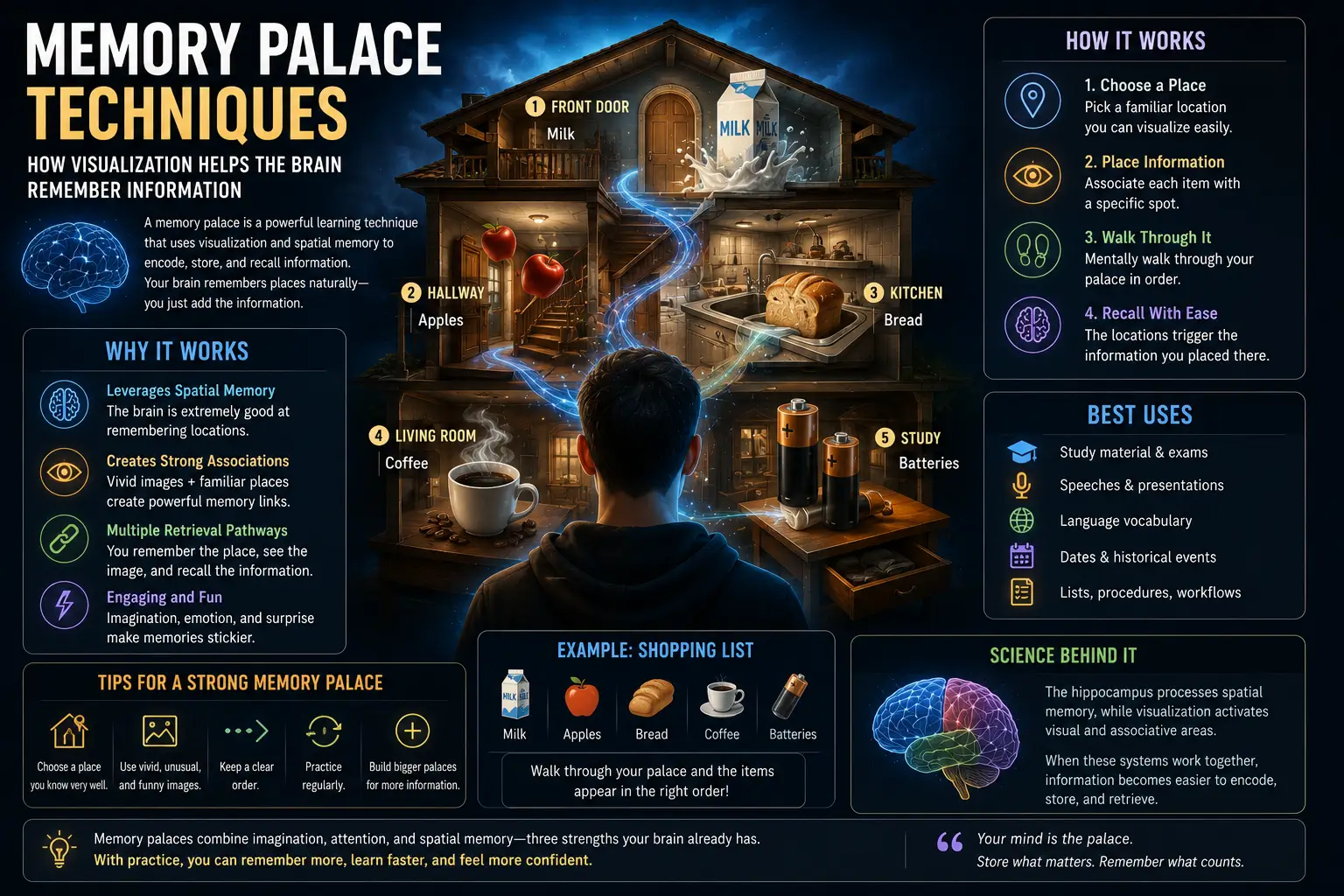
A memory palace is a visualization technique that associates information with familiar physical locations.
Instead of trying to memorize abstract facts directly, the brain stores them inside an imagined environment.
This environment might be:
- your home,
- a childhood neighborhood,
- a favorite walking route,
- or any location you know well.
Each piece of information is mentally placed somewhere within that environment.
Later, when you mentally walk through the location, the information becomes easier to retrieve.

🚪 Why The Brain Remembers Places So Well
The human brain evolved to navigate environments long before it evolved to memorize phone numbers, formulas, or exam material.
Remembering locations once played a critical role in survival.
People needed to recall:
- food sources,
- shelter locations,
- safe routes,
- and environmental landmarks.
As a result, spatial memory became one of the brain’s strongest abilities.
Memory palace techniques take advantage of this natural strength by attaching information to locations that already exist in memory.
📚 A Simple Memory Palace Example
Suppose you want to remember five items:
- milk,
- apples,
- bread,
- coffee,
- and batteries.
Instead of repeating the list over and over, you could imagine walking through your house.
At the front door, picture milk pouring from the handle.
In the hallway, imagine giant apples bouncing off the walls.
In the kitchen, visualize a loaf of bread sitting inside the sink.
The more unusual the images become, the easier they often are to remember.
When you later revisit those locations mentally, the items tend to reappear naturally.
🎯 Why Visualization Improves Recall
The brain processes images differently than plain text.
Abstract information can be difficult to remember because it lacks context.
Visual imagery provides meaning, structure, and emotional significance.
This creates additional retrieval pathways that may make information easier to access later.
Rather than relying on repetition alone, memory palaces combine:
- visualization,
- spatial awareness,
- association,
- and imagination.
Related article: Executive Function and Attention Regulation.
🧩 Memory Palaces Are Not Just For Memory Competitions
Many people assume memory palaces are only useful for professional memory athletes.
In reality, the technique can be applied to everyday situations.
People often use memory palaces to remember:
- presentation outlines,
- study material,
- foreign language vocabulary,
- historical dates,
- or important talking points.
The technique is flexible because it adapts to almost any type of information.
⚡ Attention Matters More Than Most People Realize
Memory does not begin with remembering.
It begins with attention.
If information never receives focused attention in the first place, it becomes much harder to store effectively.
This is one reason modern digital environments often create memory challenges.
Notifications, multitasking, and constant interruptions compete for cognitive resources.
Related article: Cognitive Performance and Attention Span.
📱 Modern Life Encourages Forgetfulness
Technology gives people instant access to information.
As a result, many individuals no longer feel a strong need to memorize things.
The brain increasingly relies on external storage systems such as phones, apps, and search engines.
This is not necessarily harmful.
However, it changes how people interact with information.
The challenge often becomes not finding information, but retaining it.
😴 Sleep Plays A Major Role In Memory
Even the most effective memory technique cannot replace healthy sleep.
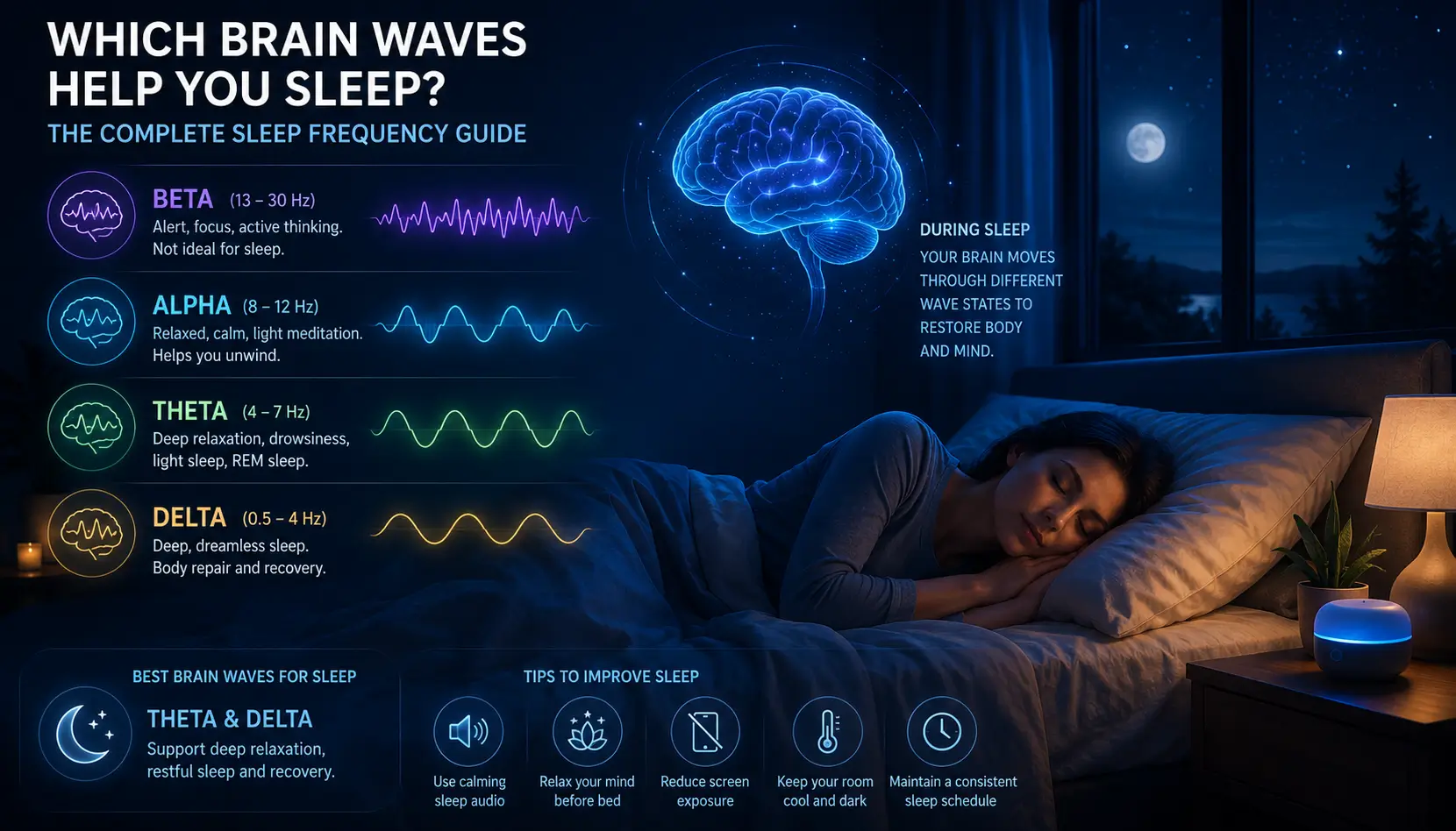
Sleep supports numerous processes related to learning and memory consolidation.
During sleep, the brain helps organize and strengthen information acquired throughout the day.
Related article: Sleep Waves Explained.
Without sufficient recovery, learning efficiency may decline regardless of which memorization strategy is used.
🌿 Building A Stronger Memory Is Usually About Habits
People often search for a secret memory hack.
In reality, long-term memory improvement usually comes from consistent habits.
These may include:
- active learning,
- sleep quality,
- focused attention,
- spaced repetition,
- and meaningful engagement with information.
Memory palaces work best when combined with these broader learning habits.
Related article: Neuroplasticity and Brain Rewiring.
⚠️ Common Misunderstandings About Memory Palaces
❌ “You Need A Photographic Memory”
No special memory ability is required to use a memory palace effectively.
❌ “The Technique Only Works For Geniuses”
The method is based on ordinary cognitive processes that most people already use naturally.
❌ “Visualization Alone Creates Perfect Memory”
Attention, repetition, sleep, and learning habits still play important roles in long-term retention.
🧠 Final Thoughts
The memory palace remains one of the most fascinating learning techniques ever developed.
By combining visualization with spatial memory, it leverages abilities the brain has relied upon for thousands of years.
While it is not a shortcut to perfect recall, it offers a practical way to organize information and make learning more memorable.
Sometimes the most effective memory tools are not new technologies — but ancient techniques that continue working remarkably well in the modern world.
Related Articles
Related Posts
Stay Informed With the Latest & Most Important News
Previous Post
Next Post