
Now Reading: Cognitive Performance and Attention Span: How Focus, Mental Energy, and Modern Overstimulation Affect the Brain
-
01
Cognitive Performance and Attention Span: How Focus, Mental Energy, and Modern Overstimulation Affect the Brain
Cognitive Performance and Attention Span: How Focus, Mental Energy, and Modern Overstimulation Affect the Brain
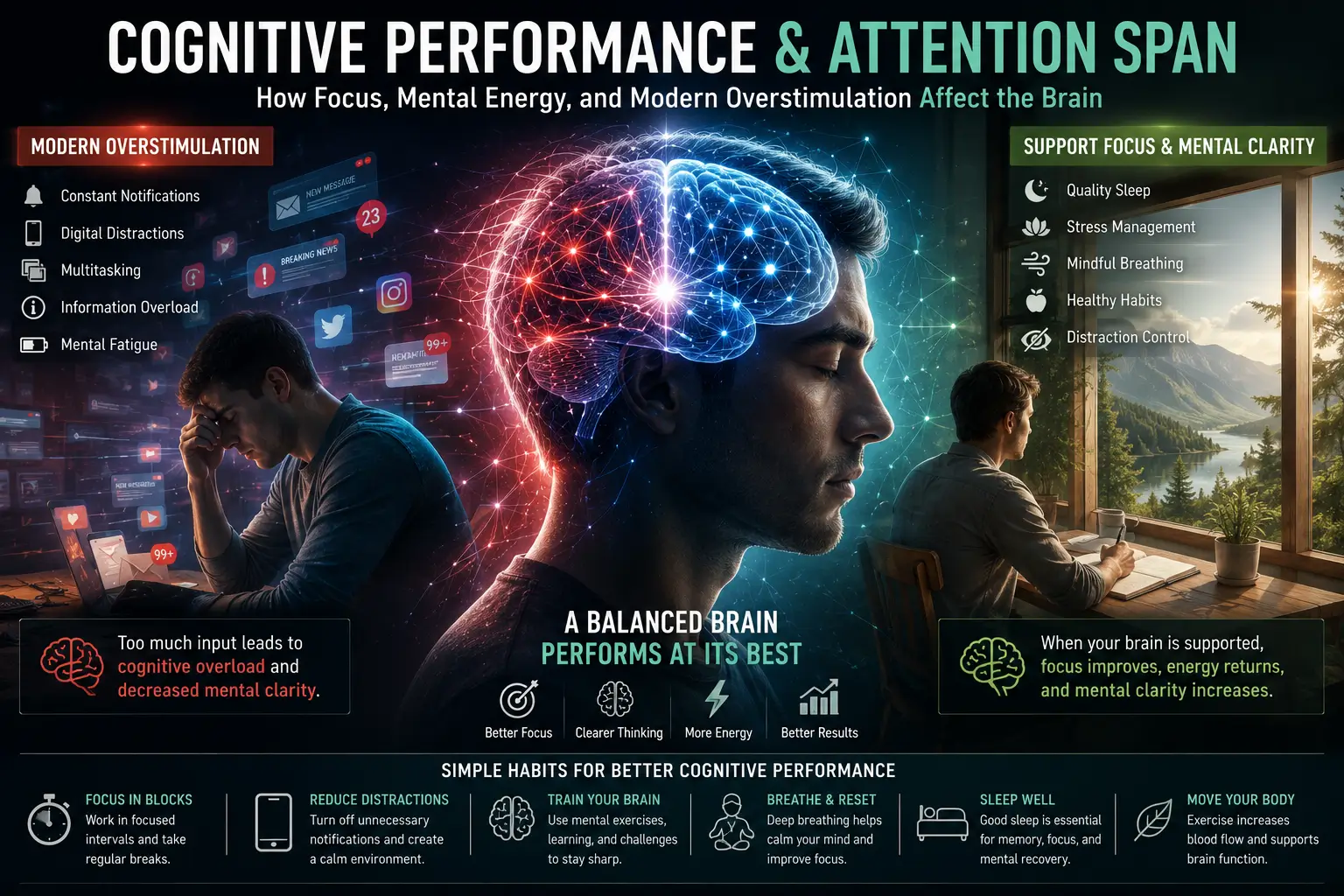
Modern life constantly competes for human attention.
Notifications, multitasking, short-form content, endless scrolling, and nonstop digital stimulation place continuous demands on the brain throughout the day.
As a result, many people now struggle with:
- mental fatigue,
- difficulty concentrating,
- attention fragmentation,
- reduced mental clarity,
- and cognitive overload.
In recent years, interest in cognitive performance and attention span has grown significantly because more individuals are searching for ways to improve focus while reducing mental exhaustion.
Modern neuroscience increasingly suggests that attention is not simply about “trying harder.”
Instead, focus may be strongly influenced by environment, stress levels, sleep quality, recovery habits, and overstimulation.
🎯 What Is Cognitive Performance?
Cognitive performance generally refers to how efficiently the brain handles mental tasks.
This may include:
- focus,
- memory,
- attention control,
- decision-making,
- mental flexibility,
- and information processing.
Cognitive performance is not fixed permanently.
The brain constantly responds to habits, stress, environments, sleep quality, and repeated mental patterns.
This is one reason people often notice major differences in focus depending on their physical and mental state.
📱 Why Attention Span Feels Shorter Today
Modern environments expose the brain to nonstop stimulation.
Digital platforms are specifically designed to capture and retain attention for as long as possible.
The brain constantly switches between:
- messages,
- videos,
- notifications,
- social feeds,
- emails,
- and background stimulation.
Over time, constant interruption may make sustained concentration more difficult.
Many people no longer struggle with under-stimulation.
Instead, they struggle with excessive cognitive input.
Related article: Modern Brain Overstimulation.
🧠 The Brain Depends on Mental Energy
Attention and focus require energy.
When the brain becomes mentally overloaded, concentration efficiency may decline.
This can sometimes lead to:
- brain fog,
- mental fatigue,
- difficulty retaining information,
- and reduced motivation.
Cognitive performance is often closely connected to recovery quality.
Without enough recovery, even simple mental tasks may feel more difficult.
😴 Sleep and Recovery Strongly Affect Focus
The brain depends heavily on sleep for cognitive restoration.
Sleep influences:
- memory processing,
- attention regulation,
- emotional balance,
- and mental recovery.
Poor sleep quality may significantly reduce attention span and mental clarity over time.
Related article: Delta Waves for Sleep.
⚡ Stress and Cognitive Overload
The nervous system constantly responds to stress and environmental demands.
When people remain under continuous pressure, the brain may spend more time in reactive mental states.
This can sometimes contribute to:
- difficulty focusing,
- reduced patience,
- attention fragmentation,
- and emotional exhaustion.
Many individuals now explore recovery habits designed to reduce mental overload and support healthier nervous system balance.
Related article: Breathwork and the Nervous System.
🧠 Neuroplasticity and Attention Habits
The brain adapts to repeated behaviors over time.
This process is commonly discussed through neuroplasticity.
Repeated attention habits may gradually influence how the brain responds to stimulation.
For example:
- constant multitasking may encourage shorter attention cycles,
- while calmer routines may support deeper concentration patterns.
This does not mean attention changes overnight.
However, repeated mental habits may influence focus patterns gradually over time.
Related article: Neuroplasticity and Brain Rewiring.
🎧 Sensory Environments and Mental Clarity
The brain continuously responds to sensory environments.
Visual clutter, background noise, constant alerts, and overstimulation may increase cognitive fatigue for some individuals.
Because of this, some people intentionally create calmer environments involving:
- reduced distractions,
- ambient soundscapes,
- mindfulness routines,
- or focus-oriented audio environments.
Related article: How Hearing Works in the Brain.
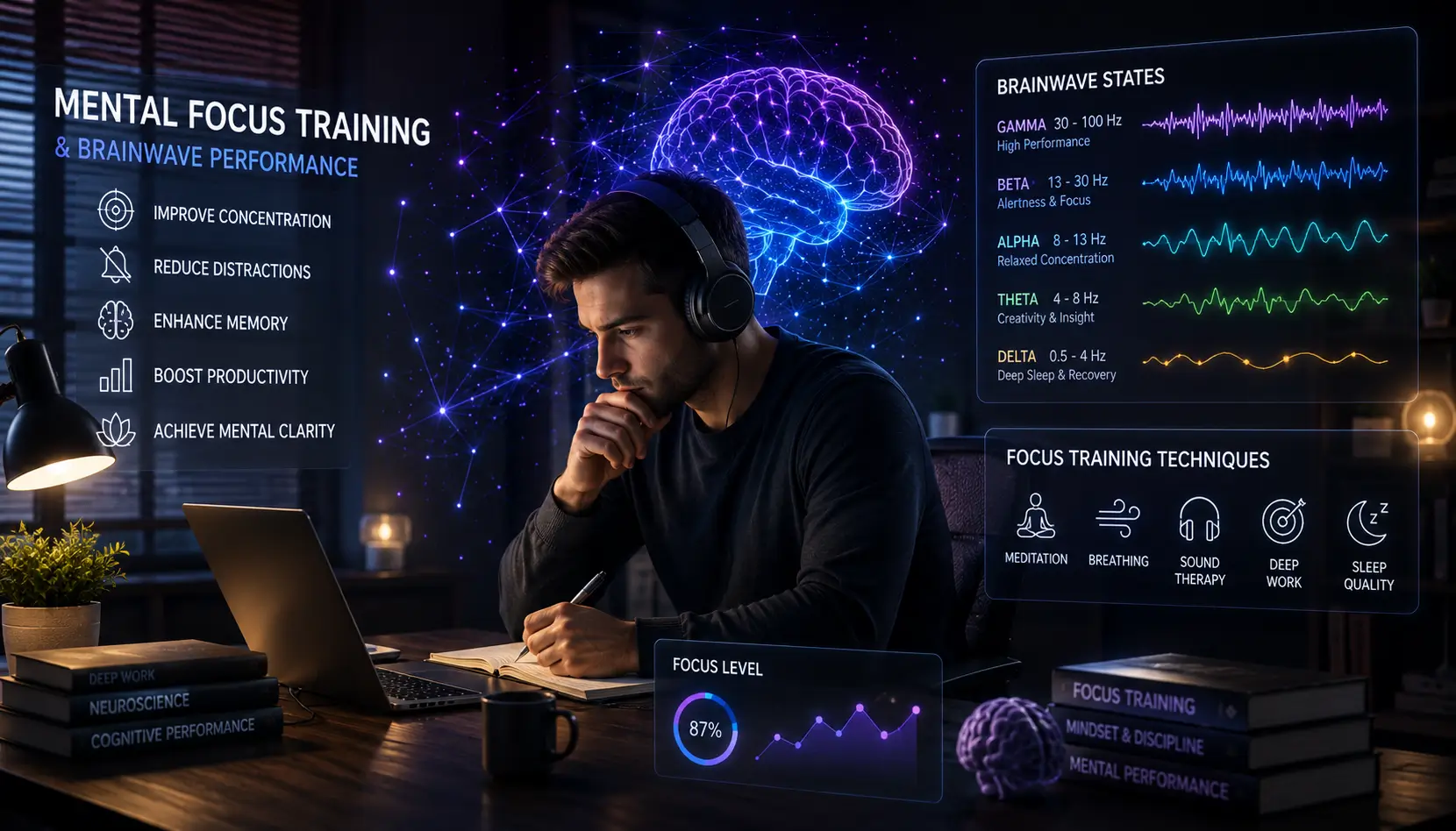
Some individuals also explore audio environments designed around focus and mental clarity as part of broader cognitive wellness routines.
📚 Small Habits May Influence Cognitive Performance
People often search for dramatic productivity solutions.
However, small repeated habits may sometimes have greater long-term influence on mental performance.
Examples may include:
- improving sleep quality,
- reducing digital overload,
- taking breaks from screens,
- creating calmer work environments,
- and practicing more intentional focus habits.
Over time, these patterns may support healthier attention regulation and cognitive recovery.
⚠️ Common Misunderstandings About Focus and Attention
❌ “People Simply Need More Discipline”
Attention is influenced by environment, recovery, stress levels, sleep quality, and overstimulation — not only willpower.
❌ “Multitasking Improves Productivity”
Constant task switching may increase cognitive fatigue and reduce sustained concentration.
❌ “Mental Fatigue Means Laziness”
Modern digital environments place continuous demands on attention systems and cognitive energy.
🌿 Modern Focus Requires Recovery Too
Many people try to improve productivity by pushing themselves harder.
However, cognitive performance often depends heavily on recovery and balance.
The brain may function more efficiently when people create healthier environments that reduce unnecessary mental overload.
In many cases, improving attention span is not only about increasing stimulation — but also about reducing it strategically.
🧠 Final Thoughts
Cognitive performance and attention span are becoming increasingly important topics in modern life.
As digital environments continue competing for human attention, more people are noticing the effects of overstimulation, mental fatigue, and cognitive overload.
Modern neuroscience increasingly suggests that focus is influenced not only by motivation — but also by sleep, stress, recovery habits, environments, and repeated attention patterns.
In many cases, healthier mental clarity may begin not with forcing the brain to work harder, but with creating environments that allow the brain to recover and focus more effectively.
Related Articles
Related Posts
Stay Informed With the Latest & Most Important News
Previous Post
Next Post