
Now Reading: How Hearing Works in the Brain: Sound, Auditory Processing, and Neuroplasticity
-
01
How Hearing Works in the Brain: Sound, Auditory Processing, and Neuroplasticity
How Hearing Works in the Brain: Sound, Auditory Processing, and Neuroplasticity
Most people assume hearing happens entirely inside the ears.
In reality, the ears are only the starting point.
The actual experience of hearing is created by the brain.
Every sound people hear — voices, music, background noise, emotional tone, rhythm, and speech — must be processed, organized, and interpreted by complex neural systems.
This process involves multiple brain regions working together almost instantly.
Modern neuroscience increasingly shows that hearing is deeply connected to:
- attention,
- focus,
- memory,
- emotional processing,
- and cognitive performance.
Understanding how hearing works inside the brain helps explain why sound environments can strongly influence mental clarity, stress levels, concentration, and everyday cognitive function.
👂 The Ears Collect Sound — But the Brain Creates Meaning
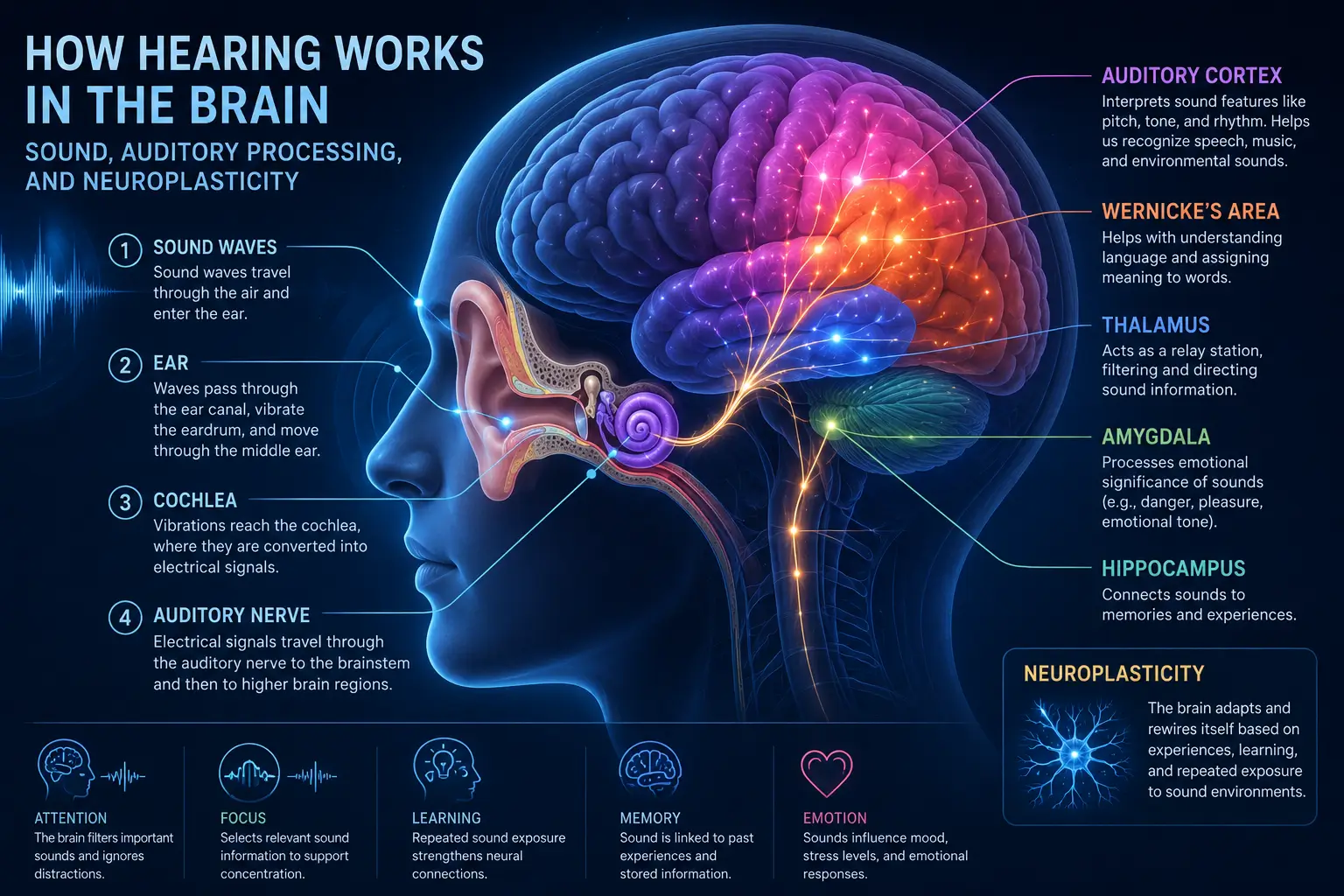
Sound begins as vibrations traveling through the air.
These vibrations enter the ear canal and eventually reach the cochlea inside the inner ear.
The cochlea converts sound vibrations into electrical signals.
Those signals are then sent to the brain through the auditory nerve.
However, hearing itself does not truly happen until the brain interprets those signals.
The brain must determine:
- where sound comes from,
- how important it is,
- whether it represents speech or background noise,
- and whether it carries emotional significance.
This entire process happens in fractions of a second.

🧠 The Auditory Cortex and Sound Processing
One of the most important brain regions involved in hearing is the auditory cortex.
This area is located inside the temporal lobe and plays a major role in interpreting sound information.
The auditory cortex helps the brain distinguish between:
- speech and environmental noise,
- different voices,
- pitch and rhythm,
- music and language,
- and familiar versus unfamiliar sounds.
This is one reason certain sounds can instantly trigger memories or emotional reactions.
The brain constantly connects sound information to past experiences and stored patterns.
🎯 What Is Auditory Processing?
Auditory processing refers to how the brain organizes and interprets incoming sound information.
People sometimes assume hearing quality depends only on the ears.
But the brain’s processing efficiency also matters significantly.
The brain must continuously:
- filter distractions,
- focus on important sounds,
- recognize speech patterns,
- process timing and rhythm,
- and connect meaning to sound.
This becomes especially difficult in overstimulating environments filled with constant digital noise and multitasking.
Related article: Modern Brain Overstimulation.
📱 Why Modern Environments Affect Attention
Today’s environments expose the brain to nonstop auditory stimulation.
Notifications, crowded spaces, short-form content, and constant background audio can increase cognitive overload.
The brain must work harder to decide which sounds deserve attention and which should be ignored.
Over time, excessive stimulation may contribute to:
- mental fatigue,
- difficulty concentrating,
- attention fragmentation,
- and reduced mental clarity.
This is one reason conversations about focus, cognitive recovery, and healthier sound environments have become increasingly common.
🧠 Neuroplasticity and the Brain’s Ability to Adapt
One of the most fascinating concepts in neuroscience is neuroplasticity.
Neuroplasticity refers to the brain’s ability to adapt and reorganize over time.
The auditory system itself is highly adaptable.
The brain constantly responds to:
- repetition,
- learning,
- environmental input,
- attention patterns,
- and sound exposure.
This is why musicians, language learners, and individuals exposed to complex sound environments often develop stronger auditory recognition abilities over time.
Related article: Neuroplasticity and Brain Rewiring.
🎧 Sound Environments and Cognitive Performance
Researchers continue exploring how sound environments influence:
- focus,
- attention regulation,
- stress levels,
- memory performance,
- and emotional balance.
Some individuals prefer silence for concentration.
Others respond better to:
- ambient soundscapes,
- background music,
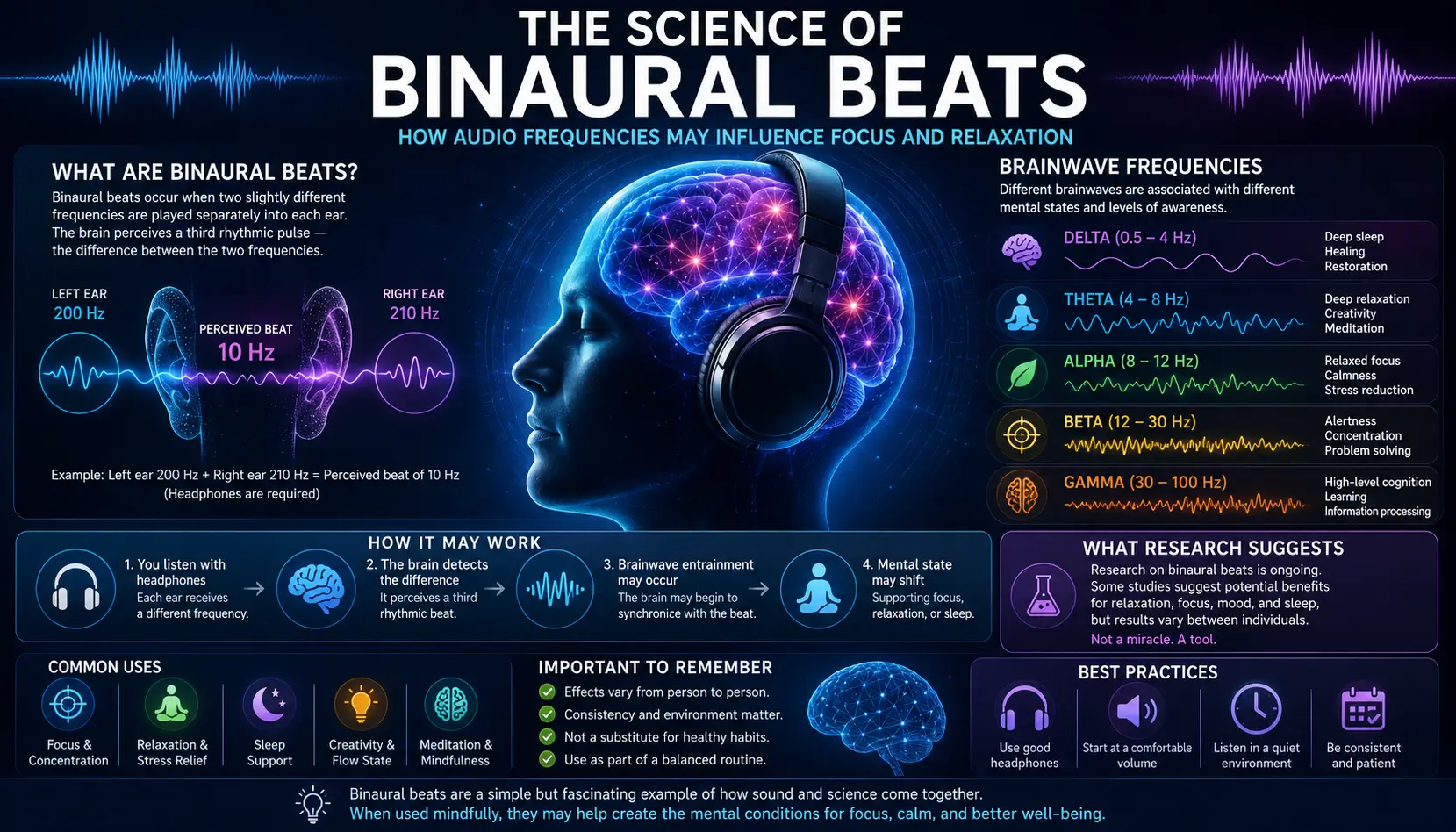
- binaural beats,
- or structured audio environments.
Discussions around neuroacoustic listening environments and brainwave-related audio have become increasingly popular among people interested in focus and mental clarity.
Related article: Brainwave Entrainment.
Some people also explore audio-based cognitive environments designed around focus, mental clarity, and relaxation routines.
Still, individuals often respond differently to different sound environments and listening habits.
😴 Sleep, Recovery, and Auditory Balance
The brain depends heavily on recovery.
Sleep plays an important role in:
- memory processing,
- attention restoration,
- emotional regulation,
- and cognitive recovery.
When the brain remains under constant stimulation without enough recovery, auditory attention and focus may become less efficient.
Related article: Delta Waves for Sleep.
⚠️ Common Misunderstandings About Hearing and the Brain
❌ “Hearing Happens Only in the Ears”
The ears collect sound, but the brain creates interpretation and meaning.
❌ “The Brain Passively Receives Sound”
The brain actively filters, prioritizes, and organizes auditory information constantly.
❌ “Modern Noise Has No Cognitive Impact”
Research increasingly suggests overstimulation and noisy environments may influence stress, focus, and mental fatigue.
🌿 Healthier Sound Environments May Support Mental Clarity
People often underestimate how much sound environments affect daily cognitive performance.
Small changes may sometimes help reduce unnecessary mental overload.
Examples may include:
- reducing constant background noise,
- improving sleep quality,
- taking breaks from overstimulation,
- using calmer focus environments,
- and practicing more intentional listening habits.
Over time, these habits may support healthier attention patterns and improved mental balance.
🧠 Final Thoughts
Hearing involves far more than detecting sound.
The brain continuously transforms vibrations into language, meaning, emotional context, memory, and conscious awareness.
Modern neuroscience increasingly shows that hearing, attention, cognitive performance, and emotional processing are deeply interconnected.
As researchers continue exploring auditory processing and neuroplasticity, people are becoming more aware of how strongly sound environments may influence focus, stress levels, mental clarity, and everyday cognitive health.
Related Articles
Stay Informed With the Latest & Most Important News