
Now Reading: Optical Illusions and the Brain: How Visual Perception Tricks the Mind
-
01
Optical Illusions and the Brain: How Visual Perception Tricks the Mind
Optical Illusions and the Brain: How Visual Perception Tricks the Mind
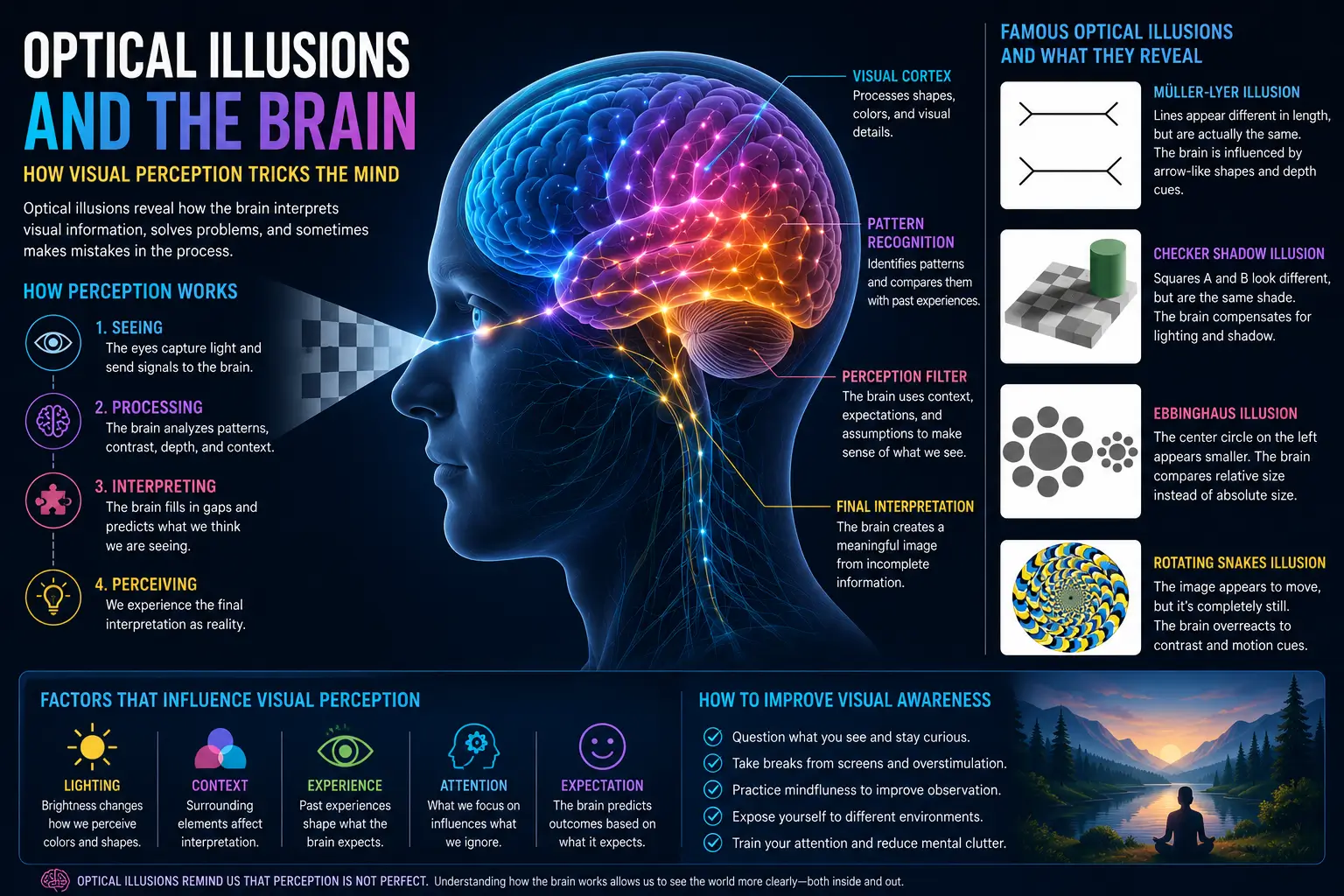
Human perception is not as objective as most people assume.
The brain constantly interprets visual information, fills missing gaps, filters details, and creates internal models of reality.
In many situations, what people “see” is actually the brain’s best interpretation of incoming visual signals.
This is one reason optical illusions are so fascinating.
Optical illusions reveal how the brain processes:
- patterns,
- depth,
- contrast,
- movement,
- and spatial relationships.
Rather than simply being visual tricks, illusions provide insight into how perception and cognition actually work.
👁️ What Are Optical Illusions?
Optical illusions occur when visual information is interpreted differently from physical reality.
The eyes collect information, but the brain must organize and interpret it.
During this process, the brain often relies on shortcuts and assumptions.
These shortcuts help humans process environments quickly and efficiently.
However, they can also create perception errors.
This is why two lines of identical length may appear different, or still images may appear to move.
The illusion itself is not happening in the eyes.
It is happening inside the brain’s interpretation systems.

🧠 The Brain Constantly Predicts Reality
Modern neuroscience suggests perception is highly predictive.
The brain does not passively receive information.
Instead, it constantly predicts what it expects to see based on:
- past experiences,
- environmental context,
- memory patterns,
- attention,
- and visual expectations.
Optical illusions expose moments where those predictions become inaccurate.
This is one reason illusions are widely studied in cognitive neuroscience and psychology.
🎯 Visual Perception Is More Complex Than It Seems
The brain must process enormous amounts of visual information every second.
To remain efficient, perception systems simplify reality constantly.
The brain quickly evaluates:
- movement,
- distance,
- brightness,
- depth,
- faces,
- and environmental threats.
Without these shortcuts, everyday perception would become mentally overwhelming.
However, these same shortcuts can occasionally produce distorted interpretations.
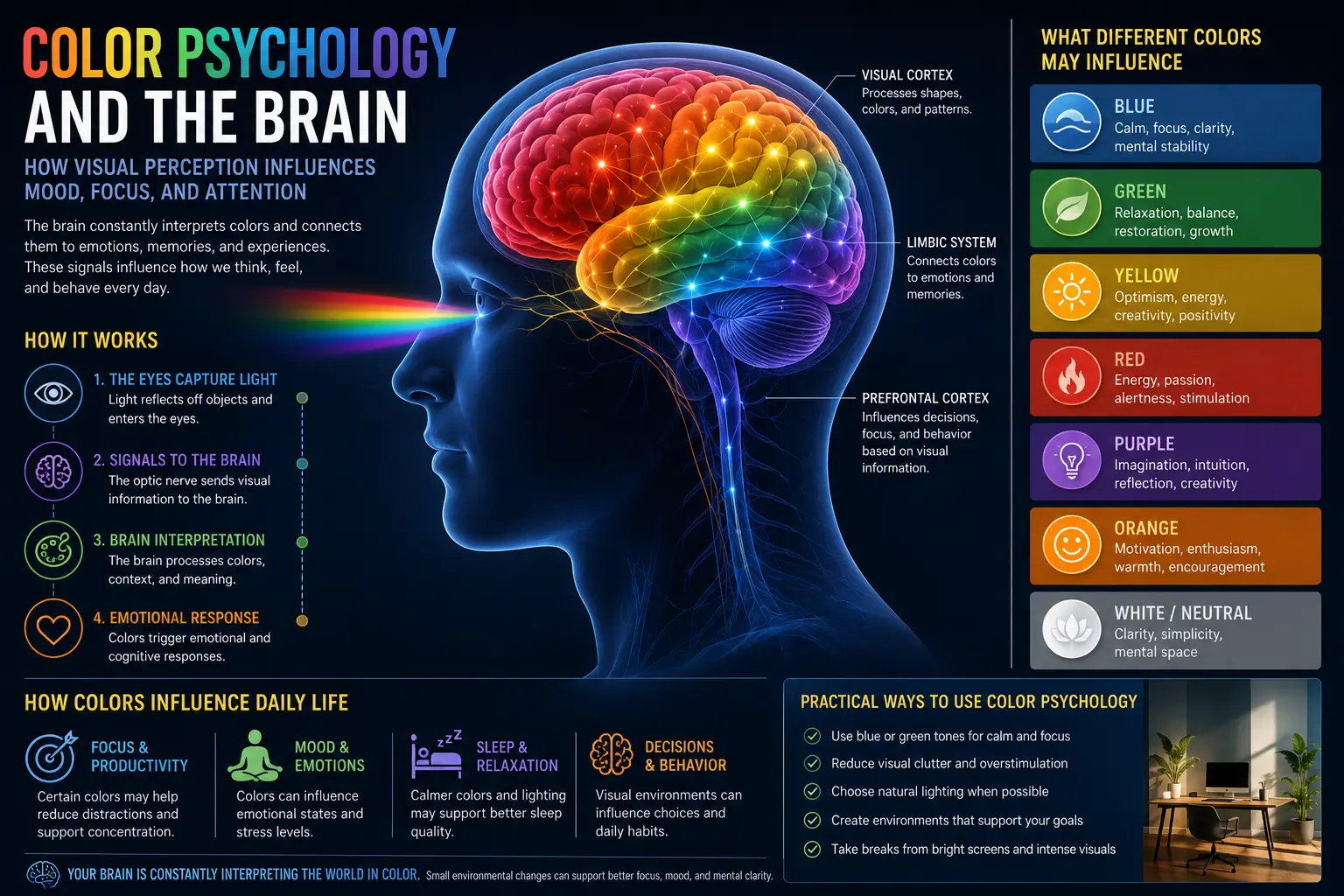
Related article: Color Psychology and the Brain.
📱 Modern Digital Environments and Attention
Modern environments expose the brain to nonstop visual stimulation.
Short-form videos, fast transitions, bright interfaces, scrolling feeds, and constant notifications continuously compete for attention.
The brain must constantly filter visual information while deciding what deserves focus.
Over time, excessive visual stimulation may contribute to:
- mental fatigue,
- attention fragmentation,
- reduced concentration,
- and cognitive overload.
Related article: Modern Brain Overstimulation.
🧠 Why the Brain Uses Perception Shortcuts
The human brain evolved to prioritize speed and survival.
Perception shortcuts allow people to react quickly without analyzing every detail consciously.
For example, the brain rapidly identifies:
- facial expressions,
- movement patterns,
- possible danger,
- and environmental changes.
This process usually works extremely well.
But optical illusions reveal that perception is not always perfectly accurate.
The brain sometimes prioritizes efficiency over precision.
🎨 Color, Contrast, and Visual Interpretation
Visual perception is heavily influenced by:
- contrast,
- lighting,
- surrounding colors,
- motion,
- and environmental context.
This is why the same image may appear different under different conditions.
The brain constantly adjusts visual interpretation depending on context.
Related article: Color Psychology and the Brain.
🧠 Optical Illusions and Cognitive Processing
Illusions are often used in neuroscience research because they help scientists study how the brain processes reality.
Researchers explore how perception connects with:
- attention systems,
- decision-making,
- pattern recognition,
- memory,
- and cognitive prediction.
Understanding these systems may help researchers better understand how humans focus, interpret information, and respond to environments.
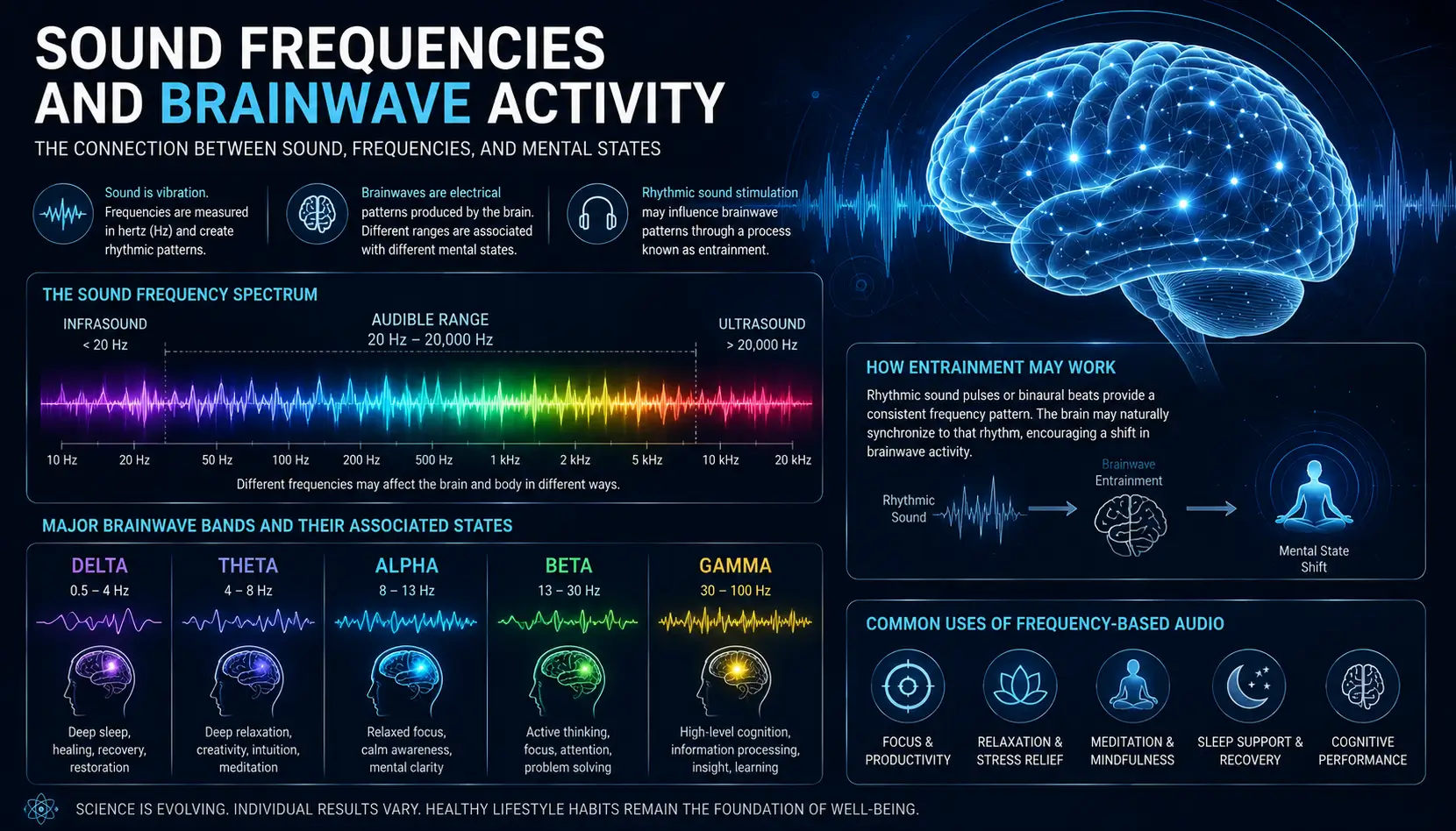
Related article: Brain Waves for Focus.
🎧 Sensory Environments and Mental Clarity
The brain does not process vision separately from everything else.
Attention, sound, stress levels, sleep quality, and sensory overload all interact together.
This is one reason some individuals explore calmer sensory environments involving:
- mindfulness routines,
- visual minimalism,
- ambient soundscapes,
- or focus-oriented audio environments.
Related article: Brainwave Entrainment.
Others explore audio environments designed around focus and mental clarity as part of broader cognitive wellness routines.
⚠️ Common Misunderstandings About Optical Illusions
❌ “Illusions Mean Human Vision Is Broken”
Optical illusions actually demonstrate how efficient and adaptive perception systems are.
❌ “People See Reality Exactly As It Is”
The brain continuously interprets and predicts reality rather than simply recording it objectively.
❌ “Illusions Are Just Entertainment”
Many illusions help researchers better understand cognition, attention, and visual processing.
🌿 The Brain Is Constantly Interpreting the World
People often assume perception happens automatically without effort.
In reality, the brain continuously works to organize enormous amounts of information every second.
Small environmental changes may influence how mentally comfortable or overwhelming an environment feels.
Examples may include:
- reducing visual clutter,
- improving lighting quality,
- taking breaks from screens,
- and creating calmer focus environments.
Over time, healthier sensory environments may support better mental clarity and attention balance.
🧠 Final Thoughts
Optical illusions reveal something important about human perception:
The brain does not simply “see” reality.
It continuously interprets, predicts, filters, and organizes information through highly complex cognitive systems.
As neuroscience continues exploring visual perception and cognitive processing, researchers are learning more about how attention, memory, stress, and environmental stimulation shape the way humans experience the world.
In many ways, optical illusions remind people that perception itself is an active process created inside the brain.
Related Articles
Related Posts
Stay Informed With the Latest & Most Important News
Previous Post
Next Post