
Now Reading: Executive Function and Attention Regulation: How the Brain Manages Focus, Planning, and Self-Control
-
01
Executive Function and Attention Regulation: How the Brain Manages Focus, Planning, and Self-Control
Executive Function and Attention Regulation: How the Brain Manages Focus, Planning, and Self-Control
Most people think focus is simply a matter of willpower.
If concentration slips, the common assumption is that someone needs more discipline, more motivation, or fewer distractions.
Modern neuroscience paints a more complicated picture.
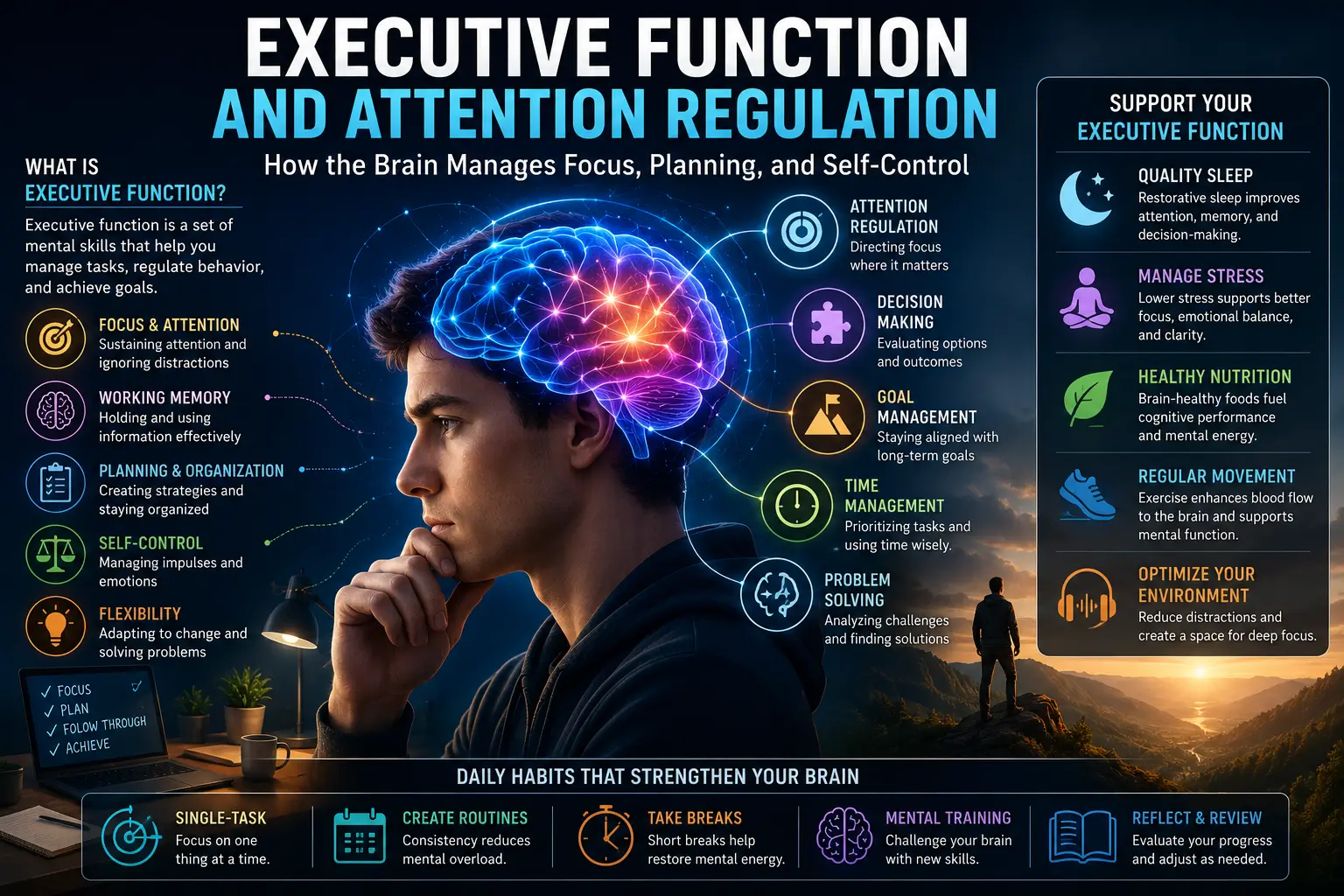
Behind attention, organization, planning, decision-making, and self-control sits a collection of cognitive processes often referred to as executive functions.
These systems help people manage daily life, prioritize information, regulate behavior, and stay aligned with long-term goals.
When executive function works efficiently, tasks feel more manageable.
When it becomes overwhelmed, even simple responsibilities may begin to feel mentally exhausting.
🎯 What Is Executive Function?
Executive function is not a single skill.
Instead, it refers to a group of mental processes that help coordinate behavior and decision-making.
These functions may support:
- attention control,
- working memory,
- planning,
- organization,
- impulse regulation,
- and problem-solving.
In many ways, executive function acts like the brain’s management system.
Rather than processing information itself, it helps determine what deserves attention and what can be ignored.
📱 Why Attention Feels Harder in Modern Life
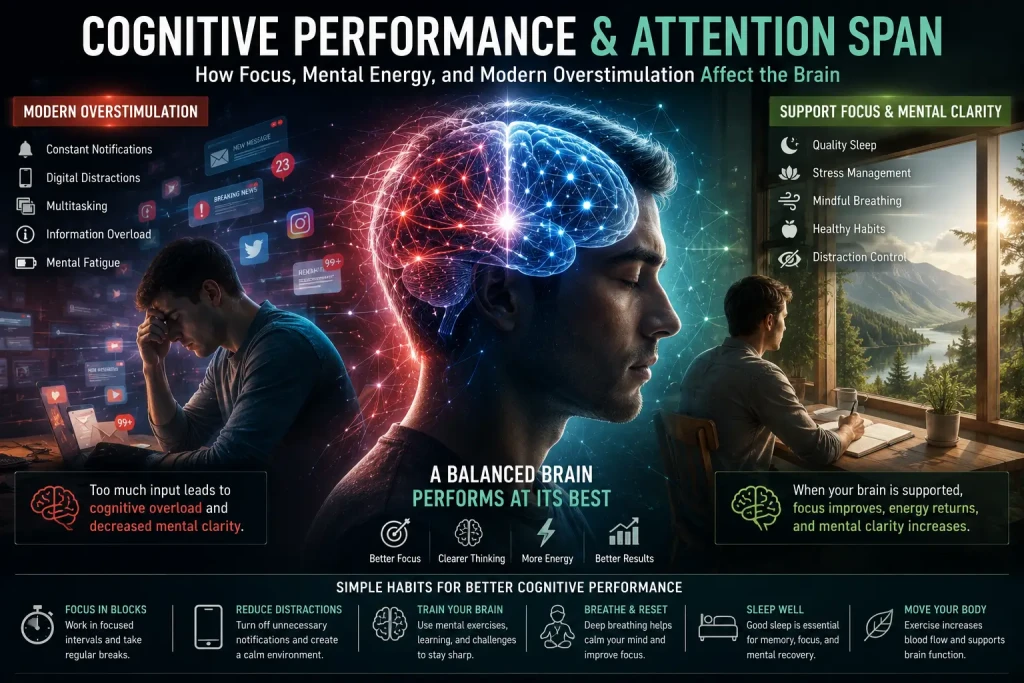
Consider how many decisions the average person makes before lunch.
Emails arrive constantly.
Messages compete for attention.
Notifications interrupt concentration.
Multiple tabs remain open across screens.
The brain is rarely allowed to focus on one thing for very long.
This environment places continuous demands on executive systems.
Over time, many people begin noticing:
- difficulty concentrating,
- mental fatigue,
- reduced productivity,
- and attention fragmentation.
Related article: Sensory Overload and the Brain.
🧠 Attention Regulation Is Different From Motivation
One of the biggest misconceptions about focus is the belief that motivation automatically creates attention.
In reality, people can feel highly motivated and still struggle to stay focused.
Attention regulation involves directing mental resources toward a task while resisting competing distractions.
This process requires cognitive energy.
When mental resources become depleted, attention may drift more easily.
This is why concentration often feels more difficult after long periods of stress, poor sleep, or excessive stimulation.
⚡ The Connection Between Executive Function and Mental Energy
Executive systems consume resources.
Every decision, interruption, and shift in attention creates additional cognitive demand.
The more frequently attention switches between tasks, the more mental energy is required to return to the original objective.
Researchers sometimes refer to this as task-switching cost.
While multitasking may feel productive, it often increases cognitive workload behind the scenes.
Related article: Cognitive Performance and Attention Span.
😴 Sleep Plays a Bigger Role Than Most People Realize
Executive function depends heavily on recovery.
Sleep helps support memory consolidation, emotional regulation, learning, and cognitive restoration.
Even modest reductions in sleep quality may influence:
- attention control,
- decision-making,
- reaction time,
- and mental flexibility.
Many people attempt to improve productivity while overlooking one of the most important variables affecting cognitive performance.
Related article: Delta Waves for Sleep.
🫁 Stress and Executive Function
The brain performs differently under stress.
When the nervous system remains in heightened alert states for extended periods, attention regulation may become more difficult.
This does not mean stress automatically eliminates focus.
However, prolonged stress may increase mental fatigue and reduce cognitive efficiency.
This is one reason many people explore habits that support nervous system recovery.
Related article: Breathwork and the Nervous System.
📚 Can Executive Function Improve?
Executive function is not entirely fixed.
The brain continuously adapts to experiences, environments, and repeated behaviors.
While dramatic overnight changes are unrealistic, small habits may gradually influence attention patterns over time.
Examples include:
- reducing unnecessary distractions,
- creating structured routines,
- improving sleep consistency,
- taking intentional breaks,
- and managing information overload.
Related article: Neuroplasticity and Brain Rewiring.
🎧 Environment Often Shapes Focus More Than People Expect
Focus does not happen in isolation.
The brain constantly responds to its surroundings.
Noise levels, visual clutter, interruptions, and digital stimulation may all influence attention quality.
Some individuals find that quieter environments help support deeper concentration.
Others prefer background soundscapes that reduce external distractions.
Some people also explore audio environments designed around focus and mental clarity as part of broader productivity routines.
⚠️ Common Misunderstandings About Executive Function
❌ “Poor Focus Means Laziness”
Attention regulation involves multiple cognitive systems and is influenced by environment, recovery, stress, and mental workload.
❌ “Multitasking Improves Productivity”
Frequent task switching often increases cognitive demand rather than reducing it.
❌ “The Brain Can Focus Equally Well All Day”
Mental energy naturally fluctuates throughout the day, influencing attention and performance.
🌿 The Real Goal Is Sustainable Attention
Many productivity discussions focus entirely on doing more.
A more useful question may be whether the brain has enough resources to sustain meaningful attention in the first place.
Modern life constantly competes for focus.
Protecting attention may be just as important as improving it.
For many people, better cognitive performance begins not with working harder, but with reducing unnecessary demands on executive systems.
🧠 Final Thoughts
Executive function influences far more than productivity.
It plays a central role in attention regulation, planning, self-control, organization, and decision-making.
As modern environments become increasingly demanding, understanding how these cognitive systems operate becomes more valuable than ever.
In many cases, stronger focus is not simply about motivation. It is about giving the brain the conditions it needs to manage attention effectively.
Related Articles
Related Posts
Stay Informed With the Latest & Most Important News
Previous Post
Next Post