
Now Reading: Lucid Dreaming Explained: What Neuroscience Says About Dream Awareness and Conscious Sleep
-
01
Lucid Dreaming Explained: What Neuroscience Says About Dream Awareness and Conscious Sleep
Lucid Dreaming Explained: What Neuroscience Says About Dream Awareness and Conscious Sleep
Most dreams feel completely real while they are happening.
People run, talk, explore strange places, and experience events without questioning whether any of it is actually real.
Then they wake up.
Only afterward do they realize it was a dream.
Lucid dreaming is different.
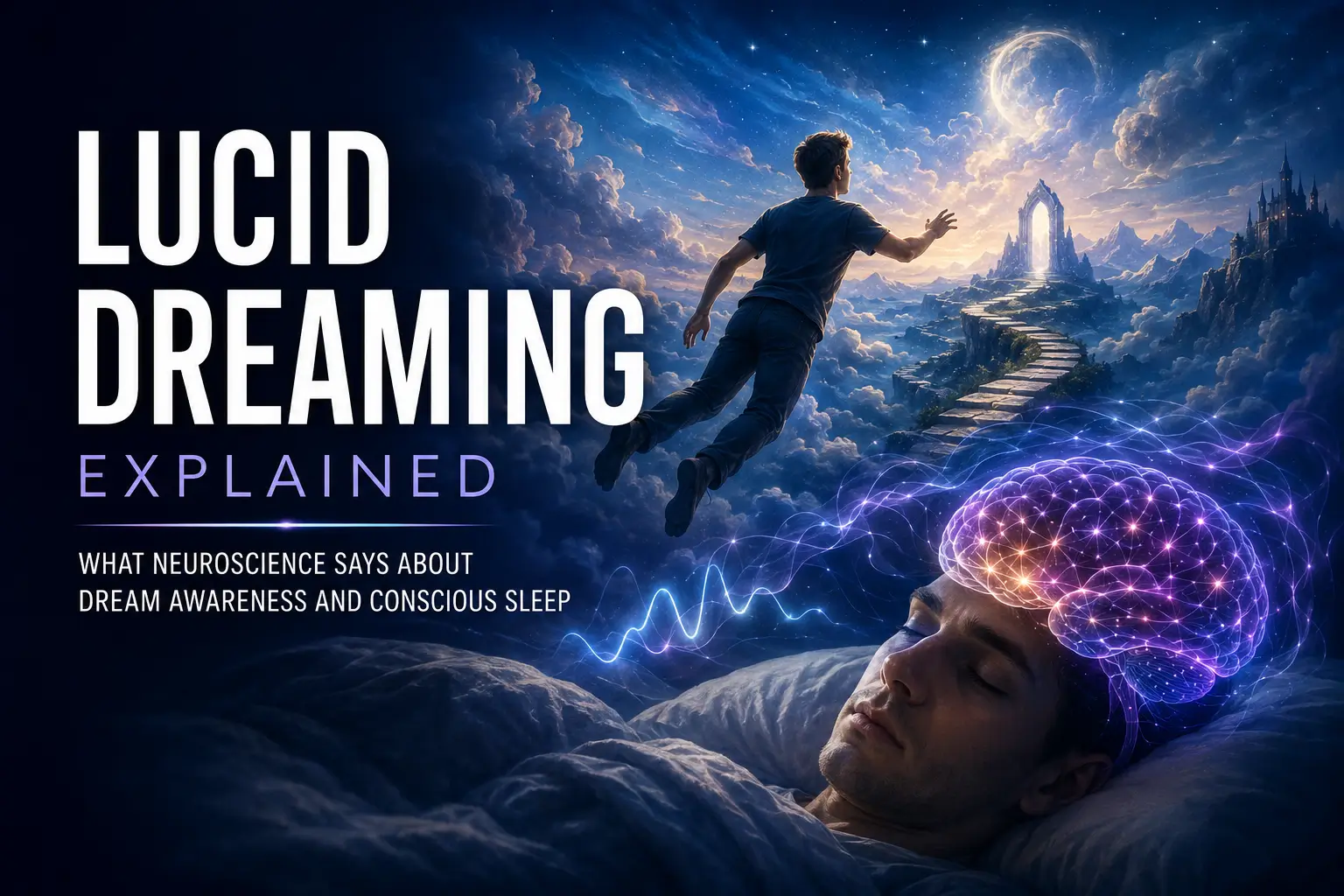
During a lucid dream, a person becomes aware that they are dreaming while the dream is still taking place.
For some individuals, this awareness lasts only a few seconds.
For others, it can become a vivid experience in which they consciously observe or even influence parts of the dream.
Because lucid dreaming combines elements of awareness and sleep, it remains one of the most fascinating subjects in modern sleep research.
🧠 What Is Lucid Dreaming?
Lucid dreaming occurs when a person recognizes that they are dreaming while remaining asleep.
Unlike ordinary dreams, the dreamer gains a level of awareness that is usually absent during normal dream experiences.
This awareness may range from a simple realization to a more active form of observation.
Not every lucid dream feels the same.
Some people simply recognize the dream.
Others report feeling unusually aware, reflective, or conscious while the dream continues around them.

🌙 Why Lucid Dreams Feel So Real
Dreams often feel convincing because the brain creates immersive experiences using memory, emotion, imagination, and perception.
While sleeping, the mind can generate environments, conversations, and sensations that feel remarkably authentic.
During a lucid dream, those experiences may remain vivid while awareness increases.
This unusual combination is one reason lucid dreaming continues attracting scientific interest.
🔍 What Does Neuroscience Say?
Researchers continue studying how lucid dreaming occurs and why some people experience it more frequently than others.
Current evidence suggests lucid dreaming may involve a unique blend of brain activity associated with both dreaming and self-awareness.
Instead of being fully asleep or fully awake, certain aspects of awareness appear to become more active during the dream state.
This overlap helps explain why lucid dreaming feels so different from ordinary dreaming.
💭 The Relationship Between Lucid Dreaming and Awareness
One of the most intriguing aspects of lucid dreaming is awareness itself.
During ordinary dreams, people usually accept events without questioning them.
In lucid dreams, the dreamer may suddenly recognize that something is unusual.
A flying object.
An impossible location.
A strange sequence of events.
This realization can trigger conscious awareness within the dream.
Researchers sometimes describe lucid dreaming as a rare meeting point between dreaming and reflective thought.
🎨 Creativity and Dream Experiences
Dreams have inspired artists, writers, musicians, and inventors throughout history.
Because dreams often combine ideas in unexpected ways, they may create experiences that feel highly imaginative.
Lucid dreaming has attracted additional interest because dream awareness may allow people to observe these creative experiences more directly.
Although creativity is difficult to measure scientifically, many individuals report unique insights and unusual perspectives emerging from dream experiences.
😴 Lucid Dreaming and Sleep Stages
Lucid dreams are frequently associated with REM sleep, a stage known for vivid dreaming activity.
REM sleep plays an important role in the broader sleep cycle and remains an active area of scientific study.
Sleep itself is far from passive.
Throughout the night, the brain cycles through multiple stages that support recovery, memory processing, and cognitive function.
Related article: Sleep Waves Explained.
🌌 The Connection Between Lucid Dreaming and Hypnagogia
Lucid dreaming is often discussed alongside hypnagogic experiences because both involve unusual states of awareness.
Hypnagogia occurs during the transition between wakefulness and sleep.
Lucid dreaming occurs while dreaming itself is already underway.
Although these experiences are different, they both reveal how flexible human consciousness can be.
Related article: Hypnagogic States and the Brain.
📱 Why People Are Becoming More Interested In Dreams
Modern interest in sleep has expanded significantly.
People are increasingly curious about:
- sleep quality,
- recovery,
- mental performance,
- dream experiences,
- and consciousness.
Lucid dreaming sits at the intersection of all these topics.
It raises fascinating questions about awareness, memory, imagination, and the sleeping brain.
🎧 Sleep Environments and Dream Experiences
The brain remains responsive to internal and external influences throughout the sleep process.
Many individuals experiment with bedtime routines designed to encourage relaxation and better sleep quality.
Some people also explore audio environments designed around relaxation and mental clarity as part of broader sleep and recovery routines.
Individual experiences vary, and no single environment works the same way for everyone.
⚠️ Common Misunderstandings About Lucid Dreaming
❌ “Everyone Can Control Every Dream”
Dream awareness and dream control are not necessarily the same thing.
A person may recognize they are dreaming without controlling what happens next.
❌ “Lucid Dreaming Means Being Awake”
Lucid dreamers remain asleep, even though awareness may become more active within the dream.
❌ “Scientists Fully Understand Lucid Dreaming”
Lucid dreaming remains an active area of research, and many questions about consciousness and dreaming are still being explored.
🌿 Why Lucid Dreaming Fascinates Researchers
Few experiences blur the line between sleep and awareness as clearly as lucid dreaming.
It offers researchers a unique opportunity to study consciousness from an unusual perspective.
By examining how awareness emerges during dreams, scientists may gain deeper insights into how the brain constructs experience itself.
🧠 Final Thoughts
Lucid dreaming remains one of the most intriguing phenomena in sleep science.
It challenges simple ideas about consciousness by showing that awareness can sometimes emerge even while a person remains asleep.
Although much remains unknown, neuroscience continues uncovering new insights into dreaming, awareness, and the remarkable complexity of the human brain.
Sometimes the most fascinating experiences occur not when we are fully awake — but while we are dreaming.
Related Articles
Stay Informed With the Latest & Most Important News