
Now Reading: Memory Recall and Retention: How the Brain Stores, Organizes, and Retrieves Information
-
01
Memory Recall and Retention: How the Brain Stores, Organizes, and Retrieves Information
Memory Recall and Retention: How the Brain Stores, Organizes, and Retrieves Information
People often think memory works like a filing cabinet.
Information goes in, stays neatly organized, and can be retrieved whenever needed.
The reality is far more complex.
Memory is not a single system, and remembering something is not as simple as pressing a button inside the brain.
Every day, the brain filters enormous amounts of information, deciding what deserves attention, what gets stored, and what eventually fades away.
This process involves two closely connected concepts: memory retention and memory recall.
Understanding how these systems work can provide valuable insight into learning, focus, and cognitive performance.
📚 What Is Memory Retention?
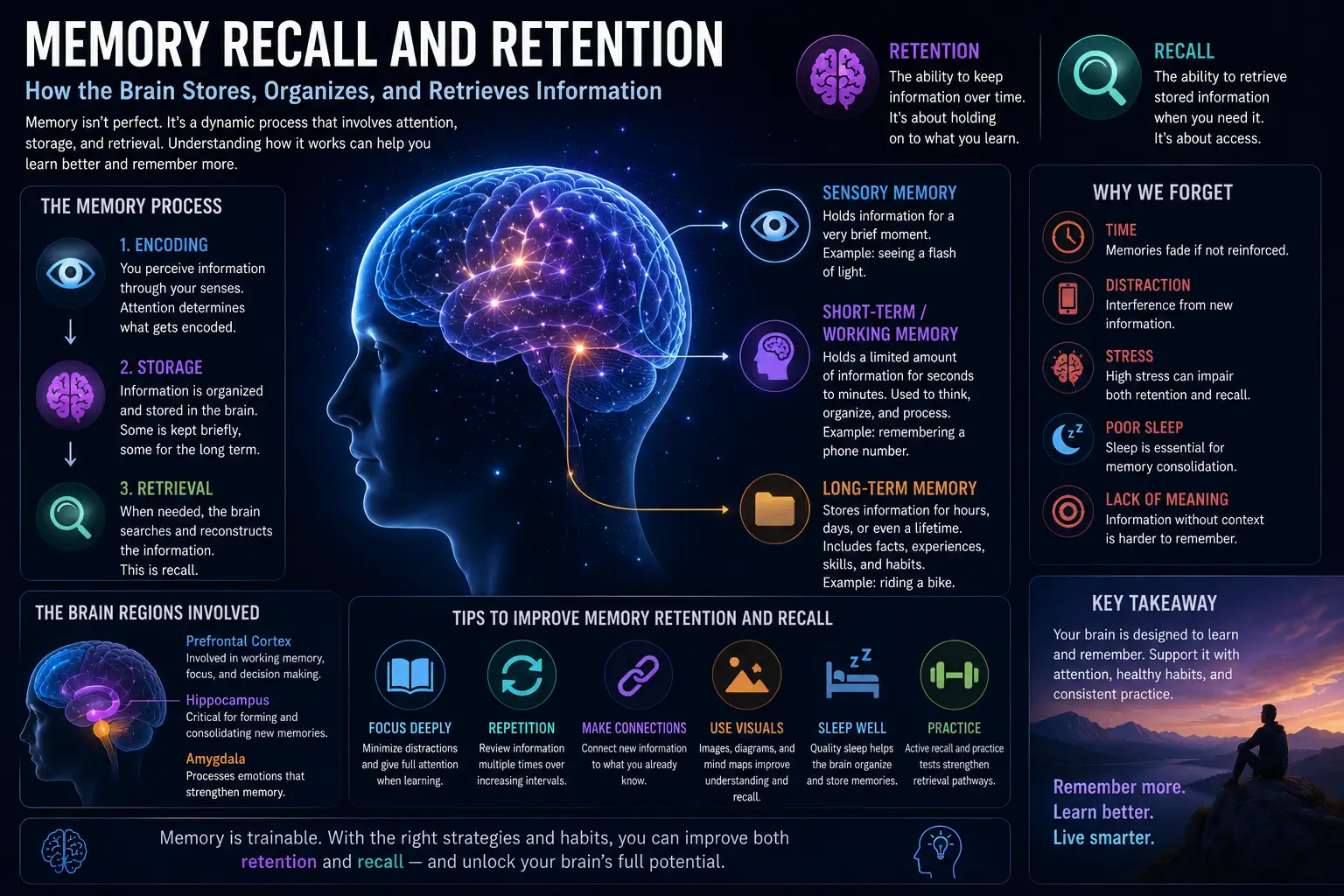
Memory retention refers to the brain’s ability to preserve information over time.
When you learn a new fact, experience an event, or practice a skill, the brain begins processing that information.
Some information disappears quickly.
Other information becomes more stable and remains accessible for longer periods.
Retention is essentially the process of keeping information available for future use.
Without retention, learning would be nearly impossible because every experience would disappear almost immediately.

🔍 What Is Memory Recall?
Memory recall is the ability to retrieve information that has already been stored.
For example:
- remembering a person’s name,
- recalling directions,
- retrieving facts during an exam,
- or remembering a conversation from last week.
Information may exist in memory, yet recall can still fail.
This is one reason people sometimes experience the frustrating feeling of knowing something while being temporarily unable to access it.
🧠 Memory Is More Dynamic Than Most People Realize
Many people imagine memory as a permanent recording.
Modern neuroscience suggests memory is far more active.
Every time information is recalled, the brain may partially reconstruct the experience.
This helps explain why memories can sometimes change over time or become influenced by new experiences.
Memory is not simply storage.
It is an ongoing process of organization, retrieval, and interpretation.
🎯 Attention Comes Before Memory
One of the biggest misconceptions about memory is the belief that remembering starts after learning.
In reality, memory often begins with attention.
If information never receives meaningful attention, the brain may never prioritize it for storage.
This is why distractions can dramatically affect learning.
The brain cannot effectively retain information that it never fully processed in the first place.
Related article: Executive Function and Attention Regulation.
⚡ Working Memory Plays a Critical Role
Working memory acts like a temporary mental workspace.
It helps people hold and manipulate information for short periods while performing tasks.
Examples include:
- remembering a phone number long enough to dial it,
- following instructions,
- solving problems,
- or organizing thoughts during conversation.
Working memory supports learning because it allows information to remain active long enough for deeper processing.
Related article: Cognitive Performance and Attention Span.
😴 Why Sleep Is Essential For Memory
Many people focus heavily on study techniques while overlooking sleep.
However, memory depends heavily on recovery.
During sleep, the brain helps process and consolidate information gathered throughout the day.
Researchers continue exploring how sleep contributes to learning, retention, and cognitive restoration.
Without adequate recovery, memory performance often becomes less efficient.
Related article: Non-Restorative Sleep.
🏛️ Why Memory Techniques Work
People have developed memory systems for centuries.
One of the best-known examples is the Memory Palace technique.
These approaches work by giving information additional structure and meaning.
The brain often remembers information more effectively when it is connected to imagery, emotion, location, or association.
Related article: Memory Palace Techniques.
📱 Modern Life Creates New Memory Challenges
Technology provides immediate access to information.
As a result, many people rely less on internal memory and more on external tools.
Phone numbers, directions, appointments, and reminders are often stored on devices rather than in memory.
This convenience is useful.
However, it also changes how people interact with information.
The challenge increasingly becomes not finding information, but retaining it.
🌿 Memory Improvement Usually Comes From Habits
People often search for a single trick that will dramatically improve memory.
The reality is usually less dramatic and more practical.
Memory performance is influenced by:
- attention quality,
- sleep consistency,
- stress levels,
- learning methods,
- and overall cognitive health.
Small improvements across multiple areas often produce more meaningful results than any single memory hack.
Related article: Brain Health and Cognitive Function.
🎧 Memory, Focus, and Learning Environments
The environment surrounding learning matters.
Noise, distractions, multitasking, and information overload can all compete for cognitive resources.
Some people learn best in silence.
Others prefer structured environments that reduce unnecessary distractions.
Some individuals also explore audio environments designed around focus and mental clarity as part of broader learning and productivity routines.
Individual experiences can vary significantly.
⚠️ Common Misunderstandings About Memory
❌ “Good Memory Means Never Forgetting”
Forgetting is a normal part of how the brain manages information.
❌ “Memory Is Fixed For Life”
The brain continues adapting and learning throughout life.
❌ “Learning More Automatically Means Remembering More”
Information must be processed, organized, and reinforced before it becomes easier to recall later.
🧠 Final Thoughts
Memory recall and retention are two essential components of learning and cognitive performance.
Retention helps preserve information, while recall allows the brain to access it when needed.
Together, they shape how people learn, solve problems, make decisions, and navigate everyday life.
While memory is influenced by many factors, one principle remains consistent: the brain remembers best when attention, learning, recovery, and meaningful engagement work together.
Related Articles
Stay Informed With the Latest & Most Important News
Previous Post
Next Post