
Now Reading: Non-Restorative Sleep: Why You Can Sleep All Night and Still Feel Tired
-
01
Non-Restorative Sleep: Why You Can Sleep All Night and Still Feel Tired
Non-Restorative Sleep: Why You Can Sleep All Night and Still Feel Tired
Most people assume that sleep and recovery are the same thing.
If you spend eight hours in bed, you should wake up refreshed, focused, and mentally recharged.
At least that is how sleep is supposed to work.
Yet millions of people experience something very different.
They sleep through the night, avoid major interruptions, and still wake up feeling exhausted.
The body may have rested, but the brain feels as if it never truly recovered.
This experience is often described as non-restorative sleep.
🧠 What Is Non-Restorative Sleep?
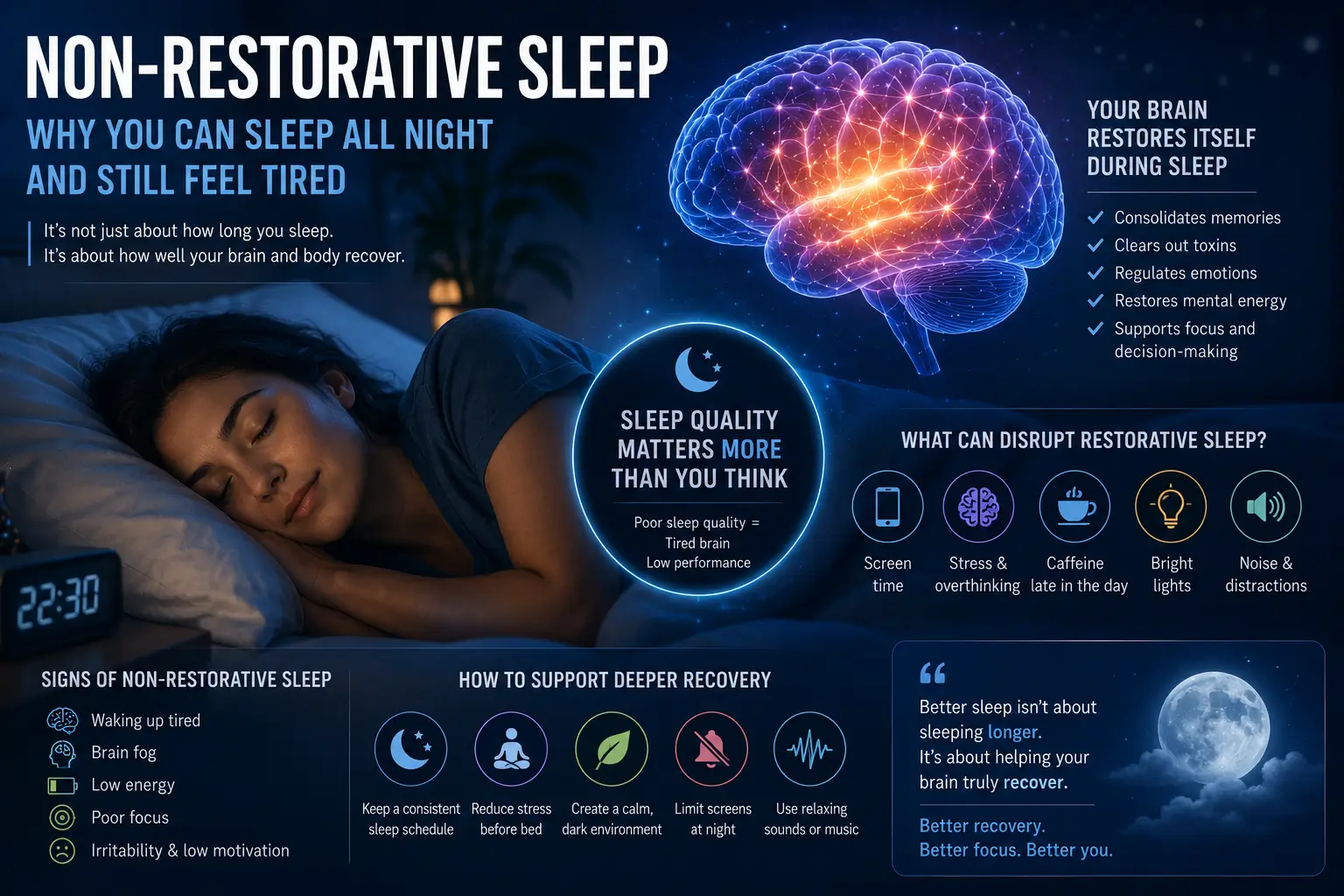
Non-restorative sleep refers to sleep that fails to leave a person feeling refreshed upon waking.
The total number of hours slept may appear normal.
However, the quality of recovery during those hours may not be.
People often describe it as:
- waking up tired,
- feeling mentally foggy,
- struggling to focus,
- lacking energy,
- or feeling as though they barely slept at all.
The experience can be frustrating because the problem is not always obvious.
🌙 Sleep Duration and Sleep Quality Are Not the Same Thing
Modern sleep science has shown that the number of hours spent asleep is only part of the equation.
The brain moves through multiple stages during the night.
Each stage contributes differently to recovery.
Healthy sleep architecture generally includes cycles involving:
- light sleep,
- deep sleep,
- and REM sleep.
When these stages become disrupted, people may technically sleep long enough while still feeling unrefreshed the next day.
⚡ Why The Brain Needs Deep Recovery
Throughout the day, the brain constantly processes information.
It manages attention, memory, emotions, decision-making, and countless automatic functions.
Sleep is not simply a period of inactivity.
It is an active biological process that helps support:
- memory consolidation,
- cognitive recovery,
- emotional regulation,
- and mental performance.
When recovery quality declines, people may notice the effects long before they realize sleep is the problem.
📱 Modern Life Often Works Against Restorative Sleep
Many sleep challenges begin long before bedtime.
Consider what happens during a typical evening.
Screens remain active.
Notifications continue arriving.
Videos autoplay endlessly.
The brain remains engaged until the final moments before sleep.
For some people, the nervous system never fully transitions into a relaxed state before bedtime.
This can make high-quality recovery more difficult.
Related article: Sensory Overload and the Brain.
🧩 Signs That Sleep May Not Be Fully Restorative
Non-restorative sleep can look different from person to person.
Common experiences may include:
- morning brain fog,
- difficulty concentrating,
- reduced motivation,
- daytime fatigue,
- mental sluggishness,
- or feeling tired despite sleeping enough hours.
Many people assume these symptoms are caused entirely by stress or workload when sleep quality may also be contributing.
🎯 The Link Between Sleep and Cognitive Performance
Attention, memory, and decision-making all depend heavily on recovery.
Even highly motivated individuals may struggle to perform at their best when sleep quality declines.
This is one reason cognitive performance discussions increasingly include sleep as a central factor.
Related article: Cognitive Performance and Attention Span.
The brain cannot continuously operate at a high level without opportunities for restoration.
🫁 Stress and The Nervous System
Stress does not automatically prevent sleep.
However, it may influence how restorative sleep feels.
Some individuals fall asleep quickly while remaining mentally overloaded beneath the surface.
The nervous system continues responding to accumulated stress even when a person is physically resting.
This is one reason relaxation and recovery habits often play a role in overall sleep quality.
Related article: Breathwork and the Nervous System.
🧠 Why Recovery Matters More Than Productivity
Many people try to solve fatigue by increasing stimulation.
More caffeine.
More productivity hacks.
More effort.
Yet sometimes the problem is not a lack of effort.
It is a lack of recovery.
The brain performs best when periods of focus are balanced by periods of restoration.
Without recovery, attention systems eventually become strained.
🎧 Sleep Environments Matter
The brain remains sensitive to environmental influences before and during sleep.
Noise, light exposure, stress levels, and bedtime habits may all affect the quality of recovery.
Some individuals prefer complete silence.
Others use calming soundscapes or structured audio environments as part of their evening routines.
Some people also explore audio environments designed around relaxation and mental clarity as part of broader recovery habits.
Individual experiences can vary significantly.
⚠️ Common Misunderstandings About Sleep
❌ “Eight Hours Automatically Means Good Sleep”
Sleep quantity and sleep quality are not always the same thing.
❌ “Morning Fatigue Is Always Normal”
Regularly waking up exhausted may indicate that recovery quality deserves closer attention.
❌ “Productivity Fixes Fatigue”
Long-term mental performance depends on recovery, not just effort.
🌿 Better Recovery Often Starts Before Bed
Healthy sleep habits usually begin well before a person closes their eyes.
Reducing stimulation, managing stress, creating a calmer environment, and maintaining consistent sleep schedules may all support better recovery.
The goal is not perfect sleep.
The goal is giving the brain the conditions it needs to restore itself effectively.
🧠 Final Thoughts
Non-restorative sleep can be one of the most frustrating experiences in modern life.
People may spend enough time asleep yet still wake up feeling mentally exhausted.
The reason is often that recovery quality matters just as much as sleep duration.
As neuroscience continues exploring the relationship between sleep and brain function, one message remains clear: mental performance depends heavily on recovery.
Sometimes the solution is not sleeping longer.
It is helping the brain recover more effectively during the sleep you already get.
Related Articles
Stay Informed With the Latest & Most Important News
Previous Post
Next Post