
Now Reading: Hypnagogic States and the Brain: The Transition Between Wakefulness, Creativity, and Sleep
-
01
Hypnagogic States and the Brain: The Transition Between Wakefulness, Creativity, and Sleep
Hypnagogic States and the Brain: The Transition Between Wakefulness, Creativity, and Sleep
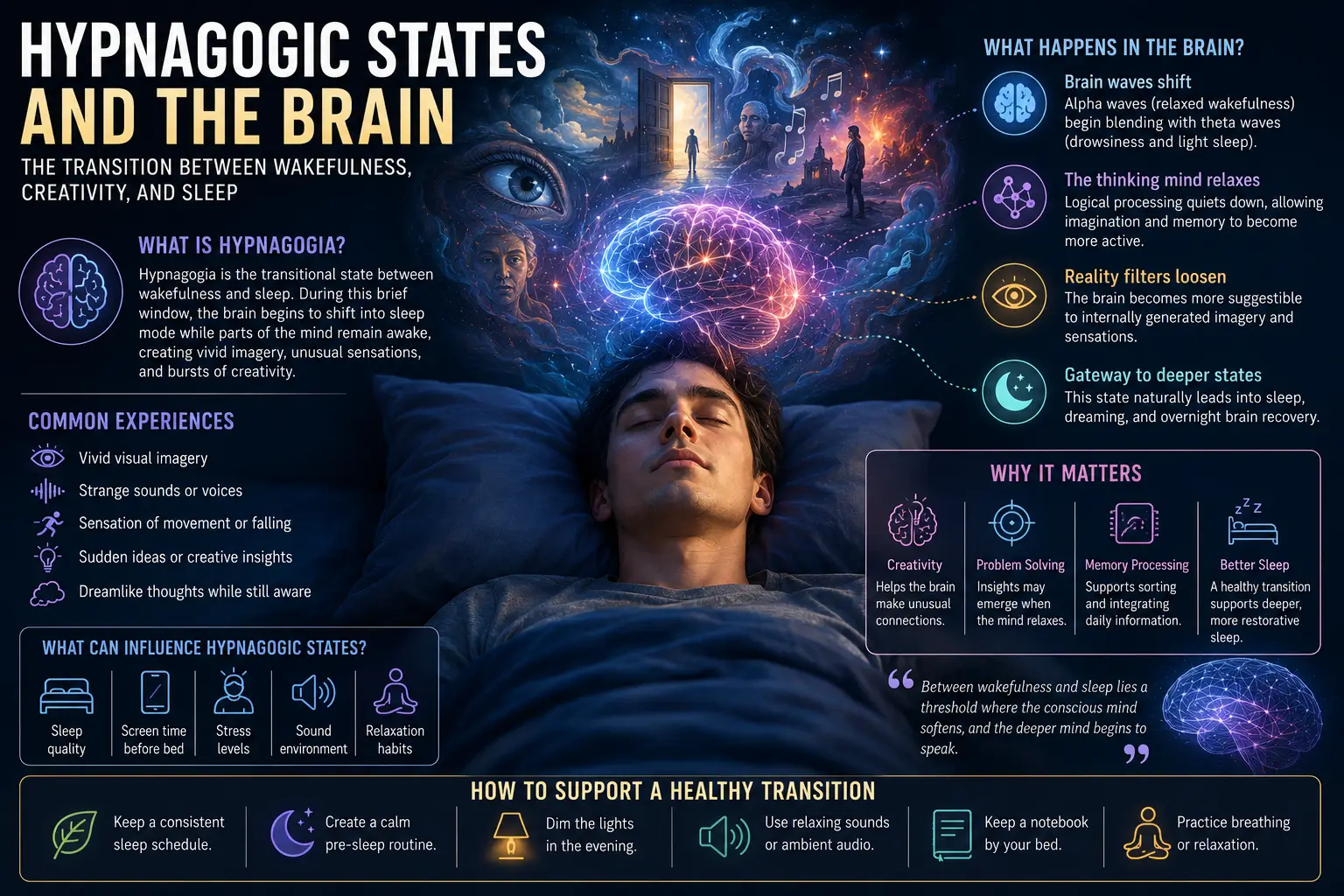
Have you ever experienced a strange moment just before falling asleep?
Perhaps you heard a voice that wasn’t there.
Maybe you briefly saw an image, a face, or an entire scene that disappeared the moment you became fully aware of it.
Some people describe the sensation as dreaming while still awake.
Others remember sudden flashes of insight, unexpected memories, or creative ideas appearing from nowhere.
These experiences often occur during a fascinating neurological transition known as the hypnagogic state.
Although many people experience hypnagogia throughout life, relatively few understand what is actually happening inside the brain during these unusual moments.
🌙 The Borderland Between Wakefulness and Sleep
Most people think of consciousness as a simple switch.
You are either awake or asleep.
Neuroscience suggests the reality is far more complex.
The brain moves through several transitional stages as it shifts between different states of consciousness.
Hypnagogia occurs during the period when wakefulness gradually gives way to sleep.
During this transition, parts of the brain begin displaying activity patterns associated with sleep while other regions continue processing information from the waking world.
The result can feel strange, vivid, and occasionally surreal.

💭 Why Thoughts Feel Different During Hypnagogia
During normal waking consciousness, the brain continuously evaluates information using logic, attention, and reality testing.
As sleep approaches, some of these systems begin relaxing.
The mind may become less focused on external reality and more influenced by internal imagery, memories, emotions, and spontaneous associations.
This is one reason hypnagogic experiences often feel dreamlike while remaining partially conscious.
The brain is no longer operating in its typical daytime mode.
Instead, it is gradually entering a different neurological environment.
🎨 The Surprising Link Between Creativity and Hypnagogia
Throughout history, artists, inventors, and writers have described moments of inspiration occurring near sleep.
Some researchers believe hypnagogic states may create conditions that encourage unusual connections between ideas.
When analytical thinking becomes less dominant, the brain may explore associations that would normally be filtered out during waking consciousness.
This does not guarantee creativity.
However, it may help explain why some people report original ideas appearing unexpectedly while drifting toward sleep.
Related article: Neuroplasticity and Brain Rewiring.
👁️ Hypnagogic Hallucinations Are More Common Than People Think
The word hallucination often sounds alarming.
In reality, hypnagogic hallucinations are surprisingly common and do not automatically indicate a medical problem.
People may experience:
- brief visual images,
- voices or sounds,
- sensations of movement,
- or vivid mental scenes.
These experiences usually last only a short time and disappear once full wakefulness or deeper sleep takes over.
Many individuals experience them occasionally without realizing there is a scientific term for the phenomenon.
🧠 What Happens Inside the Brain?
Scientists continue studying the exact neurological mechanisms behind hypnagogia.
Current research suggests that changing activity patterns across multiple brain networks may contribute to these experiences.
Attention systems begin disengaging from the outside world.
Meanwhile, internally generated imagery may become more prominent.
The brain essentially starts blending elements of waking awareness with processes typically associated with dreaming.
This overlap helps create the unique sensations many people report.
📱 Why Modern Life May Make These States Harder to Notice
Ironically, many people spend less time observing their own transition into sleep than previous generations.
The reason is simple.
Phones, streaming platforms, notifications, and digital stimulation often occupy the final moments before bedtime.
Instead of quietly drifting into sleep, many individuals remain engaged with screens until exhaustion takes over.
This may reduce opportunities to notice subtle changes in awareness that occur during hypnagogia.
Related article: Sensory Overload and the Brain.
😴 Sleep Quality Still Matters
Hypnagogic experiences may be fascinating, but they represent only a small part of the sleep process.
The brain still depends on healthy sleep for:
- memory consolidation,
- cognitive recovery,
- attention regulation,
- and emotional balance.
Understanding unusual states of consciousness should never distract from the importance of overall sleep quality.
Related article: Sleep Waves Explained.
🎧 Can Sound Environments Influence the Experience?
Many people prefer quiet environments before sleep.
Others use ambient sound, calming music, or relaxation audio as part of their evening routines.
The brain remains highly responsive to sensory environments during the transition toward sleep.
Some individuals also explore audio environments designed around relaxation and mental clarity as part of broader recovery habits.
Individual experiences, however, can vary significantly.
⚠️ Common Misunderstandings About Hypnagogia
❌ “Only Certain People Experience It”
Most individuals will experience hypnagogic states at some point during life, even if they rarely remember them.
❌ “It Means Something Is Wrong With The Brain”
Occasional hypnagogic experiences are generally considered a normal part of the transition into sleep.
❌ “Hypnagogia Is The Same As Dreaming”
Hypnagogia occurs during the transition into sleep and often includes elements of both wakefulness and dreaming.
🌌 A Reminder That Consciousness Is Not A Simple Switch
Perhaps the most fascinating lesson from hypnagogia is that consciousness exists on a spectrum.
The boundary between waking and sleeping is not always clear.
Instead, the brain gradually moves through different states, each with its own patterns of perception and awareness.
For a few brief moments, people may find themselves standing at the edge of two worlds simultaneously.
🧠 Final Thoughts
Hypnagogic states offer a fascinating glimpse into one of the brain’s most mysterious transitions.
These moments between wakefulness and sleep reveal how fluid consciousness can be and how differently the brain processes information as it prepares for rest.
While many questions remain unanswered, neuroscience continues uncovering new insights into the relationship between perception, creativity, awareness, and sleep.
Sometimes the most interesting activity inside the brain occurs not when we are fully awake — but during the moments we barely notice.
Related Articles
Stay Informed With the Latest & Most Important News
Previous Post
Next Post