
Now Reading: Binaural Beats for Memory: Can Sound Support Learning and Recall?
-
01
Binaural Beats for Memory: Can Sound Support Learning and Recall?
Binaural Beats for Memory: Can Sound Support Learning and Recall?
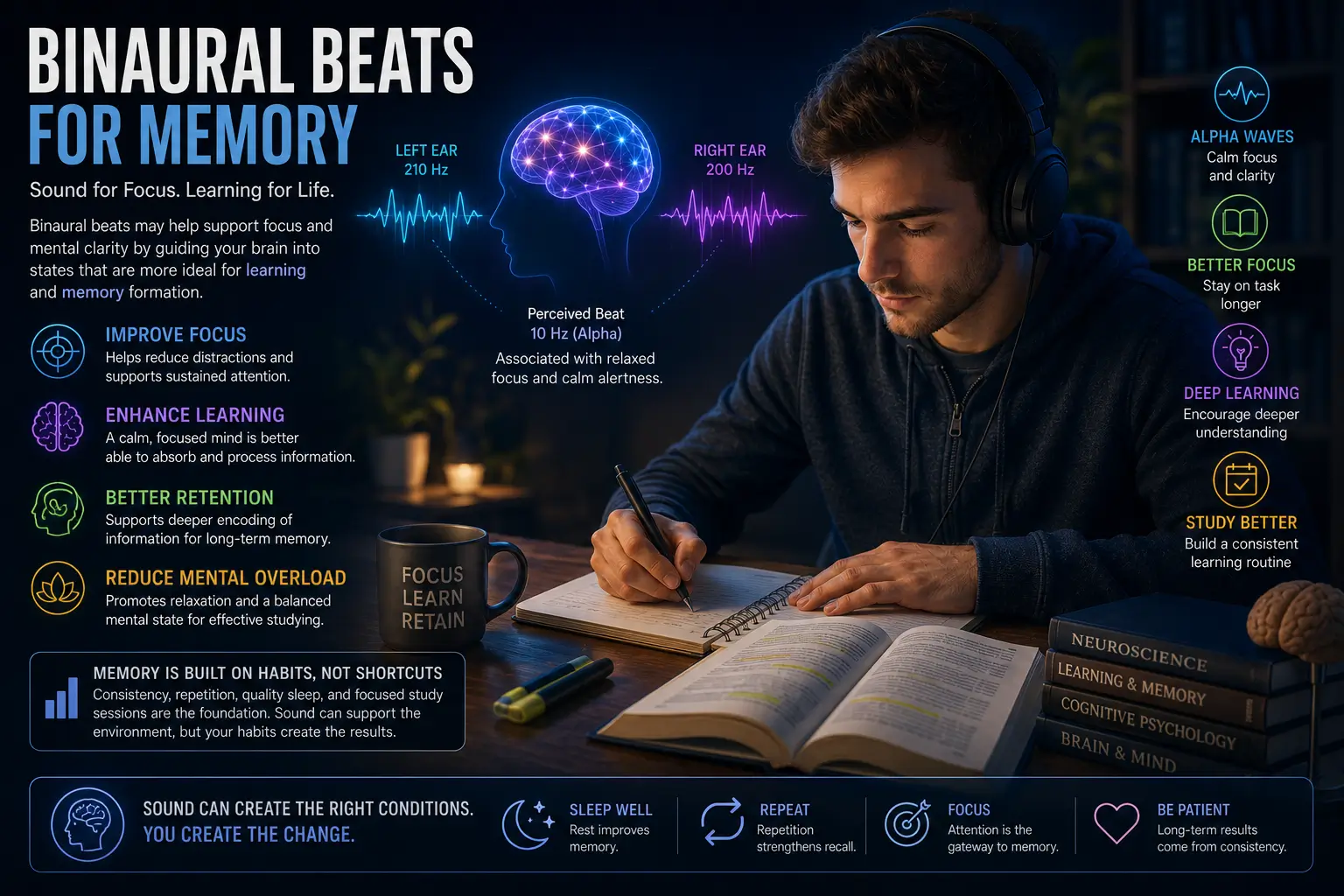
Memory is deeply connected to attention.
When focus becomes fragmented, learning often becomes weaker.
This is one reason many students, professionals, and lifelong learners search for ways to create better mental environments for studying and concentration.
Among the many tools discussed online, binaural beats are frequently promoted as a way to support memory and cognitive performance.
Some claims are realistic.
Others are wildly exaggerated.
You may have seen promises about:
- “unlocking photographic memory,”
- “remembering everything instantly,”
- or “activating hidden brain powers.”
Real memory and learning do not work that way.
However, structured sound environments may still help some people improve focus, reduce distraction, and create more consistent study routines over time.
And those factors can influence how effectively the brain processes information.
🧠 How Memory Actually Works
Memory is not a single ability.
It involves multiple processes including:
- attention,
- encoding information,
- storage,
- recall,
- and repetition.
One of the biggest problems in modern learning environments is not lack of intelligence.
It is lack of sustained attention.
Constant notifications, multitasking, digital overstimulation, and fragmented focus make it harder for the brain to deeply process information.
Related article: Digital Detox for Brain Focus.
🎧 What Are Binaural Beats?
Binaural beats are an auditory phenomenon created when slightly different frequencies are played separately into each ear.
For example:
- the left ear hears 200 Hz,
- the right ear hears 210 Hz.
The brain processes the difference between them as a rhythmic pulse.
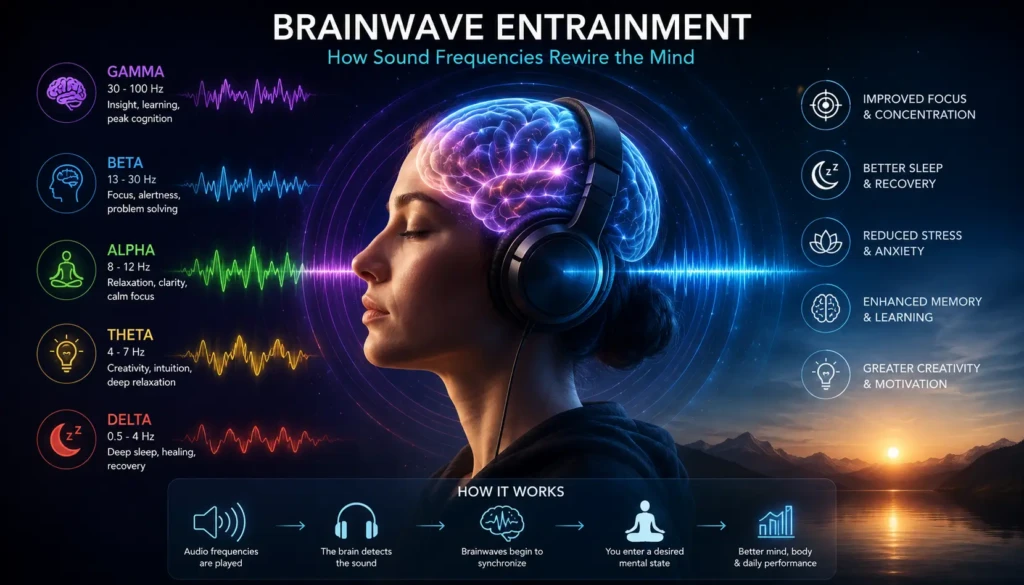
This effect is commonly associated with brainwave entrainment, where rhythmic sound patterns may influence mental states under certain conditions.
Related guide: Brainwave Entrainment Explained.
🌊 Why People Use Binaural Beats While Studying
Many people use binaural beats during:
- reading sessions,
- deep work,
- memorization practice,
- language learning,
- or focused study blocks.
The goal is usually not “magic memory enhancement.”
Instead, people often use sound environments to:
- reduce distraction,
- create mental consistency,
- improve concentration,
- or enter focused work sessions more intentionally.
For some individuals, the environment itself may become psychologically associated with studying and concentration over time.
🎯 Focus Is One of the Biggest Memory Factors
The brain remembers information more effectively when attention is stable.
Constant interruptions weaken deep learning.
This is why many memory techniques focus first on improving concentration rather than “boosting intelligence.”
When attention improves, memory performance often improves with it.
Related guide: How to Use the Memory Palace Technique.
🧠 Brainwave States and Learning
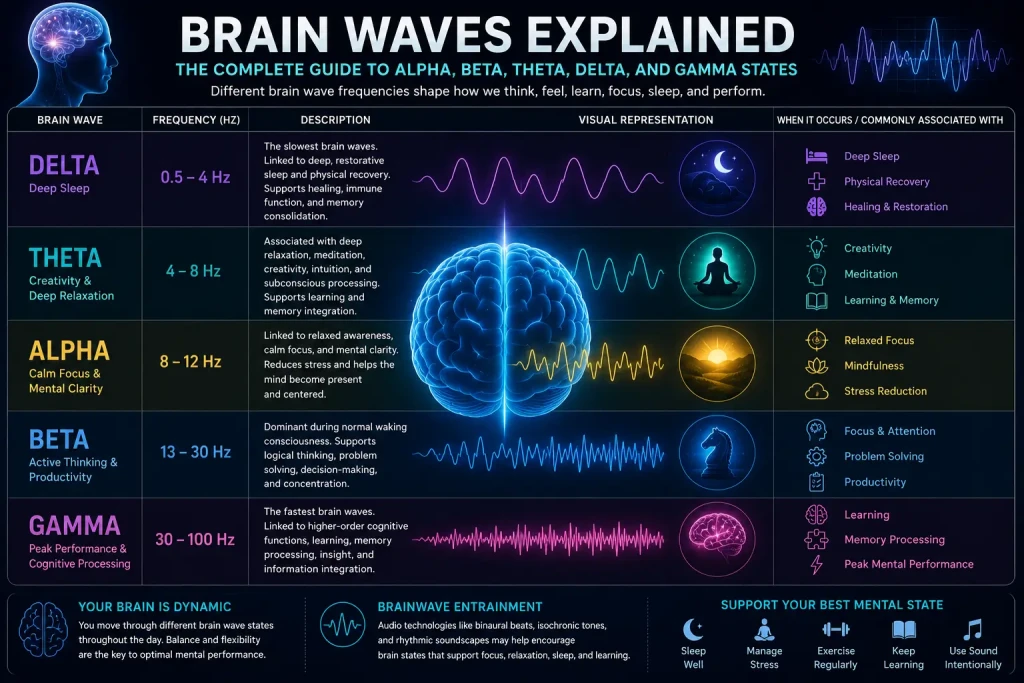
Different brainwave frequency ranges are commonly associated with different mental states.
🔵 Beta Waves
Often linked with alert thinking, active concentration, and focused attention.
Related article: Beta Waves and Motivation.
🟢 Alpha Waves
Frequently associated with calm focus and reduced mental tension.
Some learners prefer calmer environments because excessive stress can interfere with concentration.
Related article: Alpha Brain Waves and Calm Focus.
🟣 Theta Waves
Often discussed in relation to creativity, meditation, and slower mental states.
These may feel relaxing for some listeners but less ideal for active memorization sessions.
Related article: Theta Waves and Sleep.
📚 What Research Says
Research into binaural beats is still evolving.
Some studies suggest rhythmic audio stimulation may influence:
- relaxation,
- attention,
- mood,
- or focus in certain contexts.
However, scientific findings remain mixed.
Results vary significantly between individuals.
This is why responsible discussions should avoid exaggerated promises.
Binaural beats are not scientifically proven shortcuts to perfect memory.
But structured sound environments may still help support healthier focus routines for some listeners.
🧘 Calmness Can Support Learning
Stress and overstimulation can interfere with concentration.
When the brain feels overloaded, retaining information becomes harder.
This is one reason some people prefer calmer study environments.
For certain individuals, relaxing sound environments may reduce mental clutter and make sustained attention easier.
Related article: Stress, Anxiety, and the Brain.
🎵 Audio Environments and Study Habits
One practical advantage of consistent audio environments is habit formation.
The brain often responds strongly to repeated routines.
Some learners use the same sound environment repeatedly during study sessions.
Over time, this may create a psychological association between the audio and focused work.
Some people also explore neuroacoustic audio environments designed to support concentration, focus, and mental recovery routines.
These tools are generally most useful when combined with effective study habits and realistic expectations.
📵 Better Memory Requires Better Habits
No sound technology can replace:
- sleep quality,
- consistent repetition,
- healthy attention habits,
- deep focus,
- or active learning practice.
Memory improves through repetition, engagement, and consistency over time.
Audio may support the environment.
But habits still matter most.
🚫 Common Myths About Memory Audio
❌ “One Frequency Unlocks Perfect Memory”
The brain is far more complex than simplistic internet claims suggest.
❌ “Listening Alone Creates Instant Learning”
Real learning still requires attention, repetition, and active engagement.
❌ “More Intense Audio Means Better Results”
Comfort and consistency are usually more important than aggressive stimulation.
🧩 Building Better Memory Environments
Helpful memory habits may include:
- single-task focus sessions,
- reducing notifications,
- using repetition systems,
- taking breaks,
- improving sleep quality,
- and creating calmer study environments.
For some people, structured audio may become part of that environment.
🧠 Final Thoughts
Binaural beats are not magical memory shortcuts.
However, some listeners may find structured sound environments useful for reducing distraction, improving consistency, and supporting focused study routines.
Memory depends heavily on attention, repetition, recovery, and healthy learning habits over time.
And in a world filled with constant digital distraction, even creating a calmer environment for concentration can already make a meaningful difference.
Related Articles
Related Posts
Stay Informed With the Latest & Most Important News
Previous Post
Next Post