
Now Reading: Neurofeedback vs Binaural Beats: Understanding Two Different Brain Training Approaches
-
01
Neurofeedback vs Binaural Beats: Understanding Two Different Brain Training Approaches
Neurofeedback vs Binaural Beats: Understanding Two Different Brain Training Approaches
Brain training has become an increasingly popular topic in recent years.
Some people want better focus.
Others want calmer mental states, improved concentration, reduced stress, or better recovery from constant overstimulation.
Among the many tools discussed online, two approaches appear frequently:
- neurofeedback,
- and binaural beats.
At first glance, they may seem similar because both involve the brain, sound, and mental states.
But they actually work in very different ways.
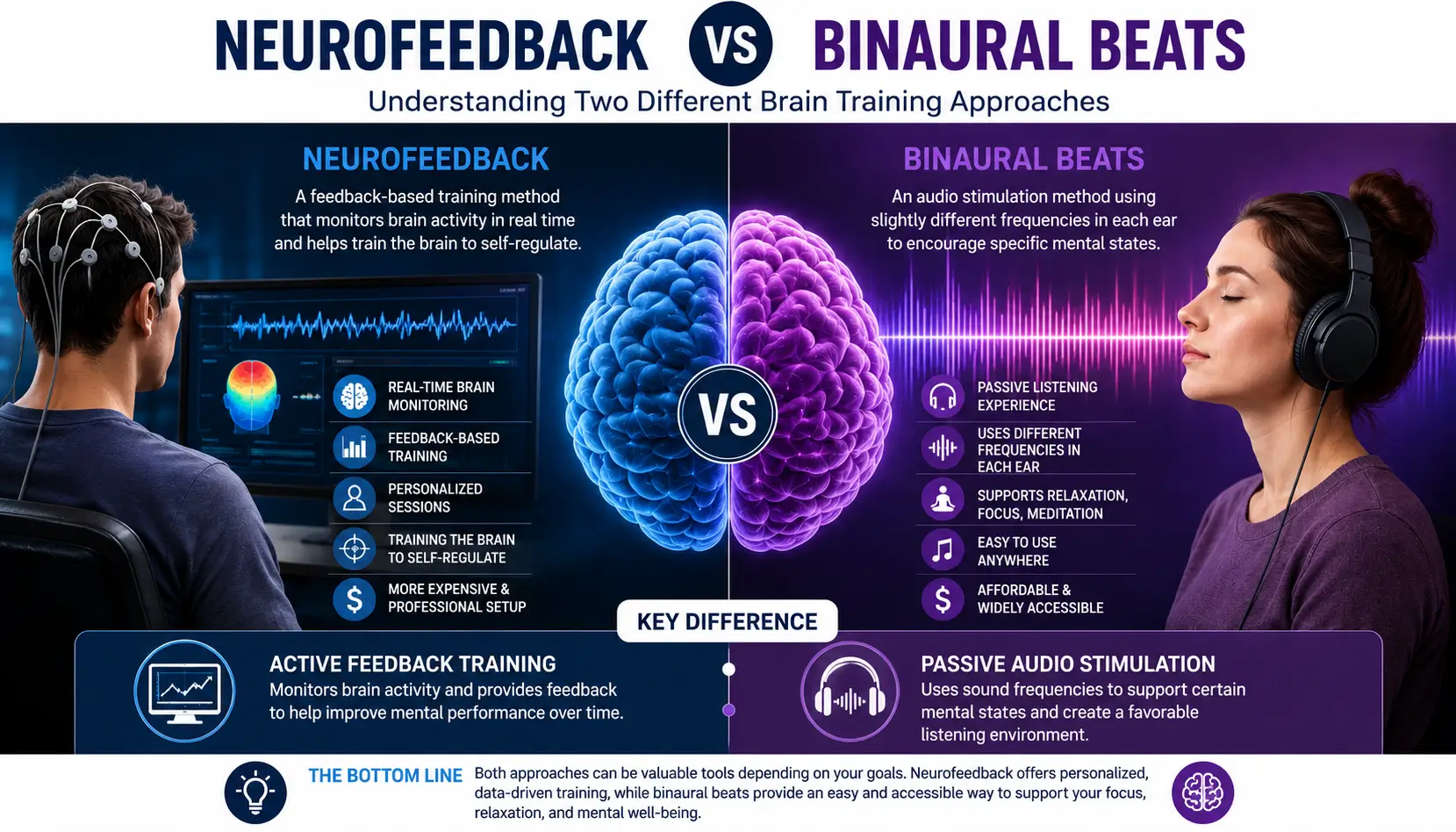
One is a structured feedback-based training system often used in clinical or professional environments.
The other is a form of auditory stimulation that some people use as part of focus, relaxation, or meditation routines.
Understanding the difference matters because many online articles oversimplify both.
🎧 What Are Binaural Beats?
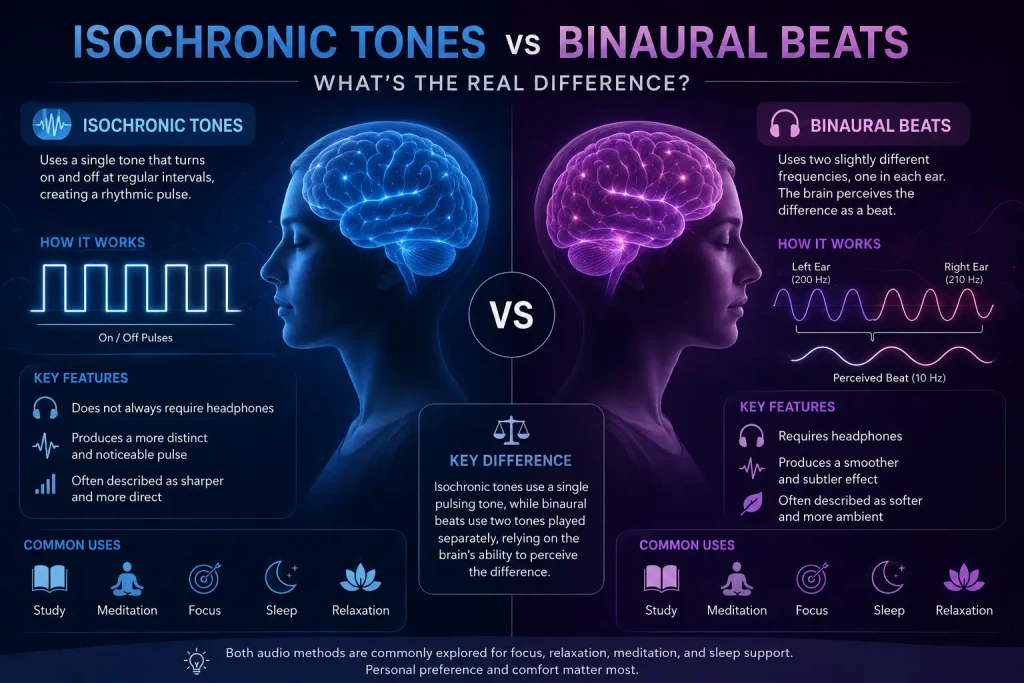
Binaural beats are an auditory illusion created when slightly different frequencies are played into each ear separately.
For example:
- the left ear hears 200 Hz,
- the right ear hears 210 Hz.
The brain processes the difference between them as a rhythmic pulse.
Different frequency ranges are commonly associated with different mental states such as:
- focus,
- relaxation,
- meditation,
- deep rest,
- or calm concentration.
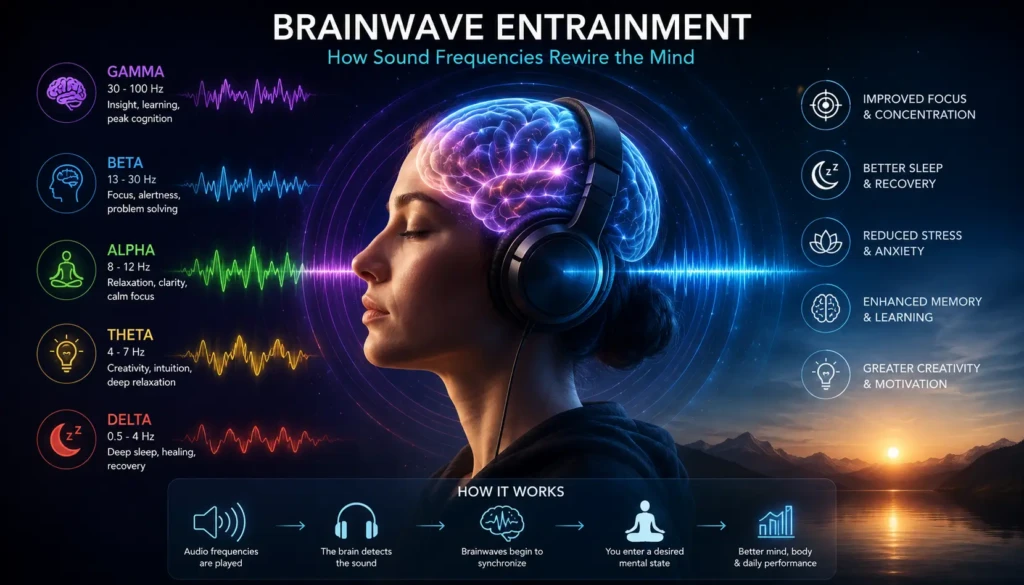
This idea is often connected to brainwave entrainment, where rhythmic stimulation may influence how the brain responds to sound patterns.
Related guide: Brainwave Entrainment Explained.
🧠 What Is Neurofeedback?
Neurofeedback is a more structured form of brain training.
It usually involves sensors placed on the scalp that monitor electrical brain activity in real time.
The system then provides feedback based on those brainwave patterns.
This feedback may appear as:
- visual cues,
- sounds,
- games,
- or computer-based tasks.
The goal is not simply to listen to audio.
The goal is to help the brain learn patterns through feedback and repetition.
This is why neurofeedback is sometimes described as a type of “brain training exercise.”
⚡ The Biggest Difference Between Them
The simplest difference is this:
🎵 Binaural Beats = Passive Listening
You listen to sound.
The audio environment may support certain mental states or routines.
No brain monitoring is required.
📈 Neurofeedback = Active Feedback Training
The system measures brain activity and responds dynamically.
The training changes based on what the brain is doing in real time.
That makes neurofeedback more interactive and technically complex.
🧩 Why People Compare Them
Even though they are different tools, people often compare them because both are associated with:
- focus improvement,
- mental performance,
- attention training,
- stress management,
- and cognitive optimization.
However, the level of scientific support, cost, accessibility, and practical use can vary significantly.
💰 Accessibility and Cost
🎧 Binaural Beats
Binaural beats are widely accessible.
Most people only need:
- headphones,
- a quiet environment,
- and an audio source.
This makes them inexpensive and easy to experiment with.
🧠 Neurofeedback
Neurofeedback systems are usually far more expensive.
Sessions may involve:
- specialized equipment,
- trained practitioners,
- software systems,
- or repeated guided training sessions.
Home systems also exist, but professional setups are generally more advanced.
📚 What Research Says
Research into both neurofeedback and binaural beats is still evolving.
Some studies suggest potential benefits related to relaxation, attention, mood, or cognitive performance in certain contexts.
But it is important to avoid exaggerated claims.
Neither approach should be presented as a miracle solution.
Results vary significantly between individuals.
Responsible discussion means separating:
- possible supportive tools,
- from guaranteed medical outcomes.
🌊 Brainwave States and Mental Performance
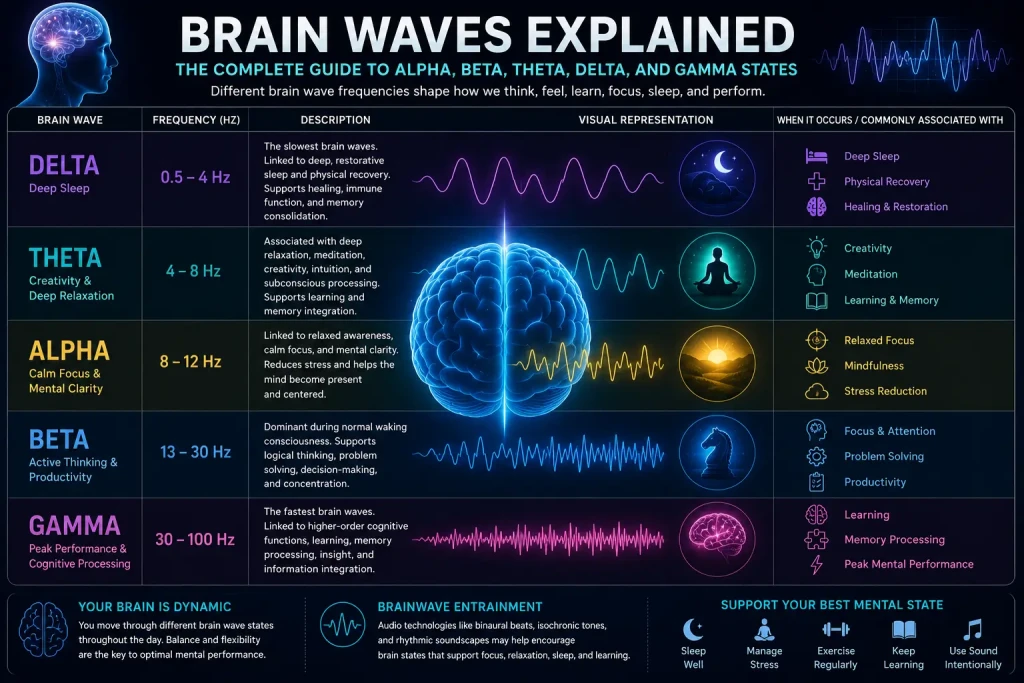
Both neurofeedback discussions and binaural beat discussions often reference different brainwave states.
🔵 Beta Waves
Often associated with alert thinking, focus, and active concentration.
Related article: Beta Waves and Motivation.
🟢 Alpha Waves
Often linked with calm focus, mental relaxation, and reduced overstimulation.
Related article: Alpha Brain Waves and Calm Focus.
🟣 Theta Waves
More commonly associated with meditation, deep relaxation, creativity, and slower mental states.
Related guide: Theta Waves and Sleep.
🎯 Why Some People Prefer Binaural Beats
Some individuals prefer binaural beats because they are:
- simple,
- affordable,
- easy to integrate into routines,
- and less technical.
People often use them during:
- studying,
- deep work,
- meditation,
- journaling,
- reading,
- or relaxation sessions.
For some listeners, the structured sound environment itself may help reduce distraction and improve consistency.
🧠 Why Some People Explore Neurofeedback
Others are more interested in feedback-based systems because they want:
- more personalized training,
- measurable brain activity data,
- or structured cognitive exercises.
Neurofeedback is generally viewed as the more technical and data-driven option.
However, it also requires more time, effort, cost, and setup.
🎵 Audio Environments and Focus Routines
Some individuals also explore neuroacoustic audio environments designed to support focus, relaxation, and mental recovery routines.
These are typically used as part of broader concentration habits rather than standalone solutions.
In many cases, consistency matters more than chasing “perfect frequencies.”
📵 Brain Training Still Depends on Lifestyle
No audio tool or brain training system can fully replace:
- sleep quality,
- stress management,
- healthy routines,
- movement,
- nutrition,
- or focused work habits.
The brain responds to overall lifestyle patterns, not only isolated tools.
That is why sustainable mental performance usually comes from combining:
- healthy routines,
- structured focus environments,
- and realistic expectations.
🚫 Common Misunderstandings
“Binaural Beats and Neurofeedback Are the Same”
They are not.
One is passive auditory stimulation.
The other uses real-time feedback systems.
“These Tools Instantly Unlock Hidden Brain Powers”
Exaggerated claims are common online.
Most real-world effects are usually more subtle and individual.
“More Intense Audio Means Better Results”
Not necessarily.
Comfort, consistency, and environment are often more important.
🧩 Which One Is Better?
There is no universal answer.
They serve different purposes.
Binaural beats may work well for:
- casual focus support,
- relaxation routines,
- meditation environments,
- or concentration sessions.
Neurofeedback may appeal more to people seeking:
- structured feedback systems,
- measurable training,
- or guided cognitive exercises.
The better choice depends on goals, expectations, budget, and personal preference.
🧠 Final Thoughts
Neurofeedback and binaural beats are often discussed together, but they are fundamentally different approaches.
One focuses on real-time brain activity feedback.
The other focuses on auditory stimulation and mental environments.
Neither should be viewed as a magical shortcut.
But both reflect growing interest in how sound, attention, environment, and brain states may influence mental performance and focus routines.
The most sustainable improvements usually come from combining healthy habits with realistic, repeatable mental training practices.
Related Articles
Related Posts
Stay Informed With the Latest & Most Important News
Previous Post
Next Post