
Now Reading: Isochronic Tones vs Binaural Beats: Understanding the Differences in Audio Entrainment
-
01
Isochronic Tones vs Binaural Beats: Understanding the Differences in Audio Entrainment
Isochronic Tones vs Binaural Beats: Understanding the Differences in Audio Entrainment
If you spend enough time exploring brainwave audio, you will eventually encounter the same question:
Are isochronic tones better than binaural beats?
For years, discussions about audio entrainment have often focused on choosing a winner.
Some people strongly prefer binaural beats.
Others argue that isochronic tones are more effective.
In reality, the comparison is more nuanced than a simple “better or worse” debate.
Both approaches are designed around rhythmic audio stimulation, yet they use very different methods to create their listening experience.
Understanding those differences can help explain why people respond differently to different audio environments.
🧠 What Is Audio Entrainment?
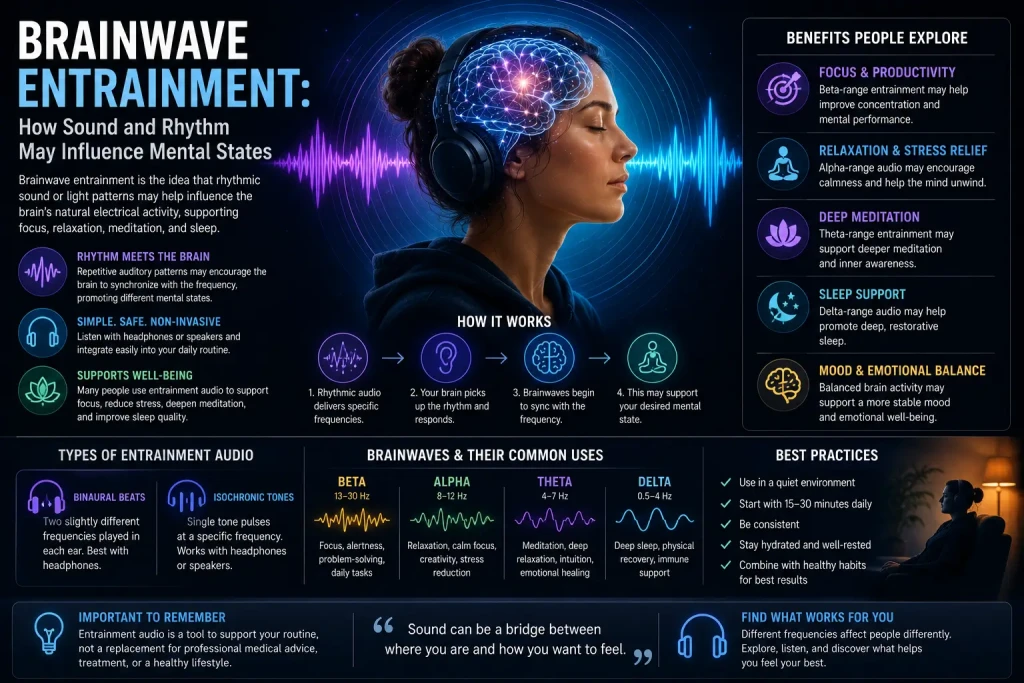
Audio entrainment refers to the use of rhythmic sound patterns designed to influence how the brain responds to auditory input.
The concept has attracted attention from researchers, meditation practitioners, students, and people interested in focus, relaxation, and cognitive performance.
Although audio entrainment remains an evolving area of research, it continues generating interest because of its connection to attention, relaxation, and mental states.
Two of the most widely discussed methods are binaural beats and isochronic tones.
🎵 What Are Binaural Beats?
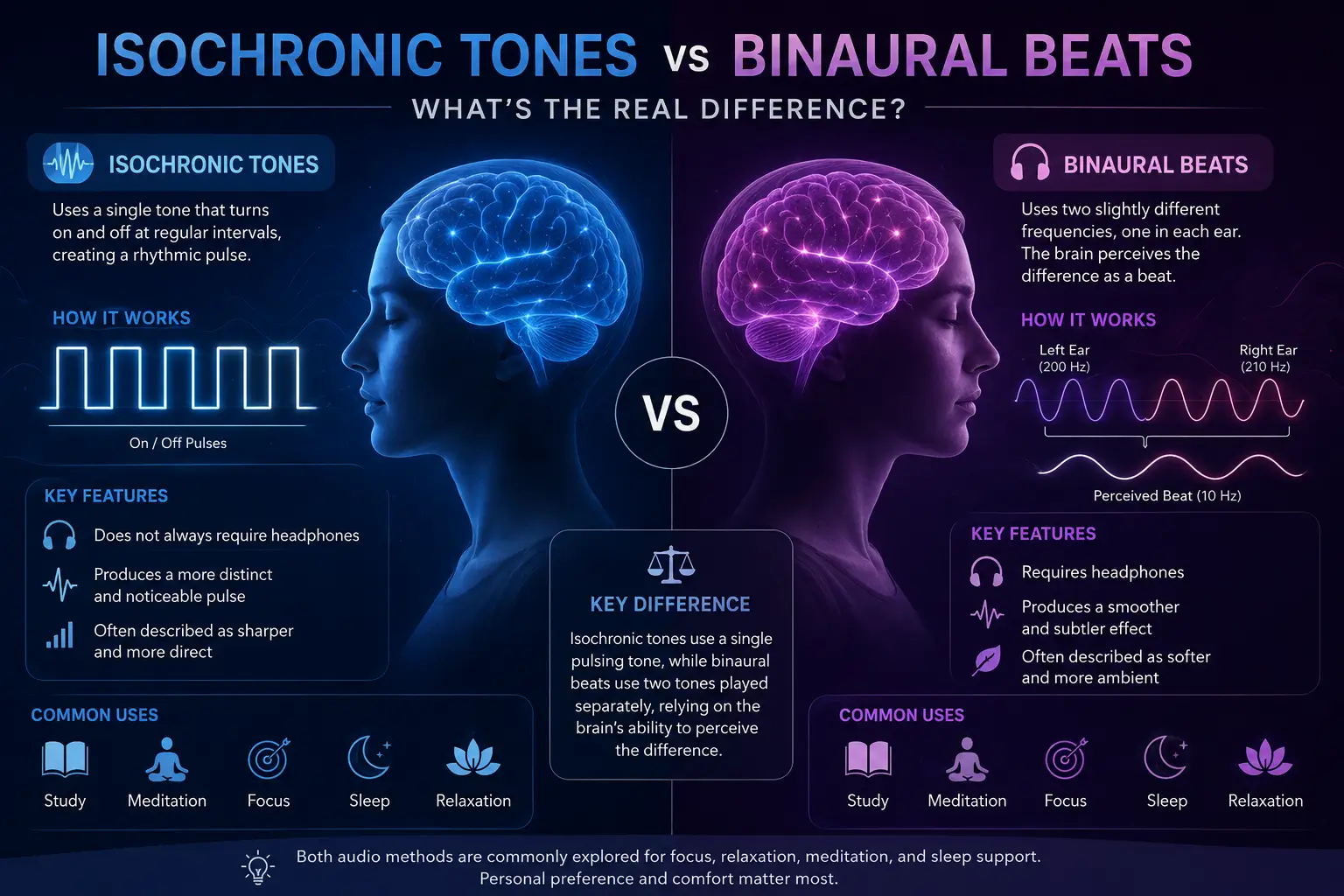
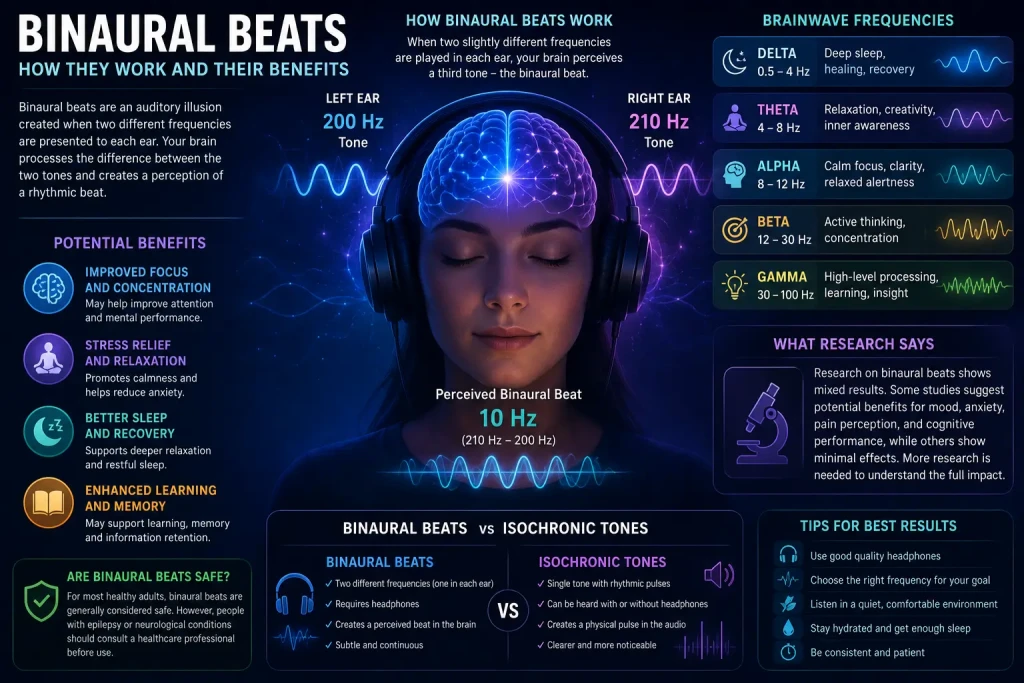
Binaural beats are created when two slightly different frequencies are presented separately to each ear.
For example:
- one tone enters the left ear,
- another enters the right ear,
- and the brain processes the difference between them.
This creates the perception of a rhythmic beat that does not physically exist in the audio itself.
Because each ear receives a different frequency, headphones are typically required for the effect to occur properly.
Related article: Binaural Beats Explained.
⚡ What Are Isochronic Tones?
Isochronic tones use a different approach.
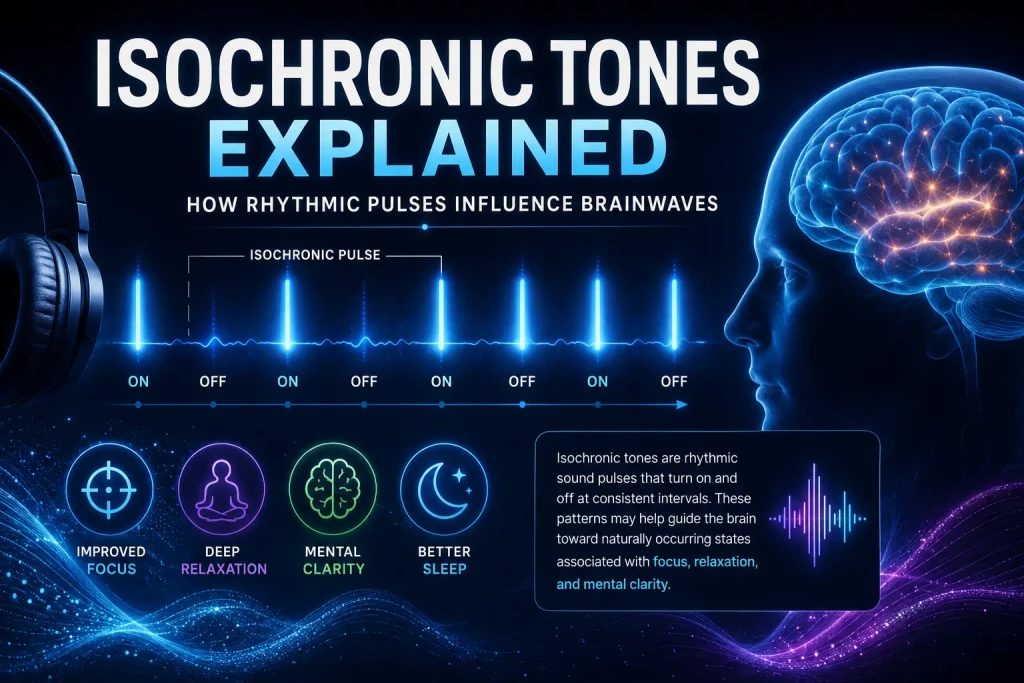
Instead of presenting separate frequencies to each ear, a single tone rapidly turns on and off at regular intervals.
The result is a distinct pulsing sound pattern.
Unlike binaural beats, isochronic tones generally do not require headphones because the rhythmic pulses exist directly within the audio signal.
This creates a listening experience that many people describe as more noticeable and more structured.
🔍 The Core Difference
The simplest way to understand the distinction is this:
Binaural beats create a perceived rhythm inside the brain.
Isochronic tones create an actual rhythmic pulse within the audio itself.
Both methods rely on repetition and rhythm, but they achieve it through different mechanisms.
This difference explains why listeners often have strong personal preferences.
🎯 Which One Feels Better?
There is no universal answer.
Some individuals find binaural beats smoother and easier to listen to during relaxation sessions.
Others prefer the clearer pulsing nature of isochronic tones.
Personal preference often plays a significant role.
Factors that may influence the listening experience include:
- audio sensitivity,
- listening environment,
- comfort with headphones,
- attention style,
- and individual expectations.
📚 What Does Research Actually Say?
One of the biggest misconceptions online is the idea that science has already declared a clear winner.
That is not the case.
Researchers continue studying how different forms of rhythmic auditory stimulation may influence attention, relaxation, and subjective experiences.
Current findings remain complex and often depend on study design, participant characteristics, and the outcomes being measured.
In other words, the science is still developing.
😌 Binaural Beats and Relaxation
Binaural beats are frequently associated with relaxation, meditation, and quieter listening environments.
Because the perceived rhythm is subtle, some listeners describe the experience as immersive and less intrusive.
This may explain why binaural beats are often discussed alongside:
- meditation,
- sleep routines,
- mindfulness practices,
- and stress management.
Related article: Theta Brain Waves Explained.
⚡ Isochronic Tones and Structured Listening
Isochronic tones often feel more direct because the rhythmic pulses are clearly audible.
Some listeners appreciate this stronger sense of structure.
Others find it distracting.
The response is highly individual.
This highlights an important reality of audio entrainment:
People do not always respond to the same sound environment in the same way.
🧠 Why The Brain Responds Differently To Different Audio
The human brain continuously processes sound.
Music, speech, ambient noise, and rhythmic patterns all influence attention in different ways.
Some people focus better with background sound.
Others perform best in complete silence.
This variability helps explain why debates about binaural beats and isochronic tones rarely produce a universal conclusion.
Related article: Cognitive Performance and Attention Span.
🎧 Modern Neuroacoustic Audio Environments
Today, many audio platforms combine multiple sound design techniques rather than relying exclusively on one method.
Ambient soundscapes, layered frequencies, nature sounds, music, and rhythmic elements are often blended together to create richer listening experiences.
Some individuals also explore neuroacoustic audio environments designed around focus, relaxation, and mental clarity as part of broader cognitive wellness routines.
Individual experiences may vary significantly.
⚠️ Common Misunderstandings About Audio Entrainment
❌ “Isochronic Tones Are Proven To Be Better”
Current research does not support a universal winner for every person or every situation.
❌ “Binaural Beats Work Without Headphones”
Binaural beats generally require separate frequencies delivered to each ear.
❌ “One Listening Session Changes Everything”
Audio experiences are highly individual and should not be viewed as instant solutions.
🌿 The Better Question May Not Be Which Is Better
Many discussions focus on choosing a winner.
A more useful question may be:
Which listening environment feels most comfortable and useful for your goals?
Because audio entrainment is highly personal, the answer often varies from one individual to another.
The most effective approach is usually thoughtful experimentation rather than assuming one method works best for everyone.
🧠 Final Thoughts
Isochronic tones and binaural beats represent two different approaches to rhythmic auditory stimulation.
While they share certain goals, they achieve them through distinct methods.
Neither approach automatically wins every comparison.
The choice often depends on personal preference, listening conditions, and individual response.
As neuroscience continues exploring how sound influences attention, relaxation, and cognition, both methods remain important parts of the broader conversation about audio entrainment.
Related Articles
Related Posts
Stay Informed With the Latest & Most Important News
Previous Post
Next Post