
Now Reading: Flow State Brain Waves: How to Enter Deep Focus on Command
-
01
Flow State Brain Waves: How to Enter Deep Focus on Command
Flow State Brain Waves: How to Enter Deep Focus on Command
Athletes call it:
“the zone.”
Writers describe it as:
complete immersion.
Programmers often experience it as:
hours passing without noticing time.
Psychologists call this mental condition:
flow state.
Flow is not ordinary concentration.
It is a deeper state of cognitive absorption where attention, performance, and awareness begin operating with unusual smoothness and efficiency.
Many researchers believe specific brainwave patterns may play a role in helping the brain transition into these immersive mental states.
The goal is not hyperactivity.
It’s frictionless performance.
🧠 What Is Flow State, Exactly?
The term “flow state” was popularized by psychologist
Mihaly Csikszentmihalyi.
He described flow as:
a mental state where a person becomes fully immersed in an activity with energized focus and reduced self-consciousness.
People often report:
- distorted time perception,
- automatic performance,
- deep immersion,
- reduced mental chatter,
- and effortless concentration.
Flow states commonly occur during:
- sports,
- music,
- gaming,
- creative work,
- coding,
- writing,
- and high-level skill performance.
Unlike ordinary focus, flow often feels:
automatic rather than forced.
🔬 The Brainwave Patterns Associated With Flow
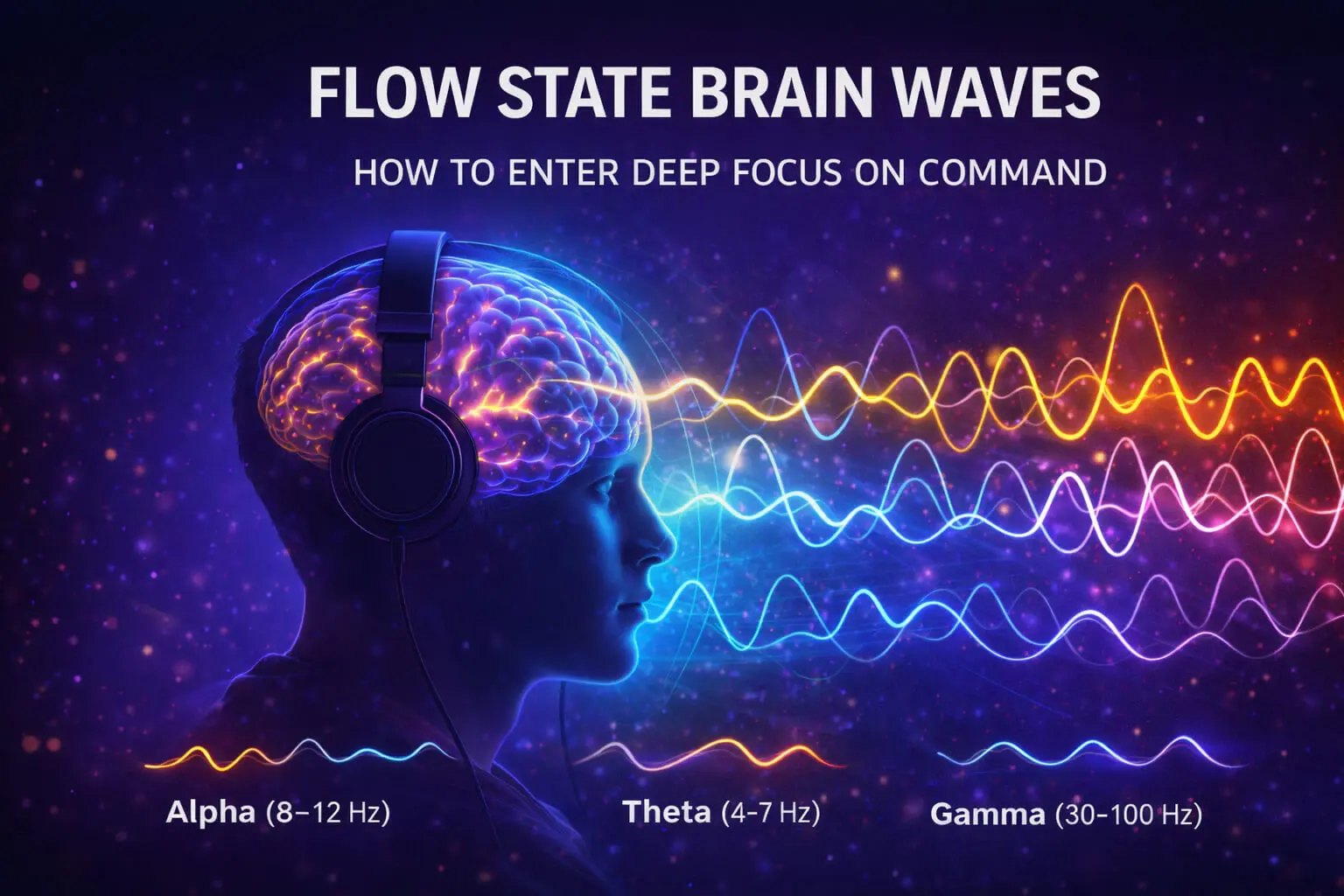
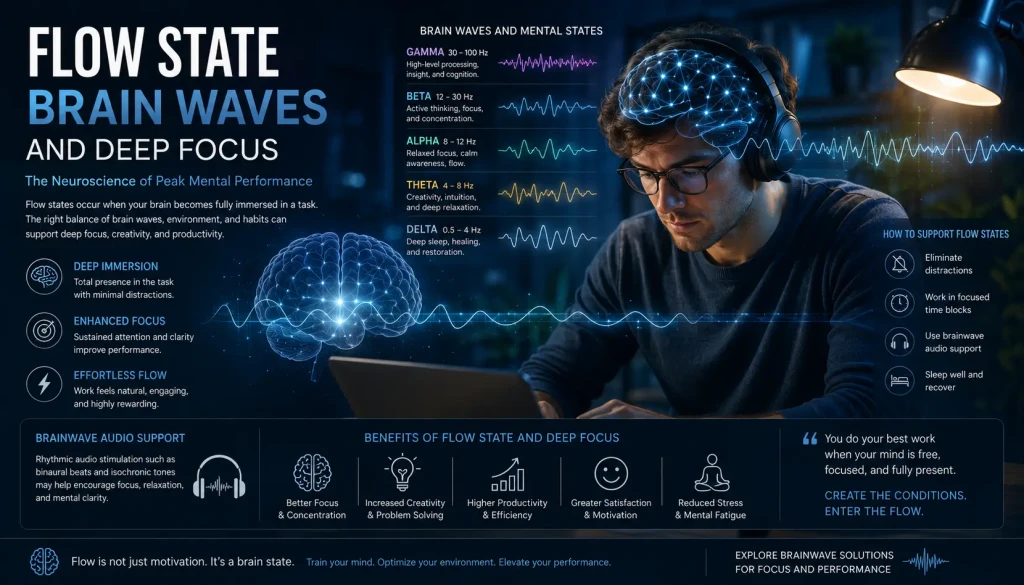
Researchers still debate the exact neurological structure of flow states, but many studies suggest that flow involves a combination of multiple brainwave ranges working together dynamically.
Commonly discussed patterns include:
- Alpha waves,
- Theta waves,
- and low Gamma synchronization.
This combination may support:
- relaxed awareness,
- reduced internal distraction,
- creative association,
- and rapid information processing.
Flow appears to exist between:
relaxation and intense cognitive engagement.
That balance is what makes it unique.
🌊 Alpha Waves & Relaxed Performance
Alpha activity is often associated with:
- calm awareness,
- reduced mental noise,
- and smooth concentration.
Many performance psychologists believe Alpha dominance helps reduce overthinking during skilled activities.
Athletes sometimes describe this sensation as:
“stopping conscious effort and letting performance happen.”
Excessive mental tension often disrupts flow.
Alpha states may help reduce that friction.
Learn more in our guide on Alpha Waves for Relaxation.
⚡ Gamma Synchronization & High-Level Processing
Gamma activity is frequently associated with:
- neural integration,
- rapid cognition,
- heightened awareness,
- and advanced information processing.
Some neuroscientists believe Gamma synchronization may contribute to moments of:
- insight,
- pattern recognition,
- and accelerated decision-making during high-performance states.
However, flow is probably not caused by Gamma alone.
The interaction between multiple brainwave systems appears more important than any single frequency.
Explore more in our article about Gamma Waves Benefits.
🎯 Why Flow Feels Different From Normal Concentration
Ordinary concentration often feels effortful.
Flow usually feels:
- immersive,
- automatic,
- and psychologically quiet.
People in flow frequently report:
- reduced awareness of distractions,
- smoother reactions,
- and reduced self-monitoring.
This difference matters.
Flow is not simply:
“trying harder.”
It is a temporary shift in how attention and awareness organize themselves.
🧘 Can Brainwave Audio Help Trigger Flow States?
Some people use brainwave entrainment audio to help create mental conditions associated with flow-oriented performance.
The idea is not to “force” flow instantly.
Instead, the goal is usually:
- reducing cognitive resistance,
- calming internal distraction,
- and supporting immersive attention.
Listeners often experiment with:
- Alpha sessions before creative work,
- Theta during brainstorming,
- and Gamma-oriented stimulation during demanding cognitive tasks.
👉 Some users explore Genius Wave because the sessions combine multiple layered frequencies designed to support calmer immersion rather than aggressive stimulation.
🧩 Why Flow Cannot Be Forced
This is one of the biggest misconceptions online.
Many productivity systems market flow like an instant switch.
But real flow states usually emerge from:
- skill familiarity,
- clear goals,
- reduced distraction,
- and sustained engagement.
Brainwave audio may help create supportive conditions — but it cannot replace practice, discipline, or genuine immersion.
Trying too hard to “enter flow” often prevents it.
Ironically, flow usually appears when mental resistance decreases.
🏃 The Athlete Mindset & Deep Cognitive Immersion
Elite athletes often describe:
- slowed perception,
- automatic reactions,
- and intense environmental awareness during competition.
Creative professionals report similar experiences during:
- writing,
- design,
- composing,
- and coding.
Although these activities differ physically, the underlying psychological pattern may be surprisingly similar:
deep cognitive immersion.
This is why flow psychology interests:
- neuroscientists,
- performance coaches,
- athletes,
- and creators alike.
⚠️ Common Myths About Flow State
Myth:
“Flow means maximum mental intensity.”
Reality:
Flow usually involves reduced mental friction, not extreme mental strain.
Myth:
“You can enter flow instantly with the right frequency.”
Reality:
Flow states are influenced by many factors beyond audio stimulation.
Myth:
“Flow is just concentration.”
Reality:
Flow involves altered awareness, immersion, and reduced self-consciousness — not just attention.
🔍 How To Create Better Conditions for Flow
If you want to improve the likelihood of entering flow states:
- Remove distractions
- Work on meaningful tasks
- Use uninterrupted time blocks
- Reduce excessive multitasking
- Practice consistently
- Use calming environments
- Avoid overstimulation before deep work
Many people find flow easier when the nervous system feels calmer and less fragmented.
Final Thoughts
Flow state remains one of the most fascinating mental phenomena in performance psychology.
It represents a state where:
- awareness narrows,
- distraction fades,
- and action begins feeling unusually fluid.
Brainwave research suggests that flow may involve a delicate balance between relaxation and advanced cognitive integration.
Not forced intensity.
Not magical transformation.
But temporary alignment between attention, skill, and immersion.
And for many people, that may be where their best work happens.
Related Articles
- Ultimate Guide to Brainwave Entrainment
- Gamma Waves Benefits
- Alpha Waves for Relaxation
- Best Frequencies for Studying
👉 Related read: The Hidden Power of Theta Brainwaves for Emotional Healing for more insights on brainwave focus and mental clarity.
Related Posts
Stay Informed With the Latest & Most Important News
Previous Post
Next Post