
Now Reading: Gamma Brain Waves for Focus and Learning: How High-Frequency Brain Activity Supports Mental Performance
-
01
Gamma Brain Waves for Focus and Learning: How High-Frequency Brain Activity Supports Mental Performance
Gamma Brain Waves for Focus and Learning: How High-Frequency Brain Activity Supports Mental Performance
If someone asked you which part of the brain is responsible for focus, learning, or attention, the answer would not be a single brain region.
The brain operates through vast networks of neurons communicating with one another every second.
Scientists often study these communication patterns by observing brainwave activity.
Among the different brainwave categories, gamma waves have attracted significant attention because of their association with higher-level cognitive processing.
While gamma activity is often discussed in popular neuroscience content, the reality is both more fascinating and more nuanced than many headlines suggest.
🧠 What Are Gamma Brain Waves?
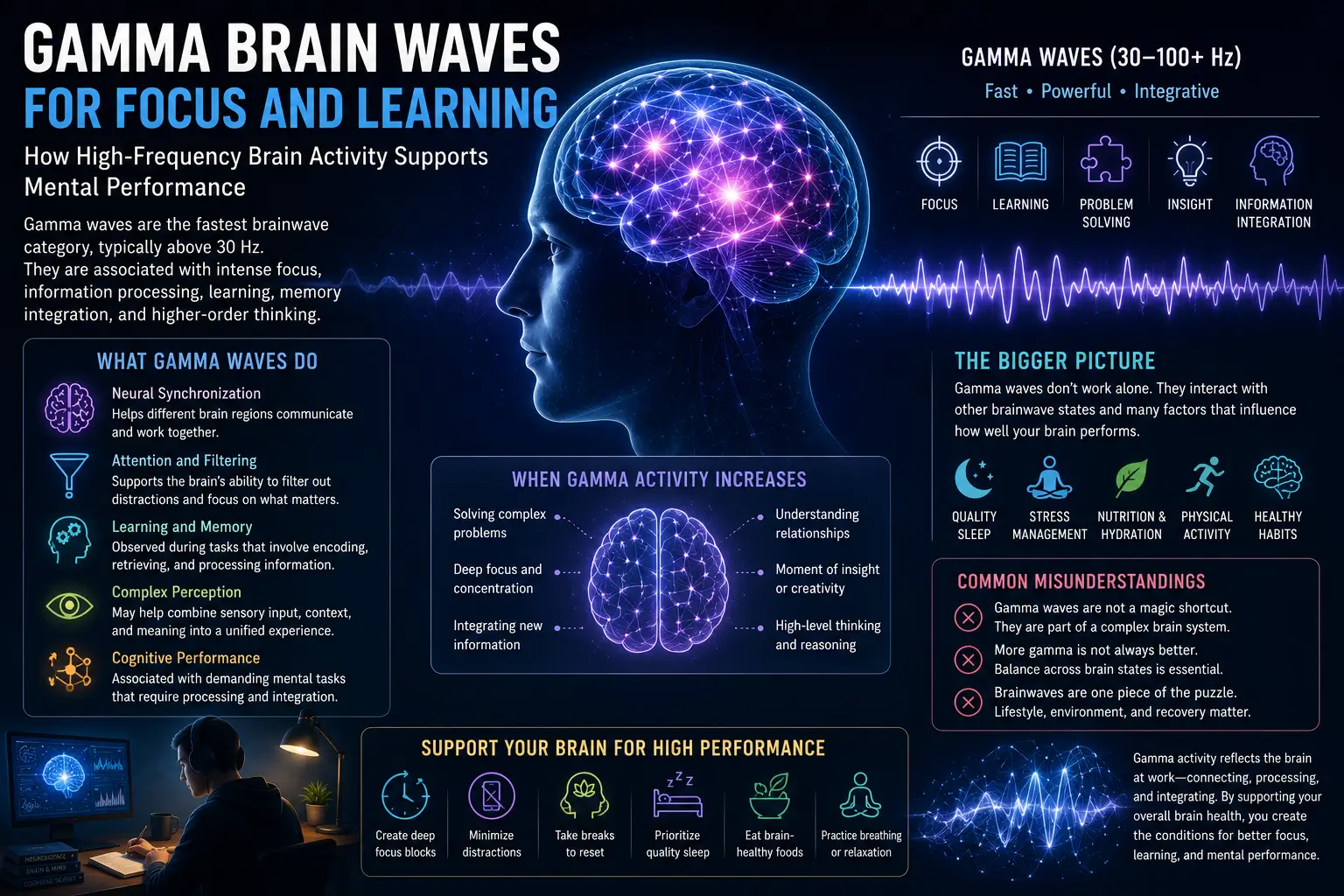
Gamma waves are generally considered the fastest commonly discussed brainwave category.
They are often measured at frequencies above 30 Hz, although exact ranges may vary depending on the research being referenced.
Unlike slower brainwave patterns associated with deep relaxation or sleep, gamma activity is frequently observed during mentally demanding tasks.
Researchers continue investigating how gamma waves may relate to:
- attention,
- learning,
- memory processing,
- problem solving,
- and sensory integration.
Related article: Gamma Brain Waves Explained.
🎯 Why Scientists Study Gamma Activity
The brain constantly receives information from multiple sources.
At any given moment, it must process sounds, visual input, memories, emotions, and environmental cues.
One of the major questions in neuroscience is how the brain combines these separate streams of information into a coherent experience.
Some researchers believe gamma activity may play a role in helping different neural networks communicate efficiently during complex cognitive tasks.
Although many questions remain unanswered, gamma waves continue to be an active area of scientific investigation.
📚 Gamma Waves and Learning
Learning requires more than simply receiving information.
The brain must organize, process, store, and retrieve knowledge efficiently.
Researchers have observed gamma activity during various learning-related tasks, leading to ongoing interest in its potential role in cognitive performance.
This does not mean gamma waves automatically create intelligence or guarantee learning success.
However, they appear to be associated with periods of active information processing.
Related article: Cognitive Performance and Attention Span.
⚡ Focus Requires More Than Concentration Alone
People often think of focus as simply paying attention.
In reality, attention involves multiple cognitive systems working together.
The brain must:
- filter distractions,
- prioritize information,
- maintain working memory,
- and allocate mental resources effectively.
Gamma activity has frequently been observed during tasks that require sustained attention and active mental engagement.
This is one reason gamma waves are often discussed in relation to focus and productivity.
👁️ Perception Is More Complex Than It Appears
Take a simple example.
When you look at a face, the brain processes shape, color, movement, memory, and emotional meaning simultaneously.
Yet the experience feels seamless.
Scientists continue exploring how neural synchronization may contribute to this process.
Gamma activity is sometimes discussed as one possible mechanism involved in coordinating information across different brain regions.
Related article: How Hearing Works in the Brain.
📱 Modern Life Places Constant Demands on Attention
Today’s environment is filled with competing sources of stimulation.
Notifications, social media feeds, messages, advertisements, and multitasking continuously compete for attention.
Many people report feeling mentally scattered even when they are highly motivated.
This is one reason discussions about cognitive performance have become increasingly common.
The challenge is often not a lack of information.
Instead, it is managing the enormous volume of information already competing for attention.
Related article: Sensory Overload and the Brain.
😴 Sleep Remains Essential For Mental Performance
People sometimes focus heavily on optimizing productivity while overlooking recovery.
However, attention, learning, and memory depend heavily on sleep quality.
During sleep, the brain performs numerous restorative processes that support cognitive function.
No discussion about mental performance is complete without acknowledging the importance of recovery.
Related article: Sleep Waves Explained.
🧩 Gamma Waves Are Not A Magic Shortcut
One of the biggest misconceptions online is the idea that a specific brainwave automatically produces a specific mental state.
The brain is far more complex than that.
Gamma activity exists within larger neural systems that involve countless interacting processes.
Focus, learning, and cognitive performance are influenced by:
- sleep quality,
- stress levels,
- environment,
- nutrition,
- habits,
- and overall health.
Brainwaves represent one part of a much larger picture.
🎧 Audio, Focus, and Cognitive Environments
Some individuals explore audio environments designed to support concentration and reduce distractions.
Others prefer silence, ambient sounds, or structured listening environments while working.
The brain continuously responds to sensory inputs, including sound.
Some people also explore audio experiences designed around focus and mental clarity as part of broader productivity and recovery routines.
Individual experiences can vary significantly.
⚠️ Common Misunderstandings About Gamma Waves
❌ “Gamma Waves Make You Instantly Smarter”
Intelligence and cognitive performance depend on many interacting biological and environmental factors.
❌ “More Gamma Is Always Better”
The brain functions through balance across multiple neural systems, not through maximizing a single brainwave category.
❌ “Brainwaves Explain Everything”
Brainwave activity provides useful information, but it represents only one aspect of how the brain operates.
🧠 Final Thoughts
Gamma brain waves remain one of the most intriguing areas of modern neuroscience.
Researchers continue studying how high-frequency brain activity may contribute to attention, learning, perception, and information processing.
While many popular claims oversimplify the science, gamma activity offers valuable insights into how the brain coordinates complex mental tasks.
The most effective approach to cognitive performance is rarely chasing a single brainwave. Instead, it involves creating healthy conditions that allow the brain to perform at its best.
Related Articles
Related Posts
Stay Informed With the Latest & Most Important News
Previous Post
Next Post