
Now Reading: The Science of Binaural Beats: How Audio Frequencies May Influence Focus and Relaxation
-
01
The Science of Binaural Beats: How Audio Frequencies May Influence Focus and Relaxation
The Science of Binaural Beats: How Audio Frequencies May Influence Focus and Relaxation
Binaural beats have become one of the most discussed topics in the world of brainwave audio.
Some people use them while studying.
Others use them during meditation, deep work, sleep routines, or relaxation sessions.
But despite their growing popularity, there is still a lot of confusion surrounding what binaural beats actually are — and what they are not.
Some online articles describe them realistically.
Others exaggerate them into magical “mind hacks” that supposedly unlock hidden powers overnight.
The truth is usually somewhere in the middle.
Binaural beats are real auditory phenomena.
However, their effects are often more subtle and individual than sensational marketing claims suggest.
🎧 What Are Binaural Beats?
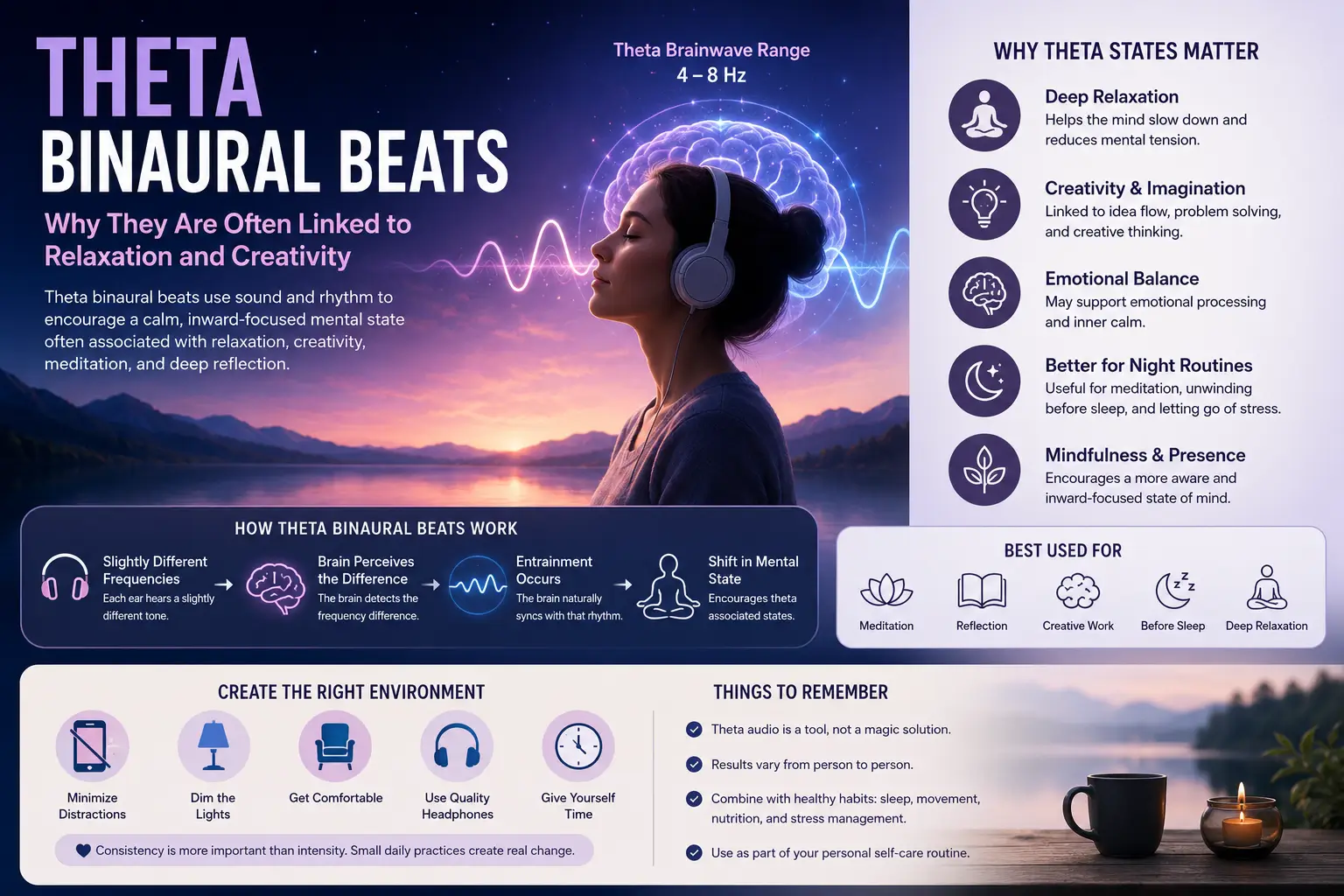
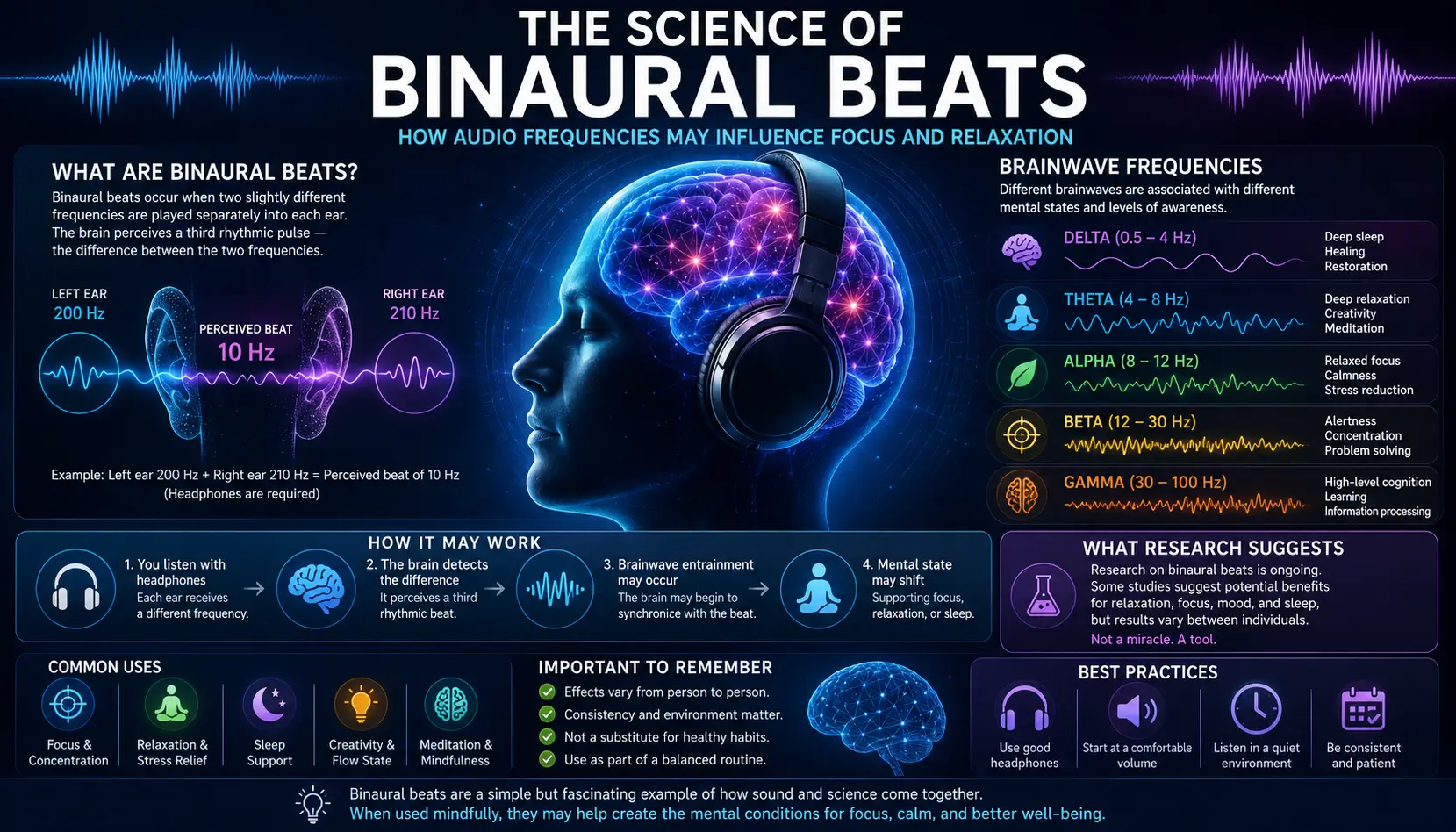
Binaural beats occur when two slightly different frequencies are played separately into each ear.
For example:
- the left ear hears 200 Hz,
- the right ear hears 210 Hz.
The brain processes the difference between them as a rhythmic pulse.
In this example, the perceived pulse would be 10 Hz.
This effect only works properly when listening with headphones because each ear must receive a separate frequency.
The phenomenon was first identified in the 19th century, long before modern wellness trends and brainwave audio products became popular online.
🧠 Why Are Brainwave Frequencies Important?
The human brain naturally produces electrical activity.
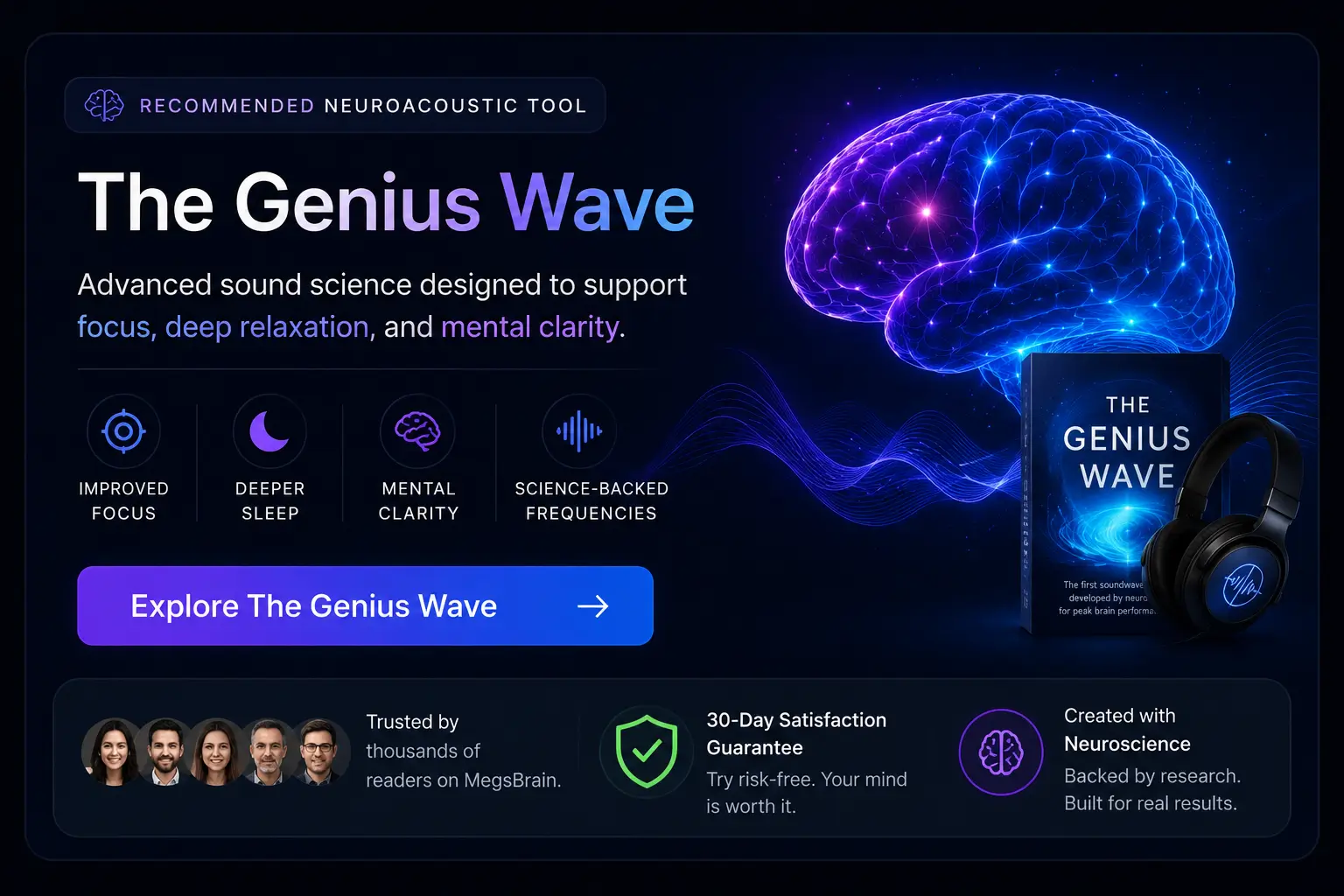
These patterns are often grouped into frequency ranges associated with different mental states.
While the brain is far more complex than simple categories, these ranges are commonly discussed in neuroscience and brainwave research.
🔵 Beta Waves
Often associated with alert thinking, active focus, and concentration.
Related article: Beta Waves and Motivation.
🟢 Alpha Waves
Often linked with calm focus, relaxation, and reduced mental tension.
Related article: Alpha Brain Waves and Calm Focus.
🟣 Theta Waves
Frequently associated with meditation, creativity, deep relaxation, and slower mental states.
Related guide: Theta Waves and Sleep.
⚫ Delta Waves
Most commonly connected with deep sleep and restorative rest.
Related article: Sleep Waves Explained.
🟡 Gamma Waves
Often discussed in relation to cognitive processing, awareness, and complex mental activity.
Related guide: Gamma Brain Waves and Cognitive Performance.
🌊 What Is Brainwave Entrainment?
Binaural beats are commonly associated with a concept called brainwave entrainment.
This refers to the idea that rhythmic sensory stimulation may influence how the brain responds to patterns of sound.
The theory suggests that repeated rhythmic input could encourage the brain to synchronize with certain frequencies under specific conditions.
However, it is important to avoid oversimplifying the science.
The brain is not a machine with a single “magic frequency” for success, intelligence, or happiness.
Human attention, mood, stress, sleep, and cognition are influenced by many biological and environmental factors.
📚 What Research Says About Binaural Beats
Research into binaural beats is still developing.
Some studies suggest possible effects related to:
- relaxation,
- stress reduction,
- attention,
- mood,
- or sleep support.
However, findings are mixed, and results vary significantly between individuals.
Some listeners report noticeable benefits.
Others experience little or no effect.
This is why responsible discussions about binaural beats should avoid extreme promises.
They are not scientifically proven miracle tools.
But they may still help create structured mental environments that some individuals find useful.
🎵 Why Some People Use Binaural Beats for Focus
One practical reason binaural beats may help some listeners is environmental consistency.
Modern life is extremely distracting.
Notifications, multitasking, constant stimulation, and fragmented attention can make deep focus difficult.
Some people use structured audio environments to reduce mental noise and transition into concentration more intentionally.
This may include:
- headphones,
- ambient sound,
- focus music,
- or binaural beat sessions.
For many listeners, the environment itself may matter as much as the frequencies.
Related guide: Best Binaural Beats for Focus and Concentration.
😴 Binaural Beats and Sleep
Binaural beats are also commonly used during nighttime routines.
Some listeners report that slower-frequency audio helps create calmer pre-sleep environments.
Again, results vary between individuals.
But reducing overstimulation before bed can itself support better rest habits.
Related article: Binaural Beats for Sleep.
⚡ Common Myths About Binaural Beats
❌ “They Instantly Unlock Hidden Brain Powers”
This is one of the most exaggerated claims online.
The brain is complex.
No audio frequency instantly creates genius-level intelligence or supernatural abilities.
❌ “More Intense Frequencies Mean Better Results”
Comfort and consistency matter more than extreme stimulation.
Louder or more aggressive audio does not automatically improve outcomes.
❌ “Binaural Beats Replace Healthy Habits”
No audio tool can replace:
- sleep quality,
- stress management,
- movement,
- nutrition,
- or focused work habits.
Brain health depends on broader lifestyle patterns.
🎧 Neuroacoustic Audio Environments
Some people also explore neuroacoustic audio environments designed to support focus, relaxation, and mental recovery routines.
These systems are generally used as supportive tools rather than standalone solutions.
The goal is often to create a calmer and more structured mental environment — especially during periods of stress, distraction, or cognitive overload.
🧩 Why Effects Differ Between People
Not every brain responds the same way to sound environments.
Factors such as:
- stress levels,
- sleep quality,
- attention habits,
- environment,
- expectations,
- and individual sensitivity
can all influence the listening experience.
This is one reason why some people report strong positive experiences while others notice little change.
📵 Building Better Focus Habits
Even the best audio environment works better when combined with healthier focus routines.
Helpful habits may include:
- reducing notifications,
- single-tasking instead of multitasking,
- taking breaks,
- using quieter environments,
- and improving sleep consistency.
Audio works best as part of a broader mental environment — not as a replacement for healthy habits.
🧠 Final Thoughts
Binaural beats are real auditory phenomena that continue to attract interest in neuroscience, focus training, relaxation, and meditation communities.
While research is still evolving, many people use brainwave audio as part of structured routines for concentration, calmness, and mental recovery.
The most realistic perspective is balanced:
binaural beats are neither magical shortcuts nor meaningless hype.
For some listeners, they may help support more intentional focus and relaxation environments.
And in a world filled with constant distraction, even creating a calmer mental space can sometimes make a meaningful difference.
Related Articles
Related Posts
Stay Informed With the Latest & Most Important News
Previous Post
Next Post