
Now Reading: Isochronic vs Binaural Beats: Which Audio Method Works Better?
-
01
Isochronic vs Binaural Beats: Which Audio Method Works Better?
Isochronic vs Binaural Beats: Which Audio Method Works Better?
Brainwave audio has become increasingly popular for focus, meditation, sleep, and relaxation.
But many people eventually run into the same question:
Which works better — isochronic tones or binaural beats?
Both are commonly discussed under brainwave entrainment. Both are used in focus and relaxation audio. But they work differently, sound different, and may feel very different depending on the listener.
The truth is that neither method is universally superior. The better option usually depends on your goals, listening setup, and personal response to sound.
Affiliate disclosure: This article may include affiliate links. If you choose to buy through them, Megs Brain may earn a commission at no extra cost to you.
🎧 What Are Binaural Beats?
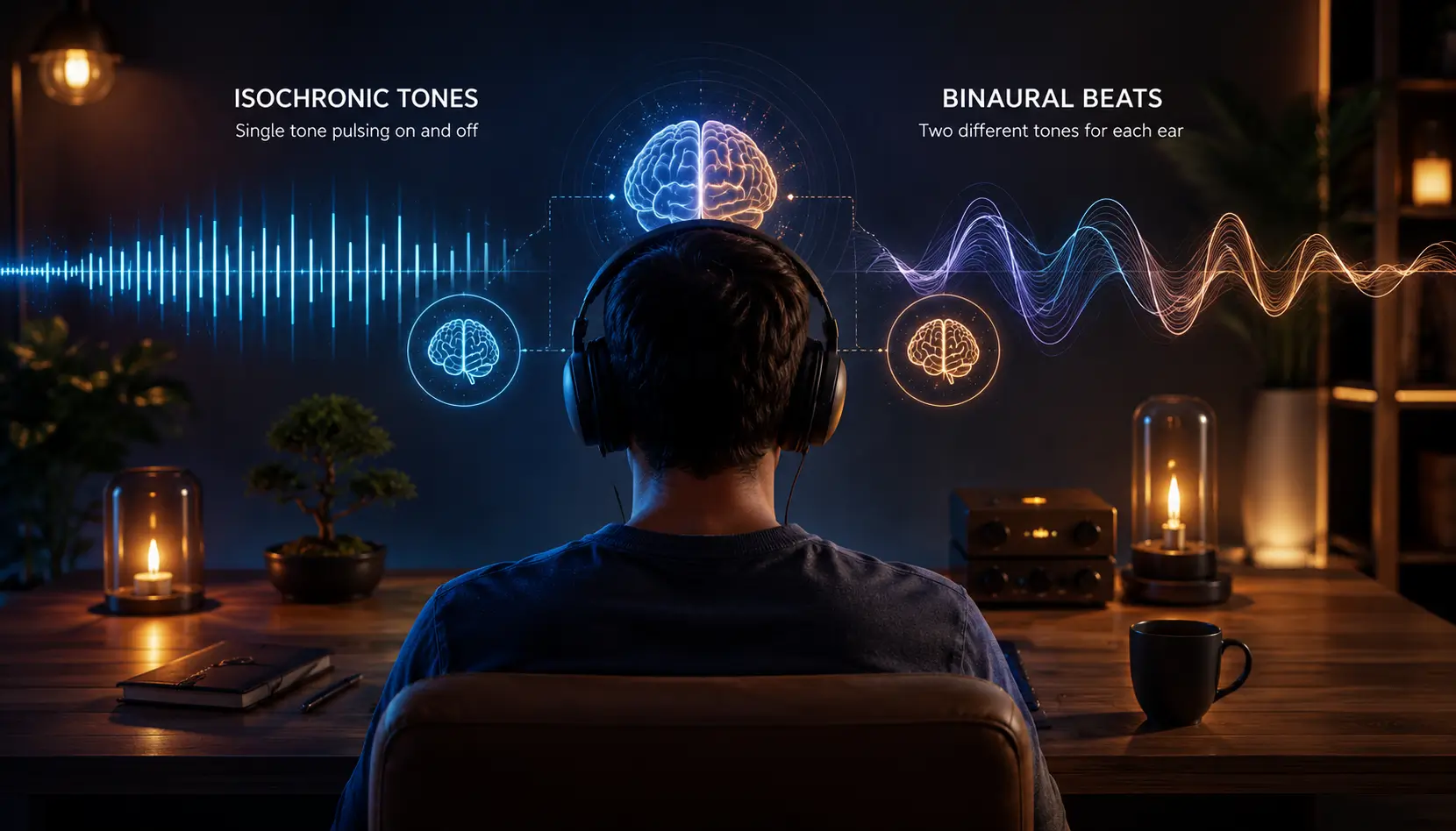
Binaural beats happen when each ear hears a slightly different tone.
For example, one ear may hear 200 Hz while the other hears 210 Hz. The brain may perceive the difference as a rhythmic 10 Hz beat.
Because the effect depends on separate signals reaching each ear, binaural beats usually require headphones.
Binaural beats are often used for:
- Focus
- Meditation
- Relaxation
- Sleep support
- Deep work sessions
Related guide:
Binaural Beats for Focus
🔊 What Are Isochronic Tones?
Isochronic tones work differently.
Instead of using two separate frequencies, isochronic tones use one repeating tone that rapidly turns on and off in a rhythmic pulse.
The pulse itself creates the stimulation pattern.
Because of this, isochronic tones usually do not require headphones, although some people still prefer them.
Isochronic tones are often used for:
- Concentration
- Focus sessions
- Meditation
- Background stimulation
- Speaker-based listening
Related article:
Isochronic Tones Explained
🧠 The Biggest Difference Between Them
The biggest difference is how the rhythmic effect is created.
- Binaural beats: use two different tones, one in each ear.
- Isochronic tones: use one pulsing tone repeated rhythmically.
In practice, binaural beats usually feel smoother and softer.
Isochronic tones often feel sharper, more noticeable, and more rhythmic.
Some people enjoy the stronger pulse of isochronic tones. Others find binaural beats more relaxing and immersive.
🎯 Which Is Better for Focus?
Both methods are commonly used for concentration.
Isochronic tones may feel more stimulating because the rhythmic pulse is very clear and direct.
Binaural beats may feel more atmospheric and less aggressive, especially when layered into ambient audio or music.
For deep work and long study sessions, some people prefer smoother binaural environments because they feel mentally easier to sustain over time.
Others prefer the sharper structure of isochronic pulses for shorter bursts of concentration.
Related article:
Best Binaural Beats for Studying
🌙 Which Is Better for Sleep?
For sleep, many listeners prefer binaural beats because the sound is usually softer and less intrusive.
Isochronic tones can sometimes feel too stimulating or mechanical for bedtime, depending on the sound design.
However, some people still enjoy low-frequency isochronic environments for nighttime relaxation.
Comfort matters more than theory.
If the sound keeps your attention active, it may not be ideal for sleep.
Related guide:
Binaural Beats vs Isochronic Tones for Sleep
🎵 Which One Feels More Natural?
Binaural beats are often described as smoother and more immersive.
Isochronic tones are often described as clearer and more structured.
For some people:
- Binaural beats feel calming and atmospheric.
- Isochronic tones feel energizing and direct.
The “best” option depends heavily on personal preference and listening context.
🎧 Do You Need Headphones?
This is one of the most practical differences.
- Binaural beats: headphones are usually recommended.
- Isochronic tones: can usually work through speakers.
If you dislike wearing headphones for long periods, isochronic tones may be more practical for daily use.
🚀 Where Genius Wave Fits Into Brainwave Audio
Some people prefer simple frequency tracks. Others prefer layered neuroacoustic experiences that combine atmosphere, rhythm, and brainwave-inspired sound design.
One example is The Genius Wave audio program, which uses structured sound environments inspired by focus, relaxation, and mental clarity concepts.
This type of layered audio may feel more immersive than raw tone-based stimulation alone, especially for people who prefer cinematic or guided listening environments.
🔬 What Does Research Suggest?
Research into brainwave entrainment is still evolving.
Some studies suggest possible effects on mood, attention, stress perception, or relaxation for certain individuals. Other findings remain mixed.
That means both binaural beats and isochronic tones should be viewed as support tools rather than guaranteed cognitive enhancement methods.
Useful research starting points:
https://www.frontiersin.org/articles/10.3389/fnhum.2019.00425/full
https://www.ncbi.nlm.nih.gov/pmc/articles/PMC4428073/
https://pubmed.ncbi.nlm.nih.gov/11191043/
⚠️ Safe Listening Tips
Brainwave audio should feel supportive, not overwhelming.
- Keep the volume comfortable.
- Take breaks during long listening sessions.
- Avoid extremely intense stimulation if you feel anxious or overstimulated.
- Use headphones responsibly.
- Speak with a medical professional if you have seizure history or neurological concerns.
Related guide:
Are Binaural Beats Safe?
📌 Final Thoughts
Isochronic tones and binaural beats both aim to create rhythmic audio environments connected to focus, relaxation, or meditation.
Binaural beats are usually smoother and more immersive. Isochronic tones are often sharper and more direct.
Some listeners prefer softer atmospheric sound. Others prefer stronger rhythmic stimulation.
The best approach is usually simple experimentation combined with realistic expectations and healthy focus habits.
If you want a more immersive neuroacoustic listening experience, The Genius Wave audio program may be worth exploring as part of a broader focus or relaxation routine.
🔗 Related Articles
Related Posts
Stay Informed With the Latest & Most Important News