
Now Reading: How Brainwave States May Influence Mood, Focus, and Emotional Balance
-
01
How Brainwave States May Influence Mood, Focus, and Emotional Balance
How Brainwave States May Influence Mood, Focus, and Emotional Balance
Most people notice emotional changes throughout the day without thinking much about what is happening inside the brain.
Some moments feel mentally sharp and energized.
Others feel calm, reflective, emotionally heavy, distracted, overstimulated, or mentally exhausted.
The brain is constantly shifting between different states depending on:
- stress,
- sleep,
- attention levels,
- environment,
- mental fatigue,
- and emotional experiences.
In neuroscience discussions, these changing mental patterns are often connected to different categories of brainwave activity.
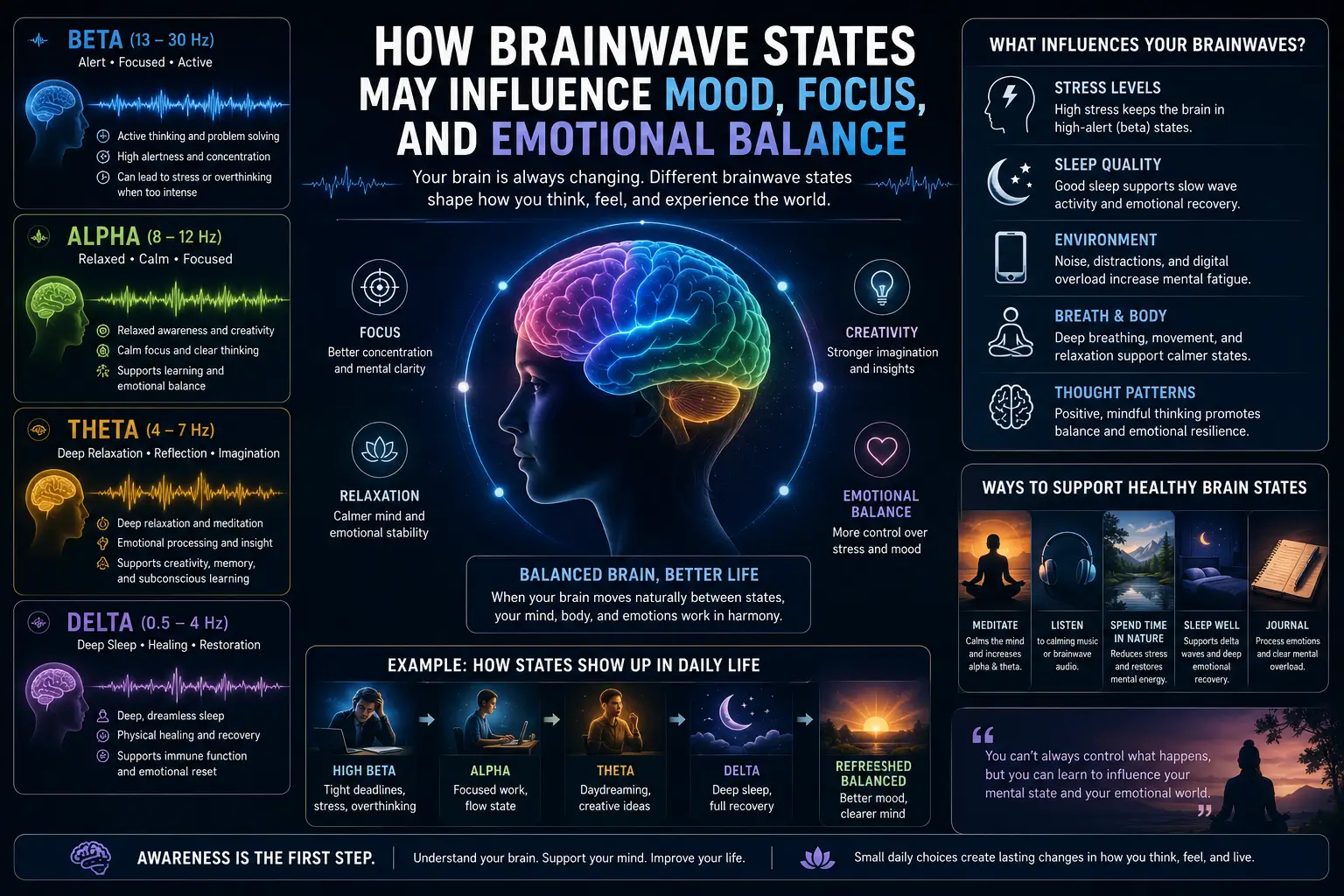
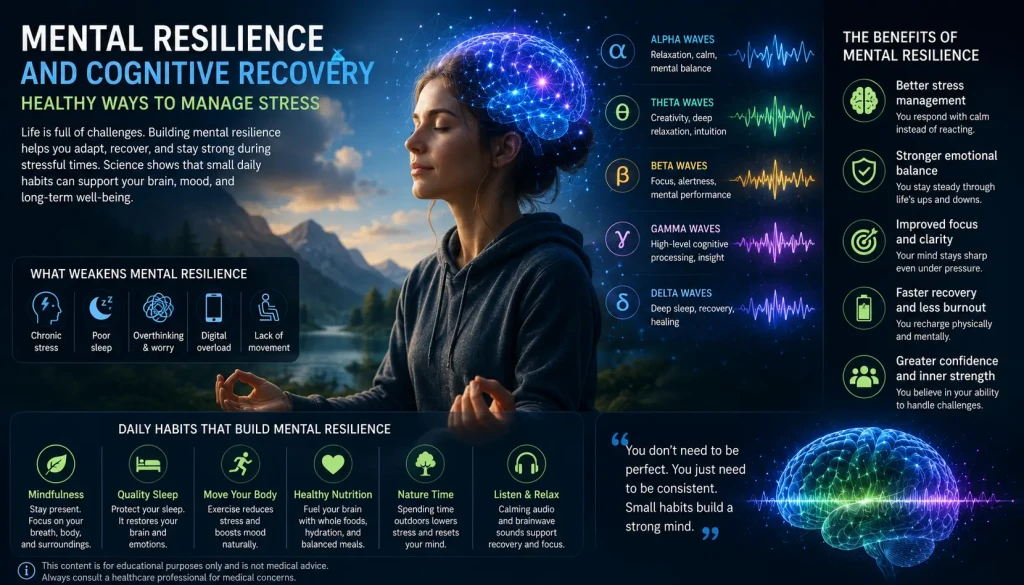
🧠 What Are Brainwave States?
Brainwaves are patterns of electrical activity produced by the brain.
Different brainwave ranges are commonly associated with different mental states and levels of alertness.
These patterns naturally shift throughout the day as attention, mood, and energy levels change.
The brain does not stay locked into one single state permanently.
Instead, it constantly adapts to both internal and external conditions.

🔵 Beta States and Mental Alertness
Beta activity is often associated with:
- active thinking,
- problem-solving,
- focus,
- and attention.
During demanding work or fast-paced environments, the brain may spend more time in highly alert states.
However, nonstop stimulation and stress can sometimes make people feel mentally overloaded rather than productive.
🟢 Alpha States and Relaxed Focus
Alpha-related discussions are commonly linked to calmer mental states.
People often describe alpha-oriented states as feeling:
- more relaxed,
- less mentally noisy,
- and easier for sustained attention.
These calmer states are often discussed in relation to:
- mindfulness,
- creative thinking,
- quiet concentration,
- or reflective moments.
Related article: Alpha Brainwaves and Relaxed Focus.
🟣 Theta States and Deep Reflection
Theta discussions are frequently connected to:
- deep relaxation,
- meditation,
- dream-like mental states,
- and creativity.
People may experience these quieter states during calm reflection, emotional processing, or deeply relaxed moments.
Theta-related discussions are also common in meditation and mindfulness communities.
⚫ Delta States and Recovery
Delta activity is strongly associated with deep sleep and physical recovery.
During healthy sleep cycles, the brain enters slower states connected to restoration and recovery processes.
Related article: Delta Waves for Sleep.
When sleep quality declines, emotional balance and concentration often become more difficult to maintain.
📱 Why Modern Life Feels Emotionally Overstimulating
Modern environments constantly compete for attention.
Notifications, short-form media, multitasking, and nonstop digital stimulation place continuous pressure on the nervous system.
Many people rarely experience true mental quiet.
Over time, this overstimulation may contribute to:
- mental fatigue,
- irritability,
- attention fragmentation,
- stress overload,
- and emotional exhaustion.
Related article: Modern Brain Overstimulation.
🌿 Emotional Balance Depends on Recovery Too
People often focus only on productivity while ignoring recovery.
However, emotional stability is closely connected to:
- sleep quality,
- stress management,
- physical recovery,
- quiet time,
- and healthy routines.
The brain struggles to maintain balance when recovery disappears completely.
🎧 Sound Environments and Mental States
Some individuals explore calming sound environments as part of focus or relaxation routines.
This may include:
- ambient audio,
- binaural beats,
- nature sounds,
- brown noise,
- or meditation-oriented soundscapes.
For some people, these environments may help create moments of reduced distraction and calmer attention.
🎵 Neuroacoustic Audio and Relaxation Routines
Some listeners also explore neuroacoustic audio environments designed around calm focus, relaxation, and mental recovery routines.
These tools are generally best viewed as supportive environmental experiences rather than guaranteed emotional solutions.
🚫 Common Misunderstandings
❌ “One Brainwave State Is Always Best”
Different mental states serve different purposes throughout the day.
❌ “Relaxation Means Laziness”
Recovery and emotional regulation are important parts of long-term cognitive performance.
❌ “The Brain Can Function Optimally Without Rest”
Sleep and recovery remain essential for emotional balance and mental clarity.
🧠 Final Thoughts
The brain constantly shifts between different states depending on attention, stress, sleep, and environment.
Understanding these changing mental patterns can help people recognize how overstimulation, recovery, focus, and emotional balance are closely connected.
And in a world filled with constant noise and distraction, creating calmer mental environments may become increasingly valuable for long-term well-being.
Related Articles
Related Posts
Stay Informed With the Latest & Most Important News
Previous Post
Next Post