
Now Reading: Memory Palace Technique: A Beginner-Friendly Guide to Better Recall
-
01
Memory Palace Technique: A Beginner-Friendly Guide to Better Recall
Memory Palace Technique: A Beginner-Friendly Guide to Better Recall
Long before smartphones and search engines existed, people developed creative ways to remember large amounts of information.
One of the most famous methods is known as the memory palace technique.
Despite the dramatic name, the concept is surprisingly simple.
Instead of trying to memorize information through repetition alone, the brain connects information to familiar locations and visual imagery.
Even today, students, public speakers, language learners, and memory competitors continue using variations of this method.
🏛️ What Is the Memory Palace Technique?
The memory palace technique is a visualization-based memory method.
It works by mentally placing information inside familiar imagined spaces.
These spaces are often based on locations a person already knows well, such as:
- a home,
- a childhood street,
- a school building,
- or a frequently visited environment.
The brain then associates specific pieces of information with different locations inside that mental space.
Later, recalling the location can help trigger the memory connected to it.

🧠 Why Visualization Helps Memory
The brain often remembers visual and spatial experiences more easily than abstract information.
Think about how easily people remember:
- routes through familiar neighborhoods,
- the layout of a childhood room,
- or where objects are placed inside a home.
Visualization techniques take advantage of this natural tendency.
By attaching information to mental imagery and spatial structure, recall may feel more organized and easier to access later.
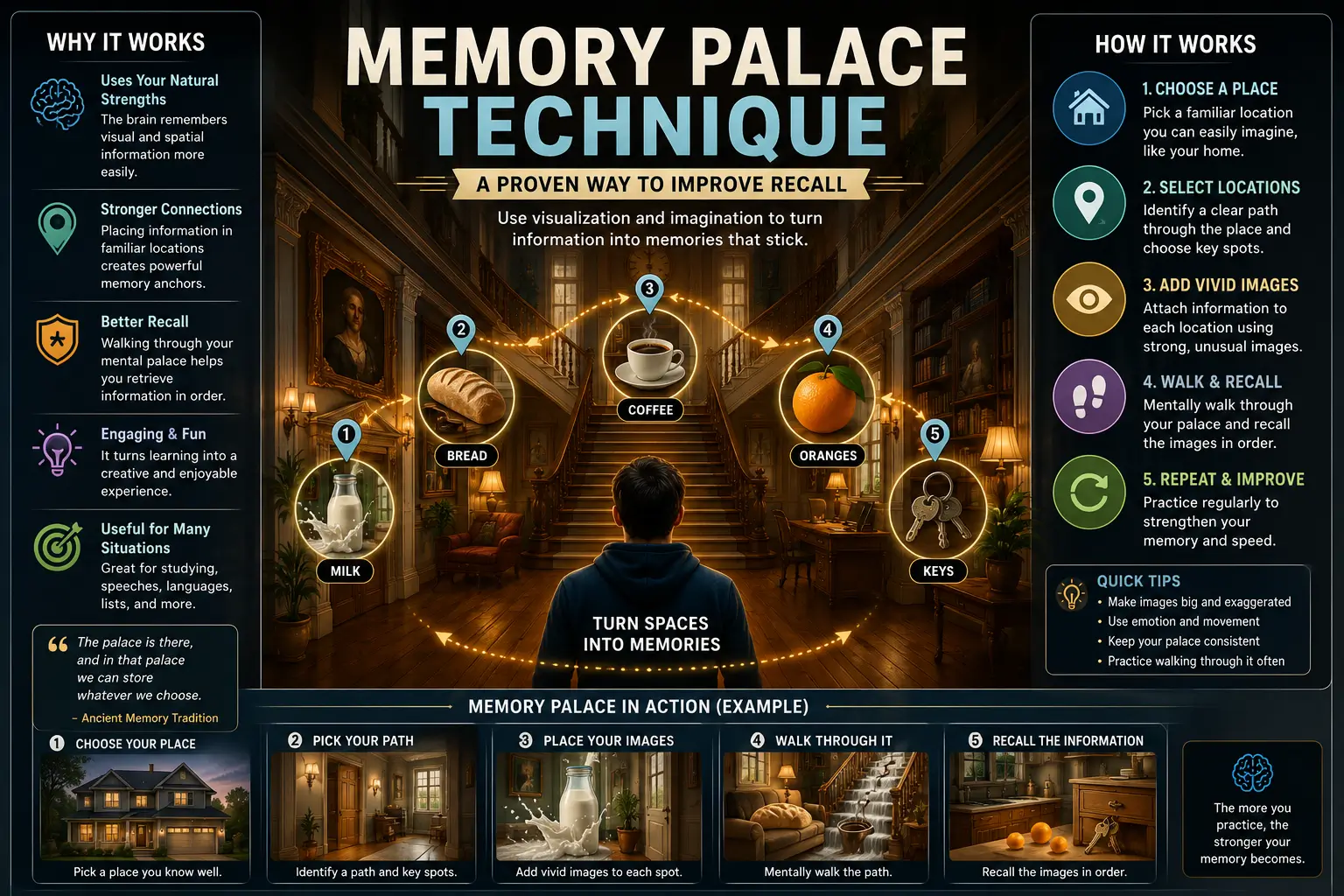
📚 A Simple Example
Imagine trying to remember a grocery list:
- milk,
- bread,
- coffee,
- and oranges.
Instead of repeating the list over and over, a person using the memory palace technique might imagine:
- milk spilling across the front door,
- bread stacked on the couch,
- coffee pouring down the stairs,
- and oranges rolling across the kitchen floor.
The unusual mental images make the information more memorable.
Later, mentally walking through the imagined environment helps trigger recall.
🎓 Why Students Use Memory Techniques
Many learners use visualization methods because traditional repetition can become mentally exhausting.
Memory techniques may help create:
- stronger mental structure,
- better organization,
- and more engaging study sessions.
Some people use memory palaces for:
- language learning,
- public speaking,
- historical facts,
- presentations,
- or exam preparation.
📱 Modern Attention Problems Make Recall Harder
Modern environments constantly compete for attention.
Notifications, short-form content, multitasking, and nonstop digital stimulation can make deep concentration more difficult.
Related article: Modern Brain Overstimulation.
Many people struggle with memory not because the brain is “broken,” but because attention rarely remains focused long enough for information to settle properly.
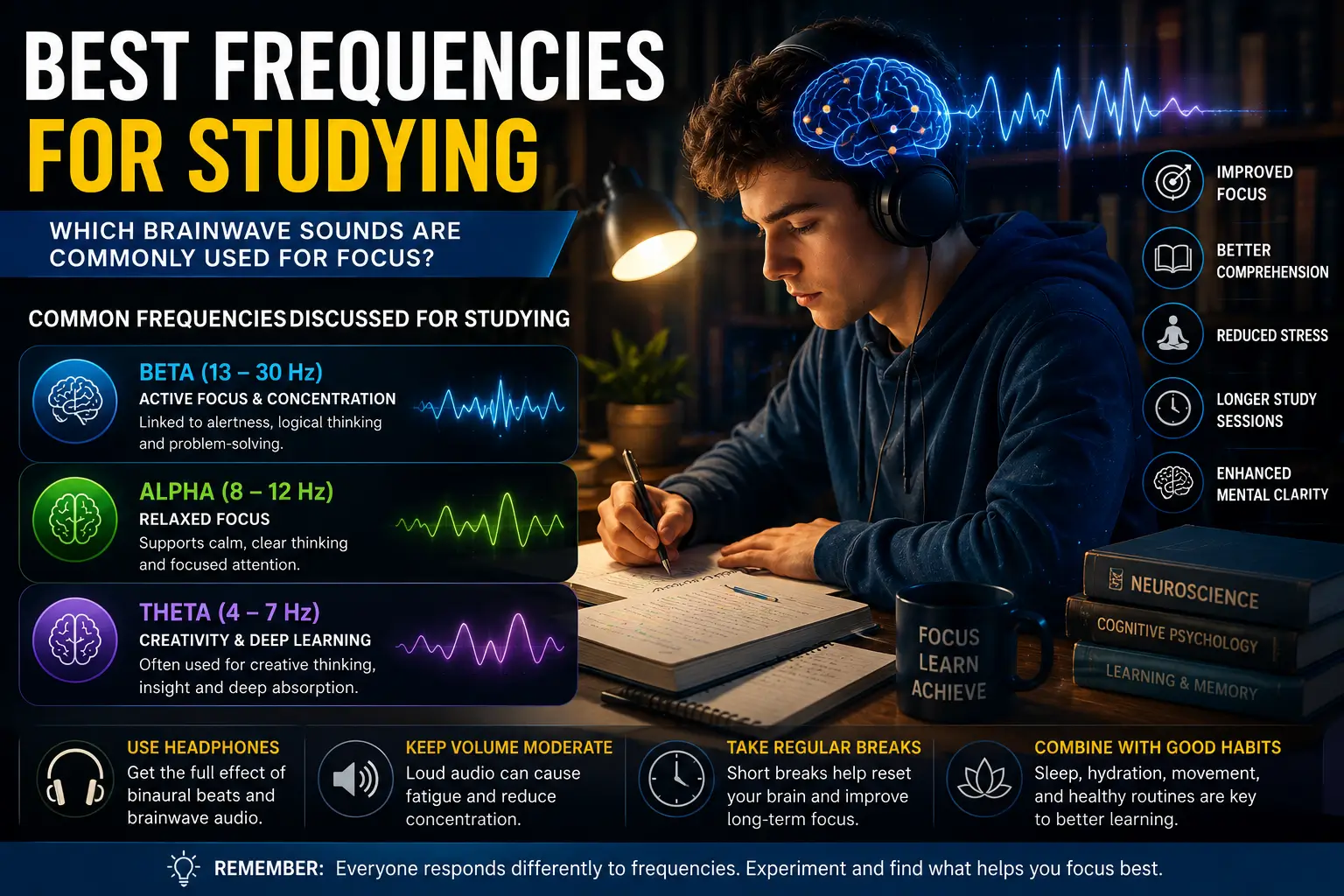
🎧 Focus Environments and Studying
Some students also experiment with calmer sound environments while studying.
This may include:
- ambient soundscapes,
- brown noise,
- focus music,
- or binaural beat audio.
For some individuals, stable environments may help reduce distraction during longer learning sessions.
Related article: Best Frequencies for Studying.
⚠️ Memory Improvement Takes Practice
Online discussions sometimes present memory techniques as instant “brain hacks.”
In reality, memory improvement usually depends on:
- consistency,
- attention quality,
- sleep,
- mental recovery,
- and repetition over time.
The memory palace technique is best viewed as a structured learning tool rather than a magical shortcut.
😴 Sleep Plays a Major Role in Recall
Memory and sleep are deeply connected.
The brain processes and organizes information during healthy sleep cycles.
When sleep quality declines, concentration and recall often decline as well.
Related article: Delta Waves for Sleep.
🎵 Neuroacoustic Audio and Learning Routines
Some people also explore neuroacoustic audio environments designed around calm focus and concentration routines.
These tools are generally most useful when combined with healthy study habits and realistic expectations.
🚫 Common Misunderstandings
❌ “Memory Techniques Instantly Create Perfect Recall”
Memory improvement still requires practice and repetition.
❌ “Visualization Works the Same for Everyone”
People learn differently and may prefer different study methods.
❌ “More Information Means Better Learning”
Mental overload often reduces concentration and retention.
🧠 Final Thoughts
The memory palace technique remains popular because it transforms abstract information into vivid mental experiences.
By combining visualization, spatial awareness, and structured recall, many people find learning more engaging and memorable.
And in a world filled with distraction, techniques that encourage deeper attention may become more valuable than ever.
Related Articles

Stay Informed With the Latest & Most Important News
Previous Post
Next Post