
Now Reading: Binaural Beats vs. Isochronic Tones: What’s the Difference?
-
01
Binaural Beats vs. Isochronic Tones: What’s the Difference?
Binaural Beats vs. Isochronic Tones: What’s the Difference?
Audio-based brainwave stimulation has become increasingly popular among people looking for tools that may support:
- focus,
- relaxation,
- meditation,
- sleep,
- and mental clarity.
Two of the most discussed methods are:
- binaural beats
and - isochronic tones.
At first glance, they may seem very similar.
Both involve rhythmic sound patterns often associated with:
- concentration,
- calmness,
- cognitive routines,
- or mindfulness practices.
However, the way these systems work is actually quite different.
Understanding those differences may help listeners decide which style feels more comfortable for their personal routines.
🧠 What Are Binaural Beats?
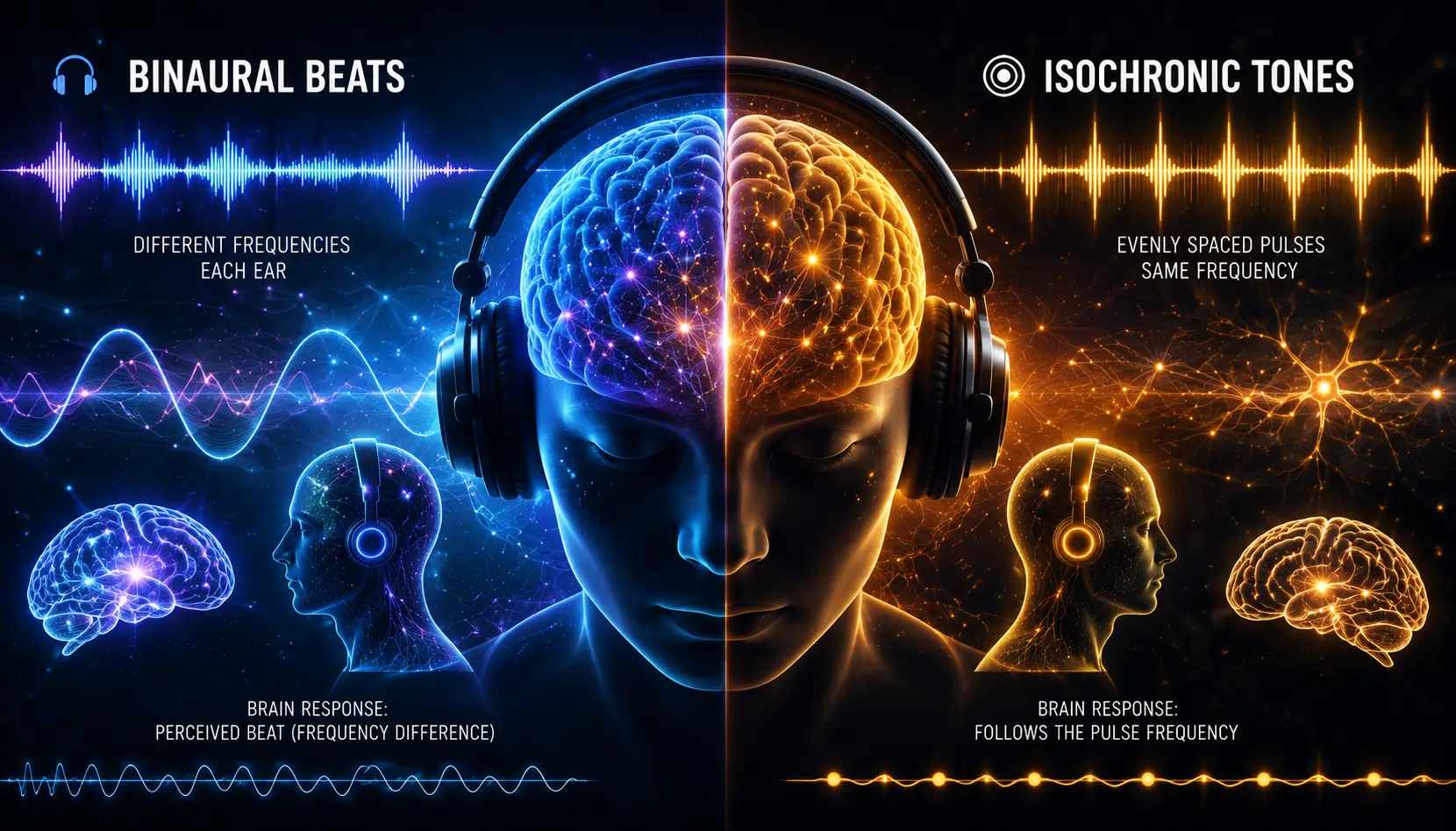
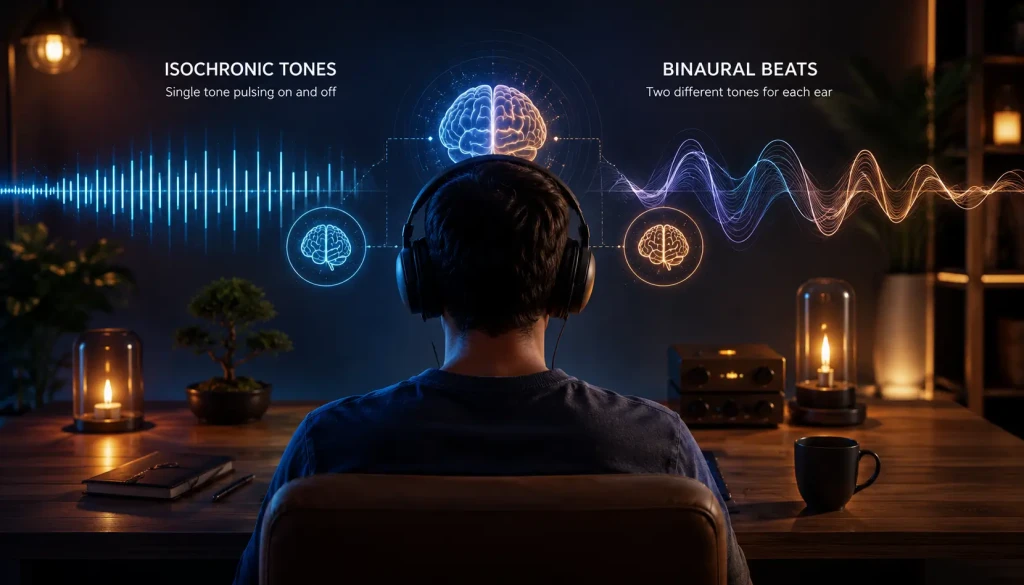
Binaural beats are auditory illusions created when two slightly different frequencies are played separately into each ear.
For example:
- left ear: 200 Hz
- right ear: 210 Hz
The brain perceives the difference between them as a rhythmic internal pulse:
- in this case, 10 Hz.
Because each ear receives a different signal, headphones are generally required for binaural beats to function properly.
Binaural audio is often used in:
- meditation sessions,
- focus routines,
- relaxation audio,
- and ambient concentration environments.
You can also explore our guide on whether binaural beats really work for a deeper overview of how these audio systems are commonly used.
⚡ What Are Isochronic Tones?
Isochronic tones work differently.
Instead of using separate frequencies in each ear, isochronic stimulation uses:
- evenly spaced sound pulses,
- rhythmic tones,
- or rapidly repeating audio bursts.
The sound itself switches on and off at regular intervals.
Unlike binaural beats, isochronic tones:
- do not require headphones,
- are usually more noticeable,
- and often feel more intense or mechanical.
Some listeners describe isochronic tones as:
- sharper,
- more stimulating,
- or more direct than binaural beats.
🌊 Why People Use These Audio Methods
Both systems are commonly explored for:
- focus,
- meditation,
- relaxation,
- sleep preparation,
- and concentration routines.
Many listeners use these audio environments while:
- studying,
- reading,
- working,
- journaling,
- meditating,
- or winding down before sleep.
The goal is usually not “mind control” or dramatic brain transformation.
Instead, most users simply want supportive sensory environments that feel calming or mentally immersive.
🔬 What Science Actually Says
Research on auditory stimulation and brainwave entrainment remains ongoing.
Some studies suggest rhythmic audio stimulation may influence:
- relaxation,
- attention,
- mood,
- and meditative states under certain conditions.
However, many online claims surrounding both binaural beats and isochronic tones become exaggerated.
There is currently no strong scientific evidence showing these audio systems:
- instantly increase intelligence,
- unlock hidden mental powers,
- or dramatically transform cognition.
Further reading:
https://www.frontiersin.org/articles/10.3389/fnhum.2019.00425/full
https://www.ncbi.nlm.nih.gov/pmc/articles/PMC10198548/
The most balanced perspective is viewing these tools as:
- focus-supportive audio environments,
- relaxation aids,
- or mindfulness companions.
🎧 Which Feels Better?
This depends heavily on personal preference.
Many people prefer binaural beats because they:
- feel smoother,
- sound more ambient,
- and blend naturally into music or meditation audio.
Others prefer isochronic tones because they:
- feel more noticeable,
- seem more stimulating,
- and create stronger rhythmic awareness.
Some listeners even alternate between both depending on the situation.
☁️ Binaural Beats vs Isochronic Tones for Focus
For productivity and concentration routines:
Binaural beats may feel:
- softer,
- calmer,
- and less distracting.
Isochronic tones may feel:
- more energizing,
- more intense,
- and more attention-grabbing.
This is highly individual.
What feels helpful for one person may feel uncomfortable or distracting for another.
You may also find our article on focus-related binaural beat frequencies helpful if concentration is your primary goal.
😴 Which Is Better for Sleep or Relaxation?
Many people prefer softer binaural environments for:
- sleep preparation,
- relaxation,
- meditation,
- and calming routines.
Isochronic tones sometimes feel too stimulating for deep relaxation depending on the listener and sound design.
However, there is no universal answer.
Personal comfort matters more than internet hype.
🧘 Why Audio Atmosphere Matters
One reason these systems remain popular is because modern life is mentally noisy.
People are increasingly searching for:
- calmer environments,
- sensory structure,
- emotional decompression,
- and improved attention routines.
Some listeners explore neuroacoustic audio systems that combine ambient soundscapes with rhythmic auditory stimulation designed to support focus and relaxation.
⚠️ Common Myths
Myth:
“One method is scientifically proven to be superior.”
Reality:
Research remains limited, and personal response varies widely.
Myth:
“Isochronic tones are dangerous.”
Reality:
Most healthy individuals simply experience them as rhythmic sound stimulation.
Myth:
“Binaural beats instantly rewire the brain.”
Reality:
Current science does not support dramatic transformation claims.
Final Thoughts
Binaural beats and isochronic tones are different forms of rhythmic audio stimulation.
Neither should be viewed as magical mind-enhancement technology.
For many people, they are simply tools that may help create:
- calmer environments,
- better focus routines,
- or more immersive relaxation experiences.
The best approach is usually experimentation, moderation, and realistic expectations.
Related Articles
Related Posts
Stay Informed With the Latest & Most Important News
Previous Post
Next Post