
Now Reading: Do Subliminal Messages Work? What Psychology and Research Suggest
-
01
Do Subliminal Messages Work? What Psychology and Research Suggest
Do Subliminal Messages Work? What Psychology and Research Suggest
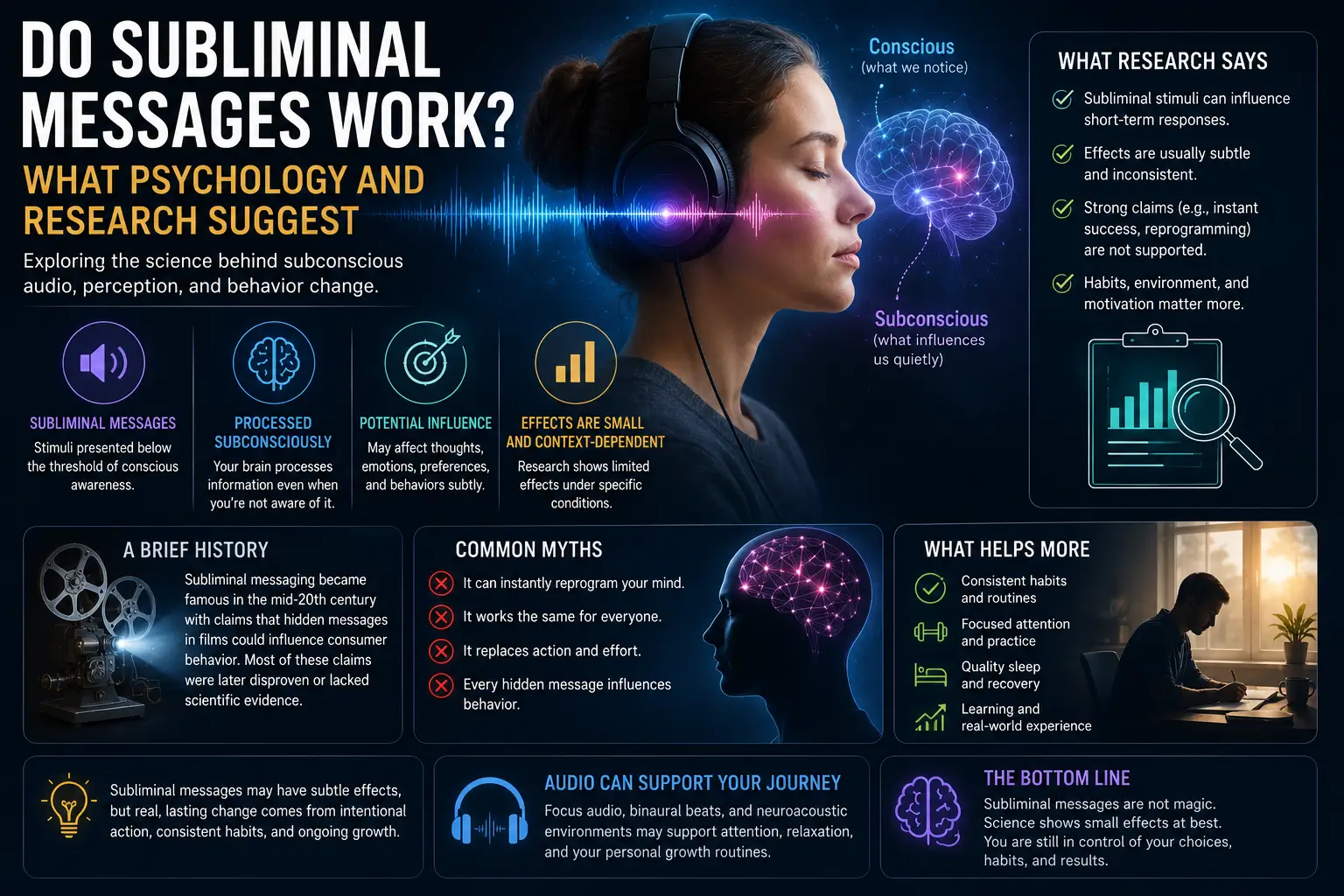
Subliminal messages have fascinated people for decades.
From self-improvement recordings to internet videos claiming to boost confidence, motivation, or success, subliminal audio remains one of the most debated topics in psychology.
Supporters often believe subliminal messages can influence the subconscious mind and create positive changes without conscious effort.
Skeptics argue that most claims are exaggerated and unsupported by evidence.
So what does research actually say?
The answer is more nuanced than many people expect.
🎯 What Are Subliminal Messages?
Subliminal messages are stimuli presented below the threshold of conscious awareness.
In simple terms, they are designed to be processed by the brain without being consciously noticed.
These messages may appear as:
- brief visual images,
- low-volume spoken phrases,
- embedded audio recordings,
- or rapidly displayed visual cues.
The theory is that information can influence thoughts or behavior even when people are not consciously aware of receiving it.
📜 A Brief History of Subliminal Messaging
The concept became widely known during the mid-20th century when claims emerged suggesting hidden messages could influence consumer behavior.
Some reports suggested that brief messages embedded within films increased product sales.
These claims attracted enormous public attention.
However, many of the original stories were later criticized for lacking scientific rigor and reliable evidence.
Despite this, public interest in subliminal messaging never disappeared.
🧠 How the Brain Processes Information
The brain continuously processes large amounts of information.
Much of this processing occurs outside conscious awareness.
People often notice only a small portion of the information their senses receive.
For example, the brain automatically processes:
- background sounds,
- environmental cues,
- facial expressions,
- patterns,
- and contextual information.
This does not automatically mean hidden messages can dramatically change behavior.
However, it does suggest that unconscious processing plays a role in human cognition.
🔬 What Does Research Say?
Research suggests subliminal stimuli may influence certain short-term perceptions, preferences, or responses under specific conditions.
However, these effects are typically small and highly dependent on context.
Studies have generally not found strong evidence that subliminal messages can completely transform personality, intelligence, wealth, confidence, or life outcomes.
The scientific consensus is that subconscious influences exist, but their effects are often more limited than popular media suggests.
⚡ Can Subliminal Audio Change Behavior?
This is where expectations often exceed evidence.
Some people report positive experiences when using subliminal audio recordings.
Others report little or no noticeable effect.
Several factors may influence outcomes:
- expectations,
- motivation,
- beliefs,
- attention,
- habit formation,
- and consistency of behavior.
Even if subliminal messages contribute to subtle psychological effects, meaningful personal growth usually requires deliberate action and repeated practice.
🎯 Attention and the Subconscious Mind
The subconscious mind plays a significant role in everyday behavior.
Many habits, emotional reactions, and automatic decisions occur with minimal conscious effort.
However, subconscious processing is not a magical shortcut.
Most lasting changes result from a combination of learning, repetition, experience, and environmental influences.
Related article: Confidence and Mindset.
📚 Habits Usually Matter More Than Hidden Messages
One reason subliminal messaging remains controversial is that behavior change is complex.
Most evidence suggests that habits, routines, and deliberate practice have a far greater impact on long-term outcomes than hidden messages alone.
For example:
- consistent study improves learning,
- regular exercise improves fitness,
- structured focus sessions improve productivity,
- and healthy sleep supports cognitive performance.
These effects are well-supported by research and do not rely on subconscious messaging.
🎧 Subliminal Audio vs Focus Audio
Subliminal recordings are often compared with other forms of audio-based cognitive support.
These may include:
- binaural beats,
- ambient soundscapes,
- instrumental focus music,
- and neuroacoustic audio environments.
Unlike subliminal recordings, many focus-oriented audio experiences are not designed to hide information from conscious awareness.
Instead, they aim to create listening environments that support concentration or relaxation.
Related article: Audio Programs for Focus and Mental Clarity.
❌ Common Myths About Subliminal Messages
Myth 1: Subliminal Messages Can Instantly Reprogram Your Brain
Research does not support dramatic overnight transformations through subliminal messaging alone.
Myth 2: Subliminal Audio Works Identically for Everyone
Individual responses vary significantly.
Myth 3: Subliminal Messages Replace Action
Behavior change typically requires practice, repetition, learning, and effort.
Myth 4: Every Hidden Message Influences Behavior
The brain filters enormous amounts of information, and not every stimulus produces measurable effects.
🌿 Why People Continue Using Subliminal Audio
Many people enjoy subliminal recordings because they become part of broader self-improvement routines.
Listening sessions may encourage reflection, goal setting, relaxation, or focused attention.
In some cases, the routine itself may be as valuable as the audio content.
Creating intentional habits often produces more reliable results than expecting a single tool to solve complex challenges.
🎧 Modern Neuroacoustic Approaches
Today, many individuals explore broader forms of cognitive audio beyond traditional subliminal messaging.
These approaches may include structured sound environments, ambient audio, rhythmic stimulation, and focus-oriented listening experiences.
Some people also explore neuroacoustic audio experiences designed around focus, relaxation, and mental clarity as part of larger personal development routines.
Results vary from person to person, and no audio method guarantees specific outcomes.
🧠 Final Thoughts
Subliminal messages remain one of the most intriguing topics in psychology and self-improvement.
Research suggests that subconscious influences exist, but their effects are generally smaller and more complex than popular myths often claim.
Lasting change is usually driven by habits, learning, consistency, and deliberate action rather than hidden messages alone.
For those interested in cognitive performance, the most reliable path remains combining healthy routines, focused effort, and evidence-based approaches to personal growth.
Related Articles
Stay Informed With the Latest & Most Important News
Previous Post
Next Post