
Now Reading: Confidence and Mindset: How Self-Belief Influences Performance and Decision-Making
-
01
Confidence and Mindset: How Self-Belief Influences Performance and Decision-Making
Confidence and Mindset: How Self-Belief Influences Performance and Decision-Making
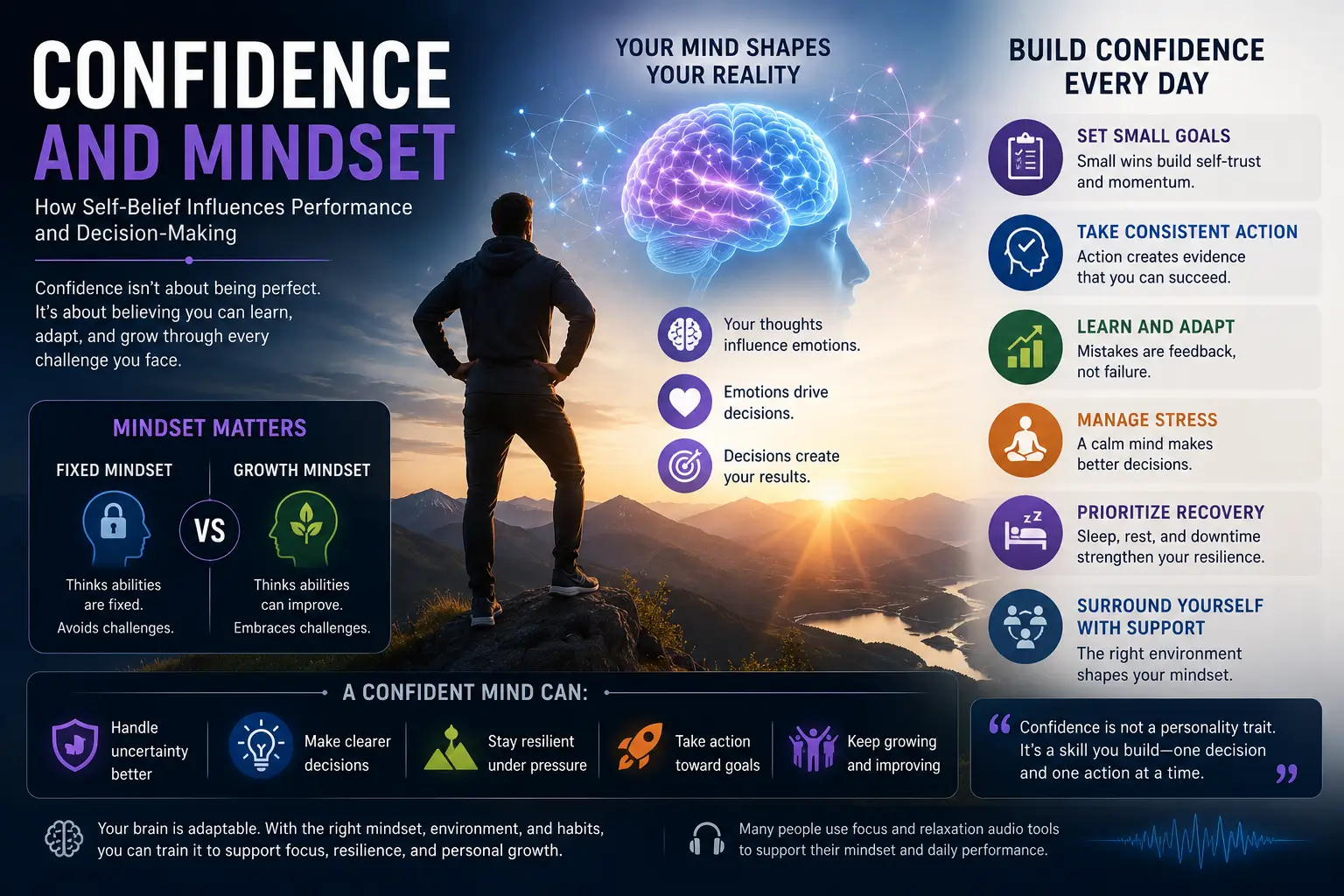
Confidence is often misunderstood.
Many people think confidence means feeling fearless, certain, or naturally talented.
In real life, confidence is usually quieter than that.
It is the ability to take action even when the outcome is uncertain.
It is the belief that you can learn, adapt, recover, and improve through experience.
This is why confidence and mindset are so closely connected.
The way people interpret challenges, mistakes, progress, and setbacks can strongly influence how they perform over time.
🎯 What Is Confidence?
Confidence is not the absence of doubt.
It is the ability to move forward without needing perfect certainty.
A confident person may still feel nervous before a difficult conversation, presentation, exam, or decision.
The difference is that nervousness does not automatically stop action.
Confidence often grows when people repeatedly prove to themselves that they can handle discomfort, learn from feedback, and recover from mistakes.

🧠 Mindset Shapes How the Brain Interprets Challenges
Mindset influences how people explain what happens to them.
Two people can face the same setback and interpret it differently.
One person may see failure as proof that they are not capable.
Another may see it as information that can guide improvement.
That difference matters.
Over time, repeated interpretations can shape motivation, persistence, and willingness to try again.
Related article: Mindset, Neuroplasticity, and Mental Performance.
⚡ Confidence and Decision-Making
Decision-making is one of the clearest places where confidence matters.
When people doubt themselves constantly, they may delay action, overthink simple choices, or avoid opportunities.
When confidence becomes healthier, decisions often become more direct.
This does not mean confident people always make perfect choices.
It means they are often better able to act, observe the result, and adjust when needed.
Confidence supports movement.
Overthinking often keeps people stuck.
📚 Self-Belief Is Built Through Evidence
Positive thinking alone rarely creates lasting confidence.
The brain usually needs evidence.
That evidence may come from:
- keeping small promises to yourself,
- practicing difficult skills,
- recovering after mistakes,
- finishing tasks you used to avoid,
- and noticing gradual improvement over time.
Confidence becomes more stable when it is connected to repeated action.
This is why small wins matter more than most people realize.
🌿 Growth Mindset and Learning
A growth-oriented mindset does not mean pretending everything is easy.
It means recognizing that ability can often improve through practice, strategy, feedback, and persistence.
This type of mindset may support learning because it reduces the fear of not being perfect immediately.
People who view skills as trainable are often more willing to practice, experiment, and revise their approach.
Related article: Neuroplasticity and Brain Rewiring.
🧩 Confidence Is Different From Ego
Confidence and ego are not the same thing.
Ego often needs to appear right.
Confidence can admit uncertainty.
Ego avoids feedback.
Confidence can learn from it.
Ego feels threatened by mistakes.
Confidence treats mistakes as part of growth.
Healthy confidence does not require superiority. It requires trust in your ability to respond, learn, and adapt.
🎯 Performance Depends on More Than Motivation
People often assume they need more motivation before taking action.
But motivation changes from day to day.
Performance often depends more on systems, habits, attention, and recovery than on emotional intensity.
Confidence becomes easier to maintain when daily routines support clear thinking and consistent action.
Related article: Cognitive Performance and Attention Span.
😌 Stress Can Distort Self-Belief
Stress can make challenges feel larger than they are.
When the nervous system is overloaded, people may become more reactive, more doubtful, and less flexible in their thinking.
This is one reason confidence is not only a mindset issue.
It is also connected to sleep, recovery, emotional regulation, and nervous system balance.
Related article: Vagus Nerve Stimulation Explained.
🧠 The Role of Mental Flexibility
Confidence becomes stronger when people can adapt.
If one strategy fails, mental flexibility allows the brain to search for another approach instead of giving up completely.
This flexibility supports learning, resilience, and long-term performance.
People who can adjust their thinking often recover faster from setbacks.
Related article: Improve Cognitive Flexibility.
🎧 Audio, Focus, and Confidence Routines
Some people use structured routines to prepare their mind before work, study, training, or creative tasks.
These routines may include breathing, journaling, movement, meditation, or focused audio environments.
The goal is not to magically create confidence.
The goal is to create a mental environment that supports calmer attention and intentional action.
Some individuals also explore neuroacoustic audio experiences designed around focus and mental clarity as part of broader performance routines.
Individual experiences vary, and no single tool replaces consistent practice.
⚠️ Common Misunderstandings About Confidence
❌ “Confidence Means Never Feeling Fear”
Many confident people still feel fear. They simply learn how to act without letting fear fully control their choices.
❌ “You Must Feel Confident Before You Start”
Confidence often develops after action, not before it.
❌ “Mindset Alone Solves Everything”
Mindset matters, but habits, environment, sleep, stress, skills, and support systems also influence performance.
🌿 Building Confidence Through Small Repeated Actions
Lasting confidence is usually built gradually.
It comes from repeated experiences that teach the brain:
- I can try.
- I can learn.
- I can recover.
- I can improve.
- I can handle uncertainty.
This process is not always dramatic.
Most of the time, confidence grows quietly through consistency.
🧠 Final Thoughts
Confidence and mindset influence how people make decisions, face challenges, and respond to setbacks.
True confidence is not about pretending to be fearless.
It is about building enough self-trust to take action, learn from outcomes, and keep moving forward.
When self-belief is supported by habits, recovery, mental flexibility, and repeated practice, it becomes more than motivation.
It becomes a foundation for better performance and personal growth.
Related Articles
Stay Informed With the Latest & Most Important News
Previous Post
Next Post