
Now Reading: How to Rewire Your Brain: Small Habits That May Support Mental Change Over Time
-
01
How to Rewire Your Brain: Small Habits That May Support Mental Change Over Time
How to Rewire Your Brain: Small Habits That May Support Mental Change Over Time
People often talk about changing their mindset as if transformation happens overnight.
In reality, the brain usually changes much more gradually.
Thought patterns, emotional reactions, attention habits, and daily behaviors tend to develop through repetition over time.
This is one reason the concept of neuroplasticity has become so popular in neuroscience and self-improvement discussions.
The brain is not completely fixed.
It constantly adapts to experiences, routines, attention patterns, stress levels, and environmental influences throughout life.
🧠 What Does “Rewiring the Brain” Actually Mean?
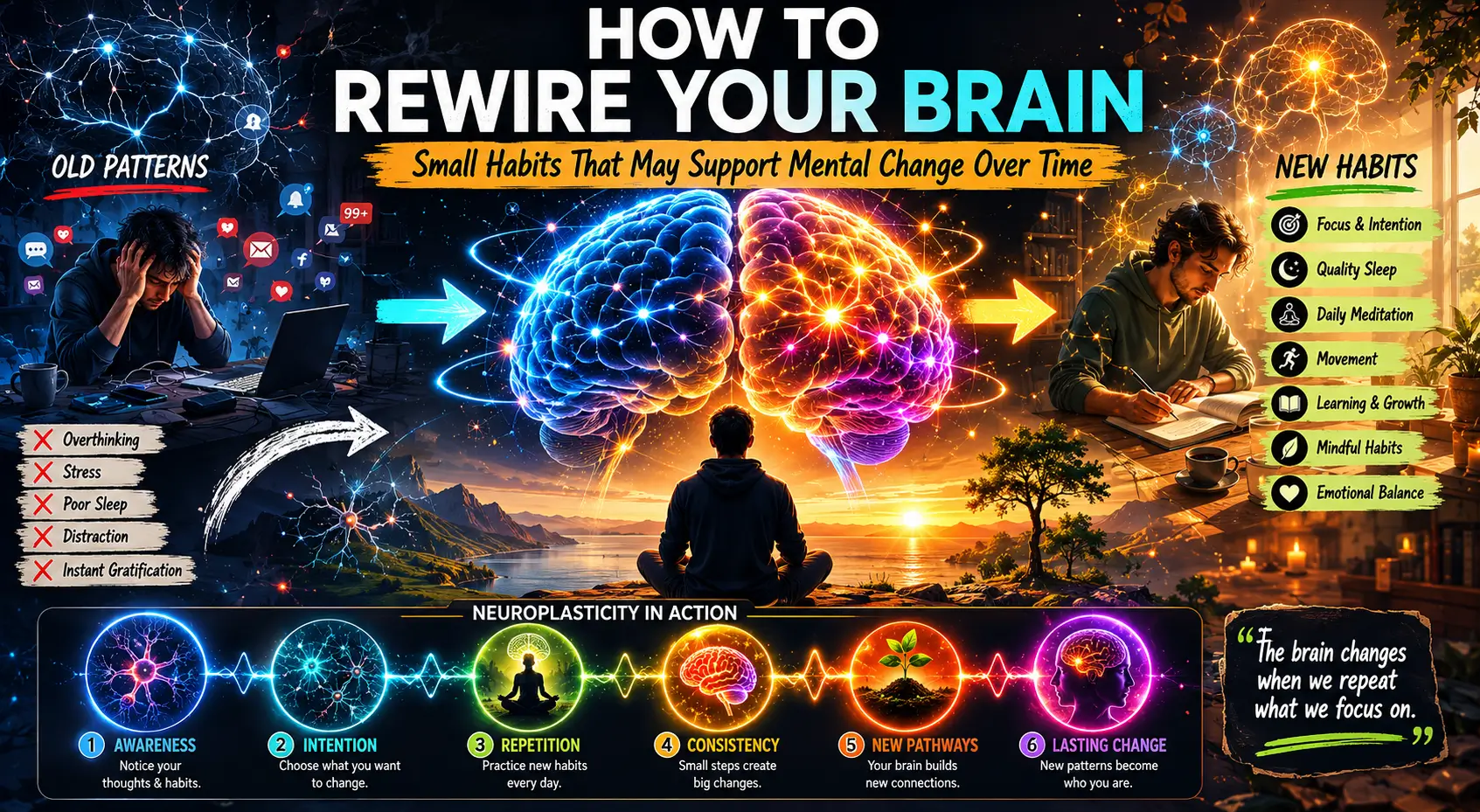
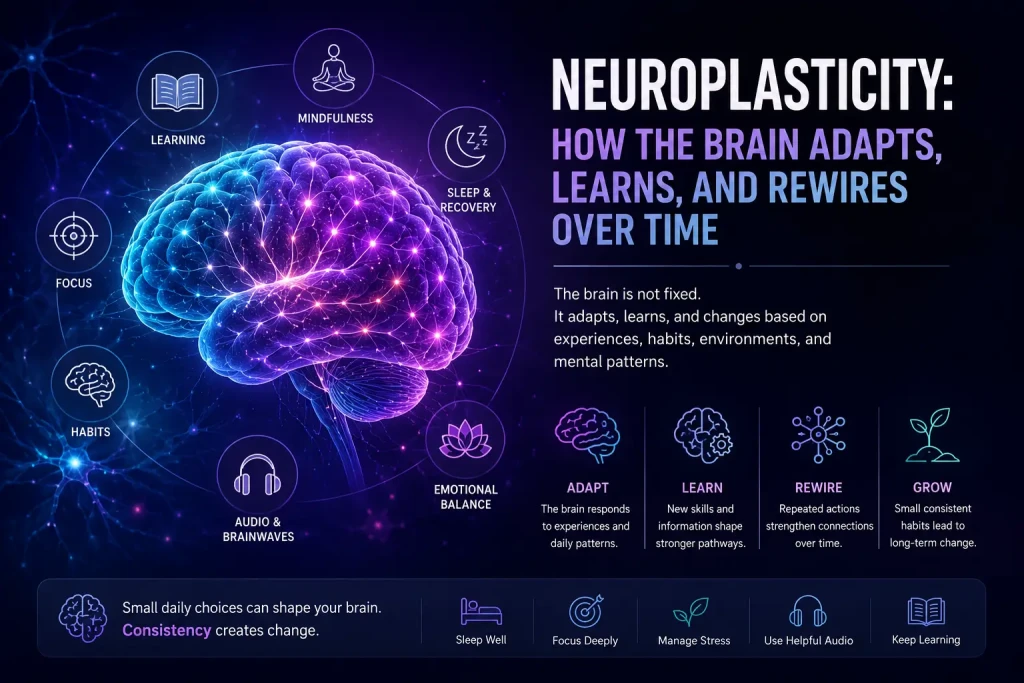
When people talk about “rewiring the brain,” they are usually referring to the brain’s ability to adapt and reorganize itself over time.
This process is often discussed through the concept of neuroplasticity.
Neuroplasticity describes the brain’s capacity to strengthen, weaken, or reshape patterns based on repeated experiences and behaviors.
In simple terms:
- what we repeatedly practice tends to become more familiar,
- and what we constantly reinforce may become easier for the brain to repeat.
📚 Small Habits Often Matter More Than Big Motivation
Many people wait for dramatic motivation before trying to change their routines.
However, long-term mental change often depends more on consistency than intensity.
Small repeated actions may gradually influence:
- attention patterns,
- stress responses,
- emotional reactions,
- and daily mental habits.
For example:
- consistent sleep schedules,
- reducing overstimulation,
- mindfulness practices,
- exercise,
- focused learning,
- and healthier routines
may all contribute to long-term mental adaptation.
📱 Modern Overstimulation Shapes Attention
Modern environments constantly compete for mental attention.
Notifications, social media feeds, multitasking, and endless digital stimulation encourage rapid shifts in focus.
Over time, this may affect concentration habits and mental recovery.
Related article: Modern Brain Overstimulation.
Many people attempt to improve focus while still remaining inside highly distracting environments all day long.
😴 Sleep and Recovery Affect Brain Function
The brain does not simply “power down” during sleep.
Healthy sleep cycles are strongly connected to:
- memory processing,
- emotional regulation,
- mental recovery,
- and cognitive performance.
When recovery disappears, mental flexibility often becomes harder to maintain.
Related article: Delta Waves for Sleep.
🌿 Emotional Patterns Can Also Become Reinforced
The brain adapts not only to external routines, but also to repeated emotional patterns.
Stress, worry, negativity, and emotional overload can become familiar mental states if they are constantly reinforced.
At the same time, calmer routines and healthier environments may support better emotional balance over time.
Related article: Brainwave States and Emotions.
🎯 Focus Improves Through Repetition
Attention works similarly to many other mental skills.
Practicing focused work repeatedly may gradually improve the brain’s ability to maintain concentration for longer periods.
Many people expect immediate results, but cognitive adaptation is often slow and cumulative.
This is one reason consistency usually matters more than temporary bursts of motivation.
🎧 Sound Environments and Mental Routines
Some individuals also experiment with calmer sound environments while studying, relaxing, or focusing.
This may include:
- brown noise,
- ambient music,
- nature sounds,
- or binaural beat audio.
For some listeners, these environments may help reduce distraction and create more intentional focus routines.
Related article: Brown Noise for Focus.
🧘 Real Change Usually Feels Less Dramatic Than Online “Brain Hacks”
Online self-improvement content often promises rapid transformation.
You may encounter claims about:
- rewiring the brain instantly,
- unlocking hidden abilities overnight,
- or permanently changing cognition through one technique.
Real mental adaptation is usually slower, less dramatic, and heavily connected to repetition and environment.
🎵 Neuroacoustic Audio and Focus Routines
Some people also explore neuroacoustic audio environments designed around focus, relaxation, and calmer mental routines.
These tools are generally best viewed as supportive environmental experiences rather than guaranteed transformation systems.
🚫 Common Misunderstandings
❌ “The Brain Changes Overnight”
Long-term mental adaptation usually develops gradually through repetition and experience.
❌ “Motivation Alone Creates Change”
Consistent routines often matter more than temporary emotional intensity.
❌ “Mental Recovery Is Optional”
Sleep, stress management, and recovery remain essential for cognitive flexibility and emotional balance.
🧠 Final Thoughts
The brain constantly adapts to repeated experiences, habits, environments, and emotional patterns.
While online discussions often exaggerate “brain rewiring,” long-term mental change is usually built through small consistent behaviors repeated over time.
And in a world filled with distraction and overstimulation, protecting attention and recovery may be some of the most important habits people can build.
Related Articles
Related Posts
Stay Informed With the Latest & Most Important News
Previous Post
Next Post