
Now Reading: Beta Brain Waves Explained: The Brain’s Alert Thinking State
-
01
Beta Brain Waves Explained: The Brain’s Alert Thinking State
Beta Brain Waves Explained: The Brain’s Alert Thinking State

Some mental states feel highly energized and mentally active.
There are moments when:
- attention sharpens,
- thoughts move quickly,
- problem-solving becomes easier,
- and the brain feels intensely engaged.
These experiences are often associated with beta brain wave activity.
Beta waves are commonly linked to:
- concentration,
- alertness,
- productivity,
- active thinking,
- and cognitive engagement.
They are among the most discussed brainwave states in conversations involving:
- focus,
- work performance,
- studying,
- mental energy,
- and attention management.
But what are beta brain waves actually — and how much of the internet hype surrounding “high-performance frequencies” is scientifically realistic?
The answer is more balanced than many productivity-focused marketing claims suggest.
🧠 What Are Beta Brain Waves?
Beta brain waves are neural oscillations generally measured between:
- 13–30 Hz.
Beta activity is commonly observed during:
- active thinking,
- concentration,
- conversation,
- decision-making,
- and task-focused attention.
Unlike slower brainwave states associated with deep relaxation or meditation, beta activity is connected to:
- mental engagement,
- external awareness,
- and alert cognitive processing.
Researchers often observe increased beta activity while people are:
- working,
- studying,
- analyzing information,
- or actively solving problems.
⚡ Why Beta Waves Matter
Beta activity is important because modern life requires constant cognitive engagement.
Daily tasks often involve:
- decision-making,
- attention switching,
- information processing,
- and mental responsiveness.
Beta-associated states may help support:
- concentration,
- mental organization,
- analytical thinking,
- and sustained attention.
This is one reason beta waves became popular in:
- productivity discussions,
- focus-oriented audio systems,
- and cognitive-performance conversations.
🔬 What Science Says About Beta Activity
Research suggests beta activity may play a role in:
- attention regulation,
- active cognition,
- working memory,
- and external awareness.
Some studies also explore how beta synchronization may relate to:
- task engagement,
- cognitive control,
- and alert mental states.
Further reading:
https://www.frontiersin.org/articles/10.3389/fnhum.2019.00425/full
https://www.ncbi.nlm.nih.gov/pmc/articles/PMC10198548/
At the same time, beta waves should not be viewed as magical productivity boosters.
Human performance depends on many biological, emotional, and behavioral factors beyond brainwave patterns alone.
☁️ Beta Waves and Productivity
Beta activity is often associated with:
- focused work,
- studying,
- problem-solving,
- and mentally demanding tasks.
Many people describe beta-dominant mental states as:
- sharp,
- alert,
- fast-moving,
- and cognitively active.
However, balance matters.
Excessive mental stimulation may sometimes contribute to:
- stress,
- mental fatigue,
- distraction,
- or cognitive overload.
Healthy cognition depends on flexibility between:
- focused alertness
and - calmer recovery states.
You may also enjoy our article on alpha waves and calm focus to understand how relaxation and concentration often work together.
🎧 Can Audio Encourage Beta States?
Some audio systems use:
- rhythmic stimulation,
- ambient soundscapes,
- binaural beats,
- and focus-oriented frequencies
designed to support mentally active environments.
Many listeners explore beta-oriented neuroacoustic audio experiences during:
- work,
- studying,
- creative projects,
- or productivity routines.
At the same time, research involving long-term entrainment effects remains limited and should be approached realistically.
🧩 Beta Waves vs Other Brainwave States
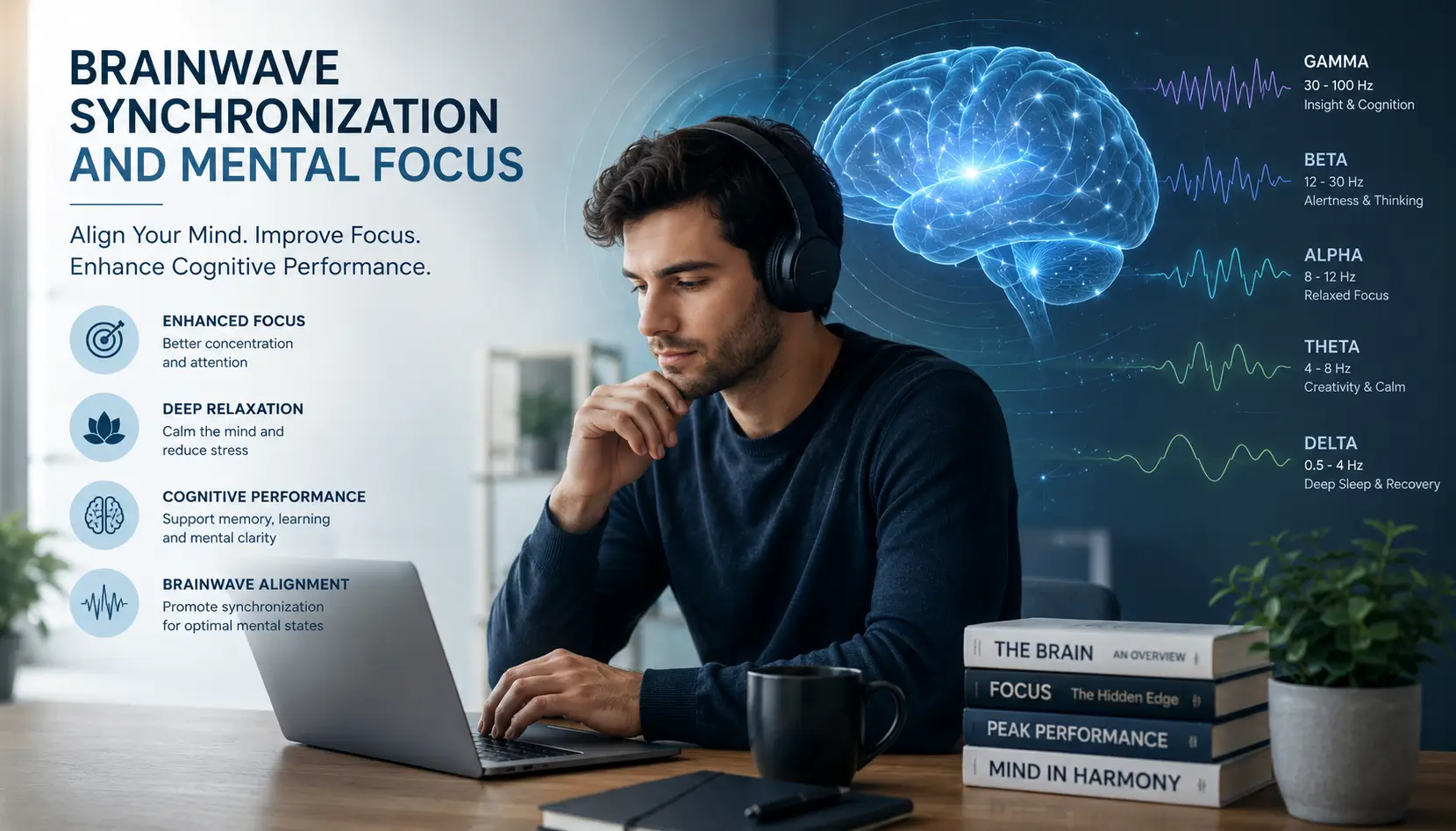
Different brainwave ranges are commonly associated with different mental conditions:
- Delta → deep sleep
- Theta → deep relaxation and imagination
- Alpha → calm focus
- Beta → alert thinking and concentration
- Gamma → high-level cognitive integration
Healthy mental performance depends on smooth transitions between these states rather than remaining fixed in one frequency pattern.
You can also explore our guides on:
to better understand how different brainwave states interact with focus, relaxation, and awareness.
⚠️ Common Myths About Beta Waves
Myth:
“Higher beta activity always improves productivity.”
Reality:
Excessive stimulation may increase stress or mental fatigue.
Myth:
“Beta frequencies instantly create motivation.”
Reality:
Motivation is influenced by many psychological and environmental factors.
Myth:
“Brainwave audio permanently upgrades focus.”
Reality:
Current research does not support dramatic transformation claims.
🌍 Why Beta Waves Became Popular Online
Modern productivity culture strongly emphasizes:
- optimization,
- efficiency,
- focus,
- and mental performance.
This has made beta-wave discussions increasingly popular among:
- students,
- entrepreneurs,
- creatives,
- and productivity enthusiasts.
People are naturally interested in tools that may help support:
- concentration,
- energy,
- and mental organization.
The challenge is separating realistic neuroscience from exaggerated marketing promises.
Final Thoughts
Beta brain waves remain one of the most important and widely discussed brainwave states in cognitive neuroscience.
Current evidence suggests beta activity may be connected to:
- alert thinking,
- concentration,
- attention,
- and active mental engagement under certain conditions.
At the same time, exaggerated “superhuman productivity” claims should be approached carefully.
The healthiest perspective is viewing beta waves as one part of a flexible and adaptive brain system involved in attention, cognition, and mental performance.
Related Articles
Related Posts
Stay Informed With the Latest & Most Important News
Previous Post
Next Post