
Now Reading: How to Use the Memory Palace Technique to Remember Anything
-
01
How to Use the Memory Palace Technique to Remember Anything
How to Use the Memory Palace Technique to Remember Anything
Most people think memory is only about repetition.
Read the same note again.
Repeat the same fact again.
Highlight the same paragraph again.
But the brain often remembers better when information is connected to images, locations, emotion, and structure.
That is why the memory palace technique has remained one of the most powerful memory methods ever used.
It is not a magic trick.
It is a practical way to turn abstract information into something your brain can mentally “walk through.”
🏛️ What Is the Memory Palace Technique?
The memory palace technique is a method where you place information inside a familiar mental location.
This location might be:
- your home,
- your childhood bedroom,
- a school hallway,
- a route you walk often,
- or any place you can easily imagine.
Instead of trying to memorize information as plain words, you turn each idea into a vivid image and place it somewhere inside that mental space.
Later, when you want to remember the information, you mentally walk through the location and collect each image in order.
This technique is also called the method of loci.

🧩 Why the Memory Palace Works
The brain is naturally strong at remembering places.
You may forget a sentence you read yesterday, but you can often remember the layout of a house you lived in years ago.
Spatial memory gives the brain a structure.
When you attach information to that structure, recall becomes easier because the memory is no longer floating randomly in your mind.
It has a location.
It has an image.
It has a path.
This is why memory palaces are often used by students, speakers, language learners, and memory competitors.
For a broader look at mental performance, read our guide to mindset, neuroplasticity, and mental performance.
📍 Step 1: Choose a Familiar Place
Start with a place you know very well.
Your first memory palace should not be complicated.
Your home is usually the easiest option because you already know the rooms, objects, and order naturally.
For example, you might use:
- front door,
- hallway,
- living room,
- kitchen,
- bedroom,
- bathroom,
- balcony or garden.
These locations become mental “stations” where you will place information.
🖼️ Step 2: Turn Information Into Images
The memory palace works better when the images are vivid.
Plain information is easy to forget.
Strange, exaggerated, emotional, or funny images are easier to remember.
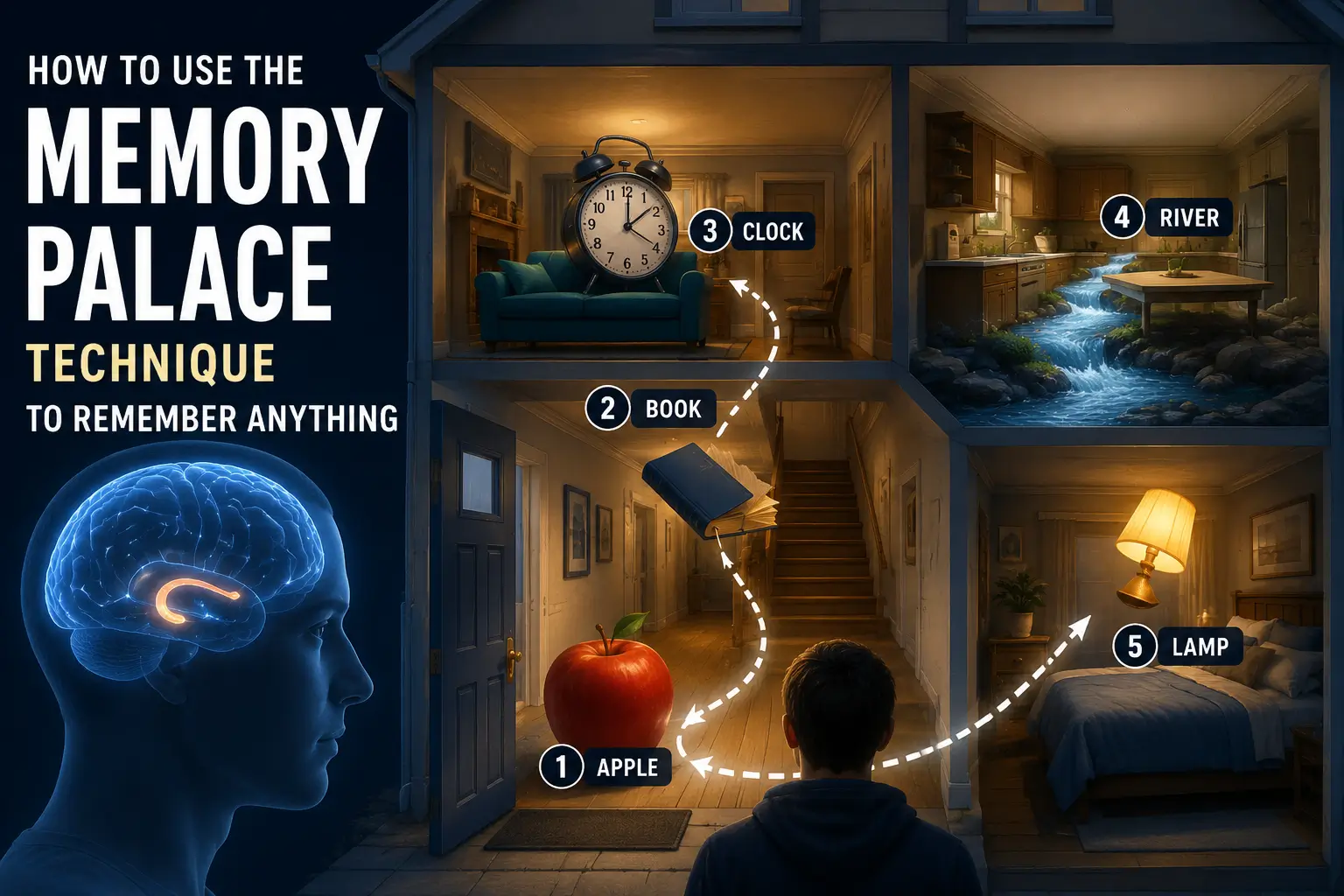
For example, imagine you need to remember these words:
- apple,
- book,
- clock,
- river,
- lamp.
You could place:
- a giant red apple blocking your front door,
- a book flying down the hallway,
- a loud clock ticking on your sofa,
- a river flowing through your kitchen,
- and a glowing lamp floating above your bed.
The stranger the image, the easier it often becomes to recall.
🚶 Step 3: Create a Fixed Route
Your memory palace needs a clear path.
Do not jump randomly from one room to another.
Use the same order every time.
This helps your brain retrieve information step by step.
Think of it like walking through a mental museum.
Each room contains one piece of information.
Each object becomes a memory trigger.
📚 Step 4: Use It for Real Learning
The memory palace is not only for random lists.
You can use it for:
- study notes,
- presentation points,
- foreign language vocabulary,
- historical timelines,
- scientific concepts,
- book summaries,
- or daily tasks.
The key is to convert each idea into something visual.
If the concept is abstract, turn it into a symbol.
For example, “focus” might become a laser beam.
“Stress” might become a shaking phone.
“Neuroplasticity” might become a road being rebuilt inside the brain.
For more on how the brain adapts through learning, read the science of neuroplasticity and brain training.
🎯 Example: A Simple Memory Palace for Studying
Imagine you want to remember five principles of better learning:
- attention,
- association,
- repetition,
- sleep,
- recall practice.
You could build this memory palace:
- At the front door, a giant spotlight represents attention.
- In the hallway, two magnets snapping together represent association.
- In the living room, a person doing push-ups represents repetition.
- In the kitchen, a bed instead of a table represents sleep.
- In the bedroom, a microphone represents recall practice.
Now the list is no longer abstract.
It has a route, images, and meaning.
⚡ Why Focus Still Matters
A memory palace works best when attention is clear.
If your mind is scattered, distracted, or overstimulated, it becomes harder to build strong mental images.
This is why many people combine memory techniques with focus routines.
Some use breathing.
Some use quiet rooms.
Some use ambient sound or structured audio before studying.
For example, listeners who enjoy sound-based focus environments may explore neuroacoustic audio routines as part of a broader concentration practice.
The tool itself is not the whole solution.
The goal is to create a mental environment where learning feels easier to begin.
🧠 Memory Palace vs Repetition
Repetition is useful, but repetition alone can be weak if the material has no structure.
The memory palace gives structure first.
Then repetition strengthens it.
A better approach is:
- build the memory palace,
- place vivid images,
- walk through it mentally,
- test yourself without looking,
- review after time has passed.
This turns passive reading into active recall.
And active recall is often far more powerful than simply rereading notes.
🌙 Sleep and Memory Consolidation
Memory does not only happen while studying.
Sleep also plays an important role in memory consolidation.
When you learn something and then sleep well, the brain has a better chance to stabilize and organize that information.
This is why all memory strategies should also respect recovery.
If you are constantly sleep-deprived, overstimulated, and mentally exhausted, even the best memory technique becomes harder to use well.
Related guide: Sleep Waves Explained: How Brain Activity Changes During Rest.
🛠️ Common Mistakes Beginners Make
Using a Place They Do Not Know Well
Your first memory palace should feel automatic.
If you need effort to remember the layout, choose a simpler location.
Making Images Too Boring
The brain remembers unusual images better than plain ones.
Make the image colorful, exaggerated, emotional, or strange.
Changing the Route Every Time
Consistency matters.
Use the same route so the order becomes stable.
Trying to Memorize Too Much at Once
Start small.
Use five to ten items first.
Then expand gradually.
📌 A Simple 10-Minute Practice Routine
Try this beginner routine:
- Choose one familiar room or route.
- Pick five pieces of information.
- Turn each one into a vivid image.
- Place each image in order.
- Close your eyes and walk through the route.
- Recall the full list without looking.
- Review again later in the day.
Do this for a week and the technique will start to feel more natural.
🧩 Final Thoughts
The memory palace technique works because it uses something the brain already does well: remembering places.
By connecting information to familiar locations, vivid images, and a clear route, you make recall more organized and less random.
This method can support studying, presentations, vocabulary learning, creative planning, and everyday memory.
It does not replace understanding.
But it can make information easier to store, revisit, and retrieve.
Start with one familiar place.
Add a few strong images.
Walk through the route.
Then test yourself.
That simple practice can turn memory from something passive into something you actively build.
Related Articles
Related Posts


Stay Informed With the Latest & Most Important News
Previous Post
Next Post