
Now Reading: How to Reset Your Mind When Life Feels Mentally Overwhelming
-
01
How to Reset Your Mind When Life Feels Mentally Overwhelming
How to Reset Your Mind When Life Feels Mentally Overwhelming
Some days do not feel physically exhausting.
They feel mentally loud.
Your thoughts keep moving even when you try to rest.
You jump between notifications, unfinished tasks, worries, conversations, videos, and endless streams of information — yet still feel mentally stuck.
Modern life often creates a strange type of exhaustion:
mental overload without real recovery.
That is why more people are searching for ways to mentally reset and regain emotional balance.
📱 The Brain Was Not Designed for Constant Input
Most people spend entire days surrounded by stimulation.
Phones vibrate constantly.
Tabs remain open.
Social feeds never end.
Even moments of silence are often filled with scrolling.
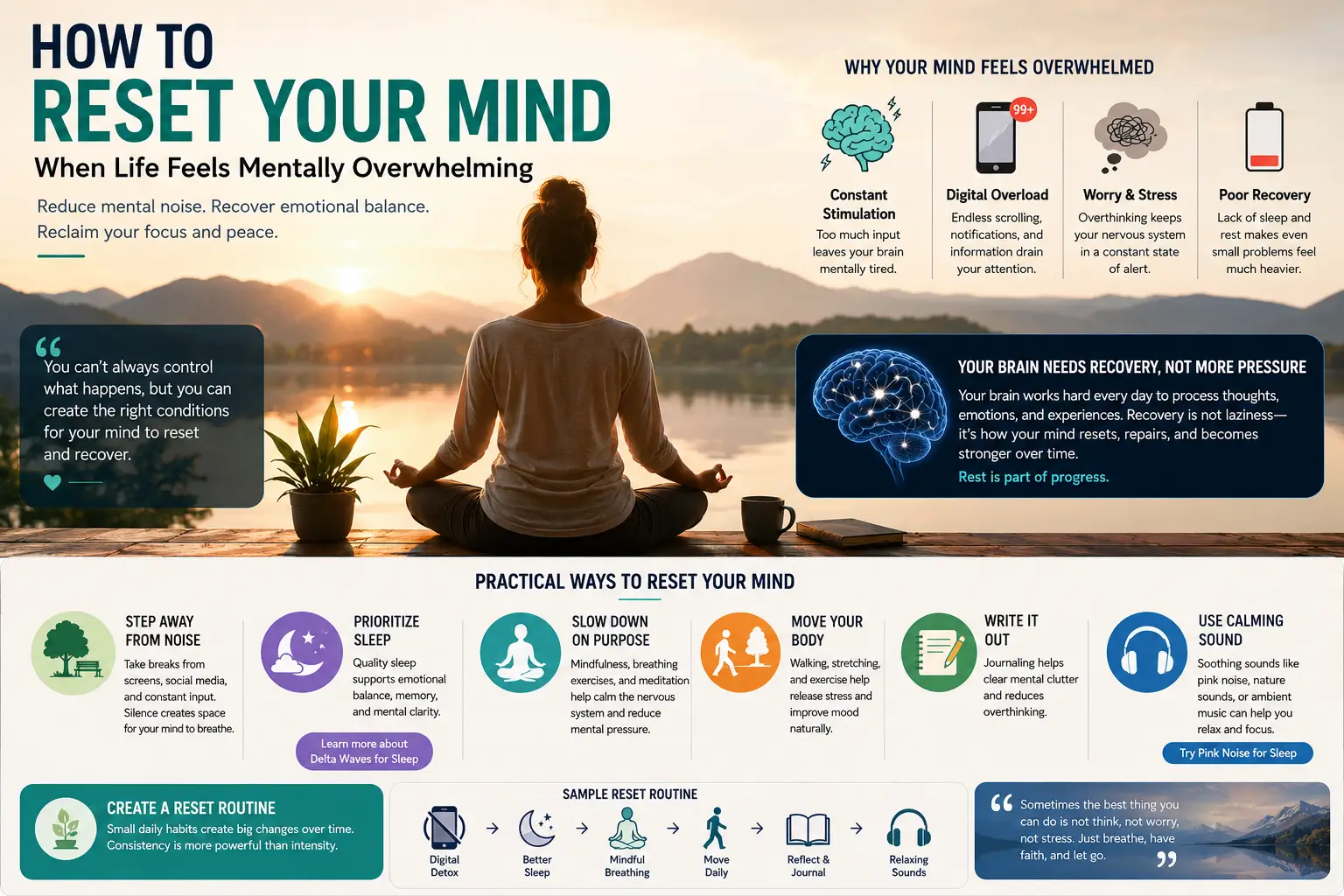
Over time, this nonstop input may leave the nervous system feeling overloaded and emotionally fatigued.
Related article: Modern Brain Overstimulation.

🧠 Mental Overload Does Not Always Feel Like Stress
One reason mental exhaustion becomes confusing is that it does not always look dramatic.
Sometimes it appears as:
- difficulty concentrating,
- lack of motivation,
- constant distraction,
- emotional numbness,
- irritability,
- or the feeling that your mind never truly slows down.
Many people attempt to “push harder” instead of recognizing that the brain may simply need recovery.
🌙 Sleep Is More Important Than Most People Realize
The brain performs essential recovery work during sleep.
Healthy sleep cycles support:
- emotional regulation,
- mental clarity,
- memory processing,
- and cognitive recovery.
When sleep quality declines, even small problems can feel emotionally heavier.
Related article: Delta Waves for Sleep.
🌿 Sometimes the Mind Needs Quiet More Than Motivation
Modern culture often encourages nonstop productivity.
People feel pressure to optimize every hour, consume more information, and constantly stay mentally active.
But the brain also needs moments without pressure.
Quiet environments, slower routines, reduced stimulation, and intentional breaks may help the nervous system feel less overloaded over time.
🎧 Why Some People Use Sound Environments to Relax
Some individuals use calming sound environments during relaxation routines.
This may include:
- rain sounds,
- pink noise,
- brown noise,
- ambient music,
- or meditation-oriented audio.
For certain people, softer environmental sound helps create mental separation from busy surroundings.
Related article: Pink Noise for Sleep.
🚶 Small Physical Habits Affect Mental Recovery Too
Mental recovery is not only psychological.
Simple physical habits may also influence emotional balance over time.
Examples include:
- walking outdoors,
- reducing screen exposure late at night,
- consistent sleep schedules,
- breathing exercises,
- stretching,
- and moments away from constant stimulation.
These habits may seem small individually, but together they can help reduce feelings of mental overload.
🧠 Emotional Recovery Is Not Weakness
Many people treat rest as if it were laziness.
But emotional recovery is part of healthy mental functioning.
The brain struggles to maintain clarity and emotional balance when recovery disappears completely.
Related article: Brainwave States and Emotions.
🎵 Neuroacoustic Audio and Mental Reset Routines
Some individuals also explore neuroacoustic audio environments designed around relaxation, calm focus, and emotional recovery routines.
These tools are generally most effective when viewed as supportive environments rather than instant solutions.
⚠️ Real Mental Recovery Usually Happens Gradually
Online content often promotes dramatic “mind reset” solutions.
You may encounter promises about:
- instant calmness,
- overnight transformation,
- or perfect mental clarity.
In reality, emotional recovery is usually slower and more gradual.
The nervous system often responds best to consistency, reduced overload, healthy sleep, and sustainable routines over time.
🧘 A Mental Reset Often Starts With Reducing Noise
Many people search for complicated solutions while remaining surrounded by nonstop mental stimulation.
Sometimes the first step toward feeling mentally clearer is simply creating more space for recovery.
Less noise.
Less pressure.
Less constant input.
And more opportunities for the brain to slow down naturally again.
🧠 Final Thoughts
Mental exhaustion has become increasingly common in overstimulating modern environments.
While there is no instant “mind reset” button, healthier routines, emotional recovery, reduced stimulation, and consistent rest may gradually help the brain feel calmer and more balanced again.
And sometimes, the most important change is not adding more mental input — but finally allowing the mind enough quiet to recover.
Related Articles
Stay Informed With the Latest & Most Important News
Previous Post
Next Post