
Now Reading: Delta Waves for Sleep: Why Slow Brainwave Activity Is Linked to Deep Rest
-
01
Delta Waves for Sleep: Why Slow Brainwave Activity Is Linked to Deep Rest
Delta Waves for Sleep: Why Slow Brainwave Activity Is Linked to Deep Rest
Sleep is one of the brain’s most important recovery systems.
Without proper rest, focus, memory, emotional balance, and mental clarity can all begin to decline.
Yet modern life constantly interferes with deep recovery.
People now sleep in environments filled with:
- notifications,
- screens,
- mental overstimulation,
- stress,
- and irregular routines.
As a result, many people search for ways to improve relaxation and create calmer nighttime environments.
One topic that frequently appears in discussions about sleep and brainwave activity is delta waves.
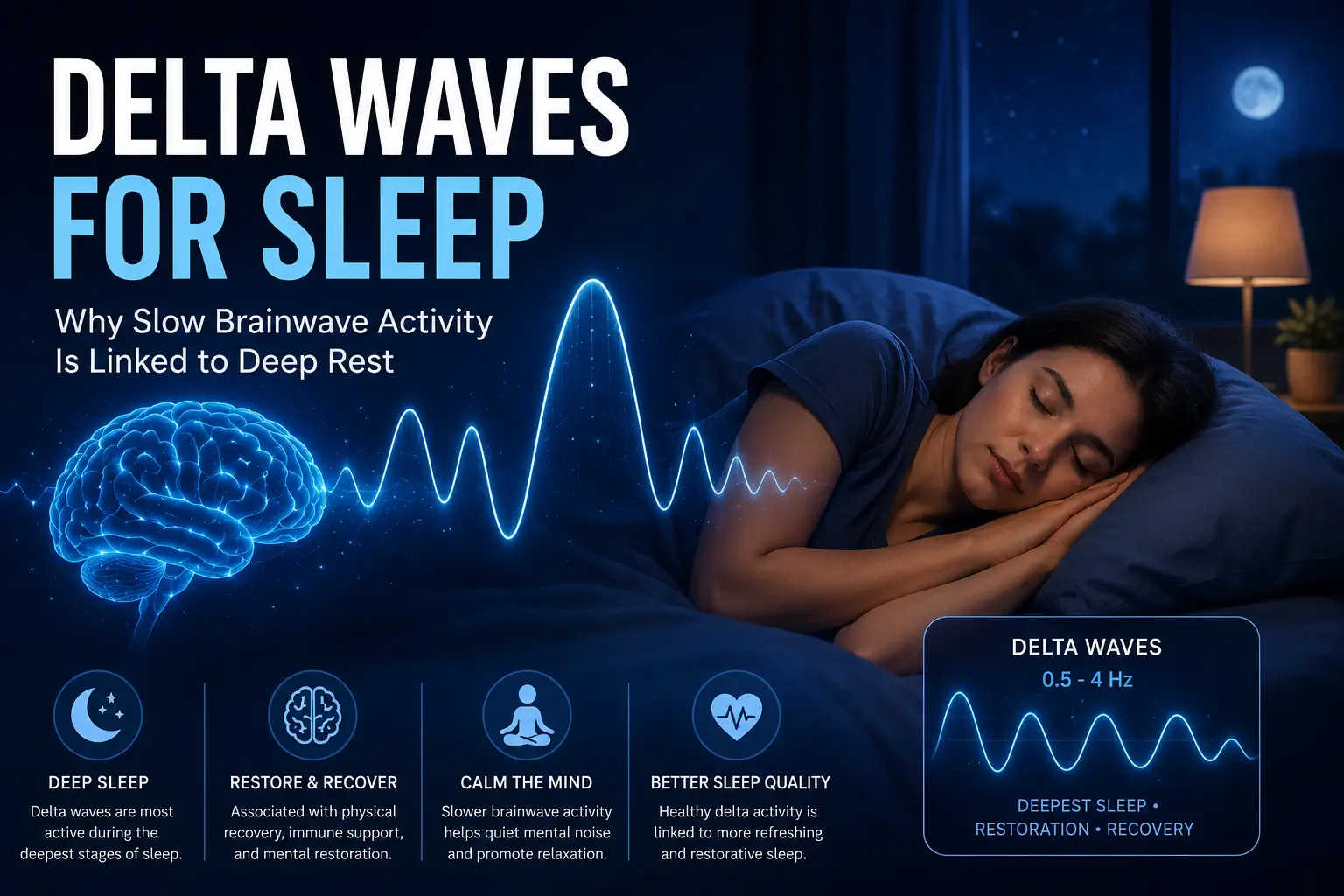
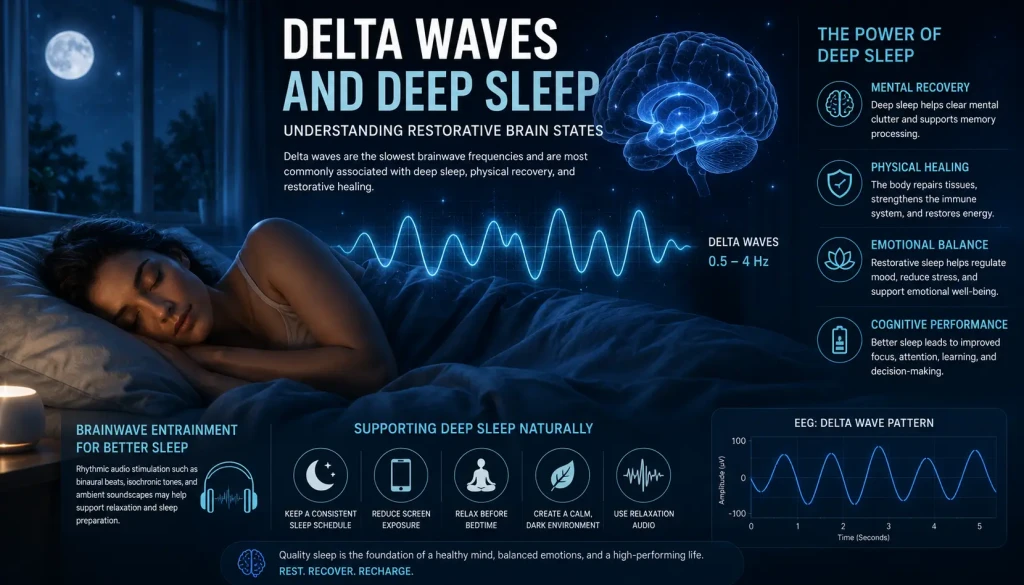
Delta waves are commonly associated with the deepest stages of sleep and physical recovery.
They are often discussed in relation to deep rest, nervous system recovery, and restorative sleep cycles.
🌙 What Are Delta Waves?
Delta waves are the slowest type of commonly discussed brainwave activity.
They are generally associated with:
- deep sleep,
- physical recovery,
- reduced awareness of the external environment,
- and restorative rest.
These slow brainwave patterns are most strongly linked with the deeper stages of non-REM sleep.
During these periods, the body and brain enter states associated with recovery and restoration.
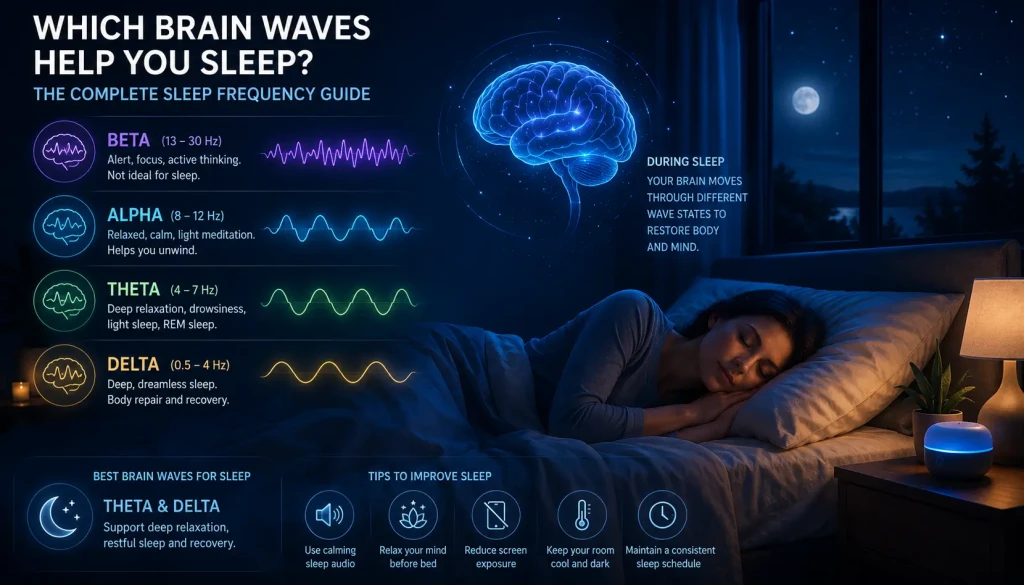
🧠 Brainwaves and Sleep Stages
Different brainwave ranges are commonly associated with different mental states.
🔵 Beta Waves
Often linked with active thinking, concentration, and alertness.
🟢 Alpha Waves
Frequently associated with calmer, more relaxed mental states.
🟣 Theta Waves
Commonly discussed in relation to meditation, light sleep, and dream-like states.
⚫ Delta Waves
Associated with the deepest stages of restorative sleep.
Related article: Types of Brain Waves Explained.
😴 Why Deep Sleep Matters
Deep sleep is important for both physical and mental recovery.
During healthy sleep cycles, the brain moves through different stages that support:
- memory processing,
- emotional regulation,
- physical recovery,
- mental clarity,
- and overall cognitive function.
When sleep quality declines, people often notice:
- reduced focus,
- mental fatigue,
- irritability,
- difficulty concentrating,
- and lower energy levels.
📱 Modern Life and Sleep Disruption
Modern environments constantly compete for attention.
Many people remain mentally stimulated long after the day ends.
Late-night scrolling, bright screens, stress, and nonstop information exposure can make it harder for the nervous system to slow down naturally.
Related article: Modern Brain Overstimulation.
🎧 Why People Listen to Delta Wave Audio
Some individuals use relaxing sound environments before sleep.
This may include:
- ambient soundscapes,
- rain sounds,
- meditation audio,
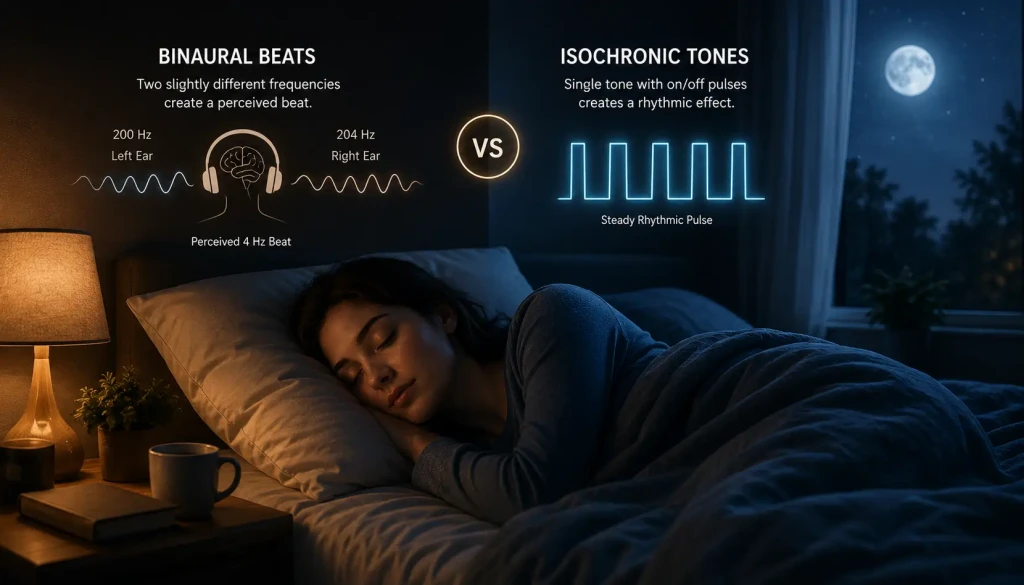
- binaural beats,
- or slower rhythmic sound environments.
Delta wave audio is often designed to create slower, calmer listening experiences intended to support nighttime relaxation routines.
For some listeners, these sound environments may help reduce distraction and create more intentional wind-down habits before bed.
🛌 Relaxation vs Unrealistic Sleep Claims
Online discussions about sleep audio sometimes become exaggerated.
You may encounter promises about:
- instant deep sleep,
- overnight brain transformation,
- or “perfect” sleep through one frequency.
Real sleep health is more complex.
Sleep quality is influenced by:
- stress levels,
- environment,
- routine consistency,
- screen exposure,
- physical health,
- and lifestyle habits.
Relaxation audio may support a calming environment for some people, but it should not be viewed as a magical solution.
🌿 Creating Better Sleep Environments
Healthy sleep habits often matter more than any single tool.
Helpful sleep-supporting habits may include:
- reducing screen exposure before bed,
- keeping consistent sleep schedules,
- creating darker sleep environments,
- reducing late-night stimulation,
- and building calmer nighttime routines.
Many people underestimate how strongly environment affects sleep quality.
🧘 Stress and Sleep Are Closely Connected
Stress can make deep sleep harder to achieve.
At the same time, poor sleep can increase stress and mental exhaustion.
This creates a cycle where the brain struggles to fully recover.
Related article: Stress, Anxiety, and the Brain.
🎵 Neuroacoustic Audio and Sleep Routines
Some people also explore neuroacoustic audio environments designed to support relaxation, calm focus, and nighttime recovery routines.
These tools are generally most useful when combined with healthy sleep habits and realistic expectations.
🚫 Common Misunderstandings
❌ “One Frequency Instantly Fixes Sleep”
Sleep quality depends on many factors beyond audio alone.
❌ “More Intense Audio Means Better Sleep”
Gentle, calming environments are often more helpful than aggressive stimulation.
❌ “Everyone Responds the Same Way”
People experience sound environments differently.
Relaxation preferences vary from person to person.
🧠 Final Thoughts
Delta waves are strongly associated with the deepest stages of restorative sleep.
While online discussions sometimes exaggerate their effects, slower and calmer sound environments may still help some people create more relaxing nighttime routines.
In many cases, improving sleep is less about finding “magic frequencies” and more about reducing overstimulation, protecting recovery time, and creating healthier environments for rest.
And in a world that rarely slows down, deep rest may be one of the brain’s most valuable recovery tools.
Related Articles
Related Posts
Stay Informed With the Latest & Most Important News
Previous Post
Next Post