
Now Reading: Binaural Beats for Focus: How Sound Frequencies Support Productivity
-
01
Binaural Beats for Focus: How Sound Frequencies Support Productivity
Binaural Beats for Focus: How Sound Frequencies Support Productivity
Staying focused for hours at a time has become increasingly difficult in modern work environments.
Constant notifications, multitasking, digital overload, and mental fatigue often reduce:
- concentration quality,
- task consistency,
- and cognitive stamina.
This is one reason many professionals experiment with binaural beats and focus-oriented audio while working.
The idea is not to create superhuman productivity.
Instead, the goal is usually:
reducing mental friction during cognitively demanding tasks.
For some people, certain sound frequencies may help create a calmer and more stable mental environment for concentration.
🧠 What Are Binaural Beats?
Binaural beats occur when:
- one frequency is played into the left ear,
- and a slightly different frequency is played into the right ear.
The brain processes the difference between these tones as a rhythmic pulse.
For example:
- Left ear → 210 Hz
- Right ear → 220 Hz
- Perceived beat → 10 Hz
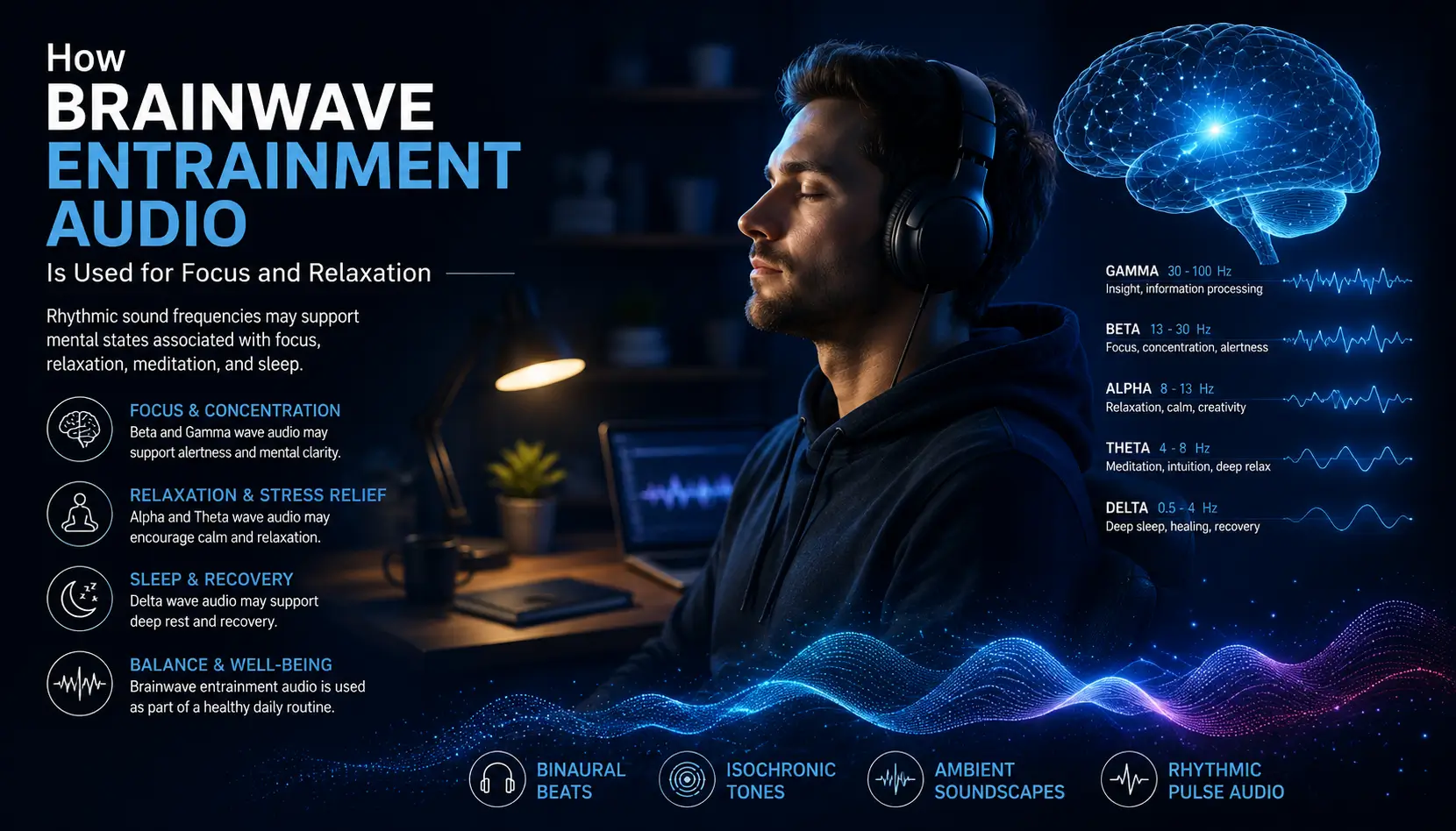
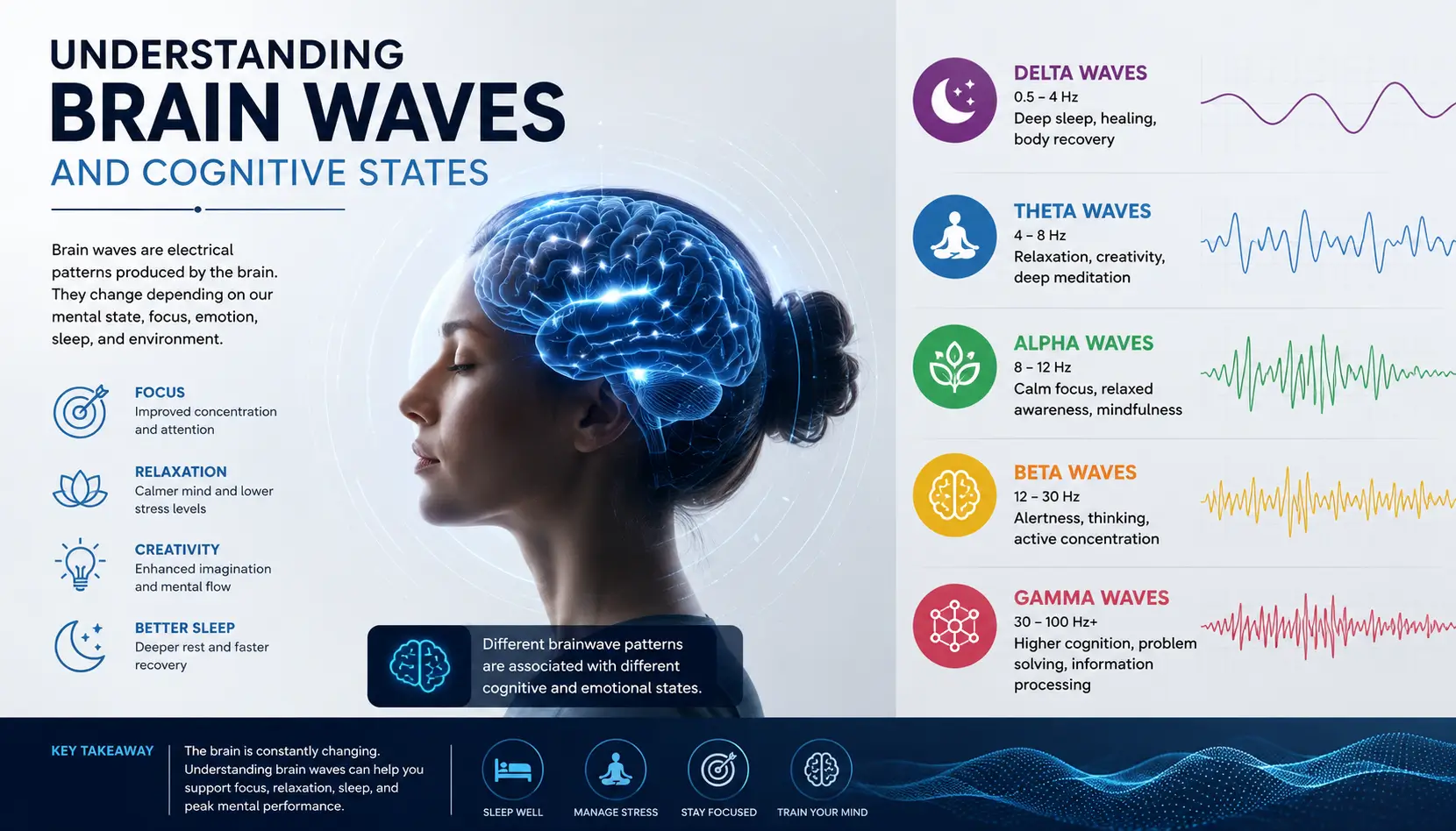
That 10 Hz pulse falls within the Alpha brainwave range, commonly associated with calm awareness and relaxed focus.
Stereo headphones are required because each ear must receive separate audio signals.
🔬 Why People Use Binaural Beats During Work
Many people use focus-oriented audio to help reduce:
- mental distraction,
- attention fragmentation,
- and cognitive fatigue during long tasks.
Certain frequency ranges are commonly associated with:
- concentration,
- alertness,
- and stable attention.
The goal is not necessarily “more energy.”
Often, the goal is:
smoother mental continuity.
This is especially relevant during:
- writing,
- coding,
- office tasks,
- analysis work,
- and extended computer sessions.
⚡ Which Frequencies Are Most Commonly Used for Concentration?
Different people respond differently, but several frequency ranges are frequently discussed in focus-oriented entrainment systems.
🌊 Alpha Waves (8–12 Hz)
Alpha frequencies are commonly associated with:
- reduced mental noise,
- calm attention,
- and smoother concentration.
Many people prefer Alpha sessions for:
- reading,
- writing,
- and mentally demanding office work.
Learn more in our guide on Alpha Waves for Relaxation.
⚡ Low Beta Waves (13–16 Hz)
Low-Beta activity is often associated with:
- active thinking,
- problem solving,
- and sustained task engagement.
Some listeners use low-Beta stimulation during:
- spreadsheets,
- technical work,
- coding,
- and analytical tasks.
However, excessive Beta stimulation may feel mentally tiring for some people.
🧠 Gamma Frequencies (30+ Hz)
Gamma-oriented sessions are sometimes explored during:
- strategic thinking,
- high-level cognitive work,
- and intensive concentration tasks.
However, Gamma stimulation is usually more mentally demanding than Alpha-focused sessions.
Read more in our article on Gamma Waves Benefits.
🧩 Why Focus Audio Feels Helpful for Some People
Many professionals describe focus-oriented audio as:
- mentally organizing,
- less distracting,
- or cognitively stabilizing.
Interestingly, the effect is often described less as:
“boosted intelligence”
and more as:
“reduced mental interference.”
That distinction matters.
Some users say the biggest benefit is simply:
- less urge to switch tasks,
- fewer wandering thoughts,
- and smoother work momentum.
🏢 Productivity, Mental Stamina & Long Work Sessions
One major challenge during office work is:
cognitive exhaustion.
Attention naturally fluctuates throughout the day.
Mental stamina often decreases because of:
- constant context switching,
- multitasking,
- stress,
- and digital overstimulation.
Some people use brainwave audio during:
- deep computer work,
- repetitive office tasks,
- long writing sessions,
- and structured productivity blocks.
The goal is often to maintain steadier concentration without excessive mental strain.
🎧 Why Audio Design Quality Matters
Not all binaural beat tracks are designed equally.
Many online focus tracks contain:
- abrupt transitions,
- unstable frequencies,
- distracting layering,
- or poor sound balancing.
This may explain why some playlists feel calming while others quickly become irritating.
Professionally designed neuroacoustic systems usually create smoother transitions between mental states.
👉 Some users explore Genius Wave because the layered sessions feel less mechanically repetitive than many generic focus tracks online.
⚠️ Common Misconceptions About Focus Frequencies
Myth:
“Binaural beats instantly create productivity.”
Reality:
Most effects appear subtle and depend heavily on environment, mindset, and consistency.
Myth:
“Higher frequencies always improve focus.”
Reality:
Excessive stimulation may increase mental fatigue instead of improving concentration.
Myth:
“You can multitask heavily while using focus audio.”
Reality:
Most listeners report better experiences during distraction-free work sessions.
🔍 Best Situations for Focus-Oriented Audio
People commonly use binaural beats during:
- coding,
- writing,
- analysis work,
- office productivity,
- studying,
- and long computer sessions.
However, different mental tasks may respond better to different frequency styles.
Creative work, for example, may benefit from calmer Alpha states, while analytical tasks sometimes feel easier during low-Beta stimulation.
🧘 Practical Tips for Better Concentration Sessions
If you want to experiment with focus-oriented audio more effectively:
- Use stereo headphones
- Keep volume moderate
- Reduce external distractions
- Work in uninterrupted blocks
- Avoid constant app switching
- Stay hydrated and rested
The goal is sustainable concentration — not overstimulation.
Final Thoughts
Modern productivity problems are often less about intelligence and more about fragmented attention.
That’s why many people explore sound-based focus tools in the first place.
Binaural beats are unlikely to create instant genius-level performance.
However, under the right conditions, they may help support:
- steadier concentration,
- reduced mental noise,
- and smoother cognitive flow during demanding work.
For many professionals, that alone can make long work sessions feel significantly more manageable.
Related Articles
- Ultimate Guide to Brainwave Entrainment
- Flow State Brain Waves
- Gamma Waves Benefits
- Do Binaural Beats Really Work?
👉 Related read: Theta Brain Wave Frequency: Unlock the Gateway to Creativity and Intuition for more insights on brainwave focus and mental clarity.
Related Posts

Stay Informed With the Latest & Most Important News
Previous Post
Next Post